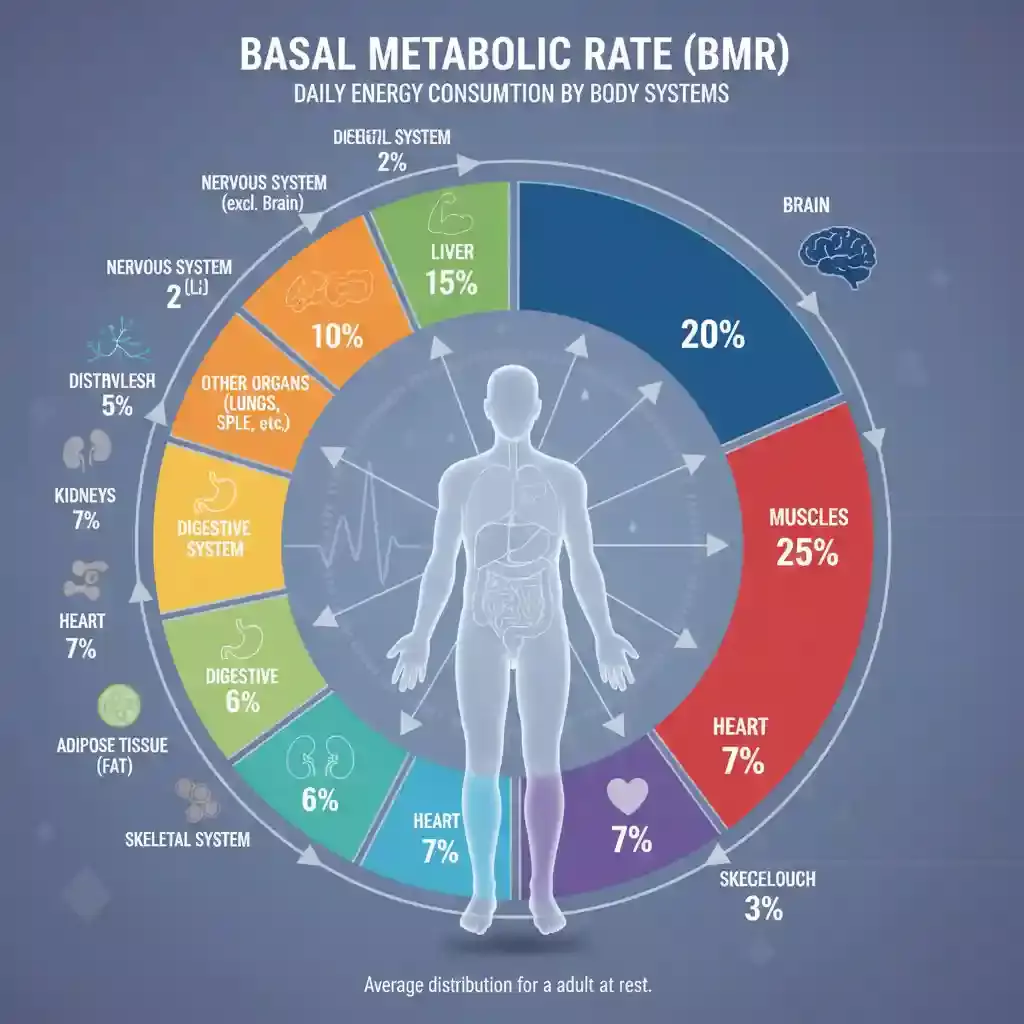
Understanding your body’s energy requirements is essential for achieving your health and fitness goals. Your Basal Metabolic Rate (BMR) represents the minimum number of calories your body needs to perform basic functions while at rest. By calculating your BMR accurately, you can develop more effective nutrition and exercise strategies tailored to your unique physiology. This comprehensive guide explains how to calculate your BMR using multiple proven formulas and provides practical applications for your results.
What Is Basal Metabolic Rate (BMR)?
BMR represents the energy your body needs for essential functions like breathing, circulation, and cell maintenance.
Basal Metabolic Rate (BMR) is the number of calories your body requires to maintain vital functions while in a completely rested state. These functions include breathing, blood circulation, cell production, nutrient processing, and protein synthesis. Your BMR typically accounts for 60-75% of your total daily energy expenditure, making it the largest component of your calorie needs.
It’s important to distinguish BMR from Resting Metabolic Rate (RMR). While the terms are often used interchangeably, they measure slightly different states. BMR is measured under very strict laboratory conditions after 8 hours of sleep and 12 hours of fasting, while RMR allows for slightly more relaxed testing conditions and typically yields values about 10% higher than BMR.
Key Fact: Your BMR accounts for 60-75% of your total daily calorie expenditure, with the remainder coming from physical activity and the thermic effect of food (calories burned during digestion).
Factors That Affect Your Basal Metabolic Rate
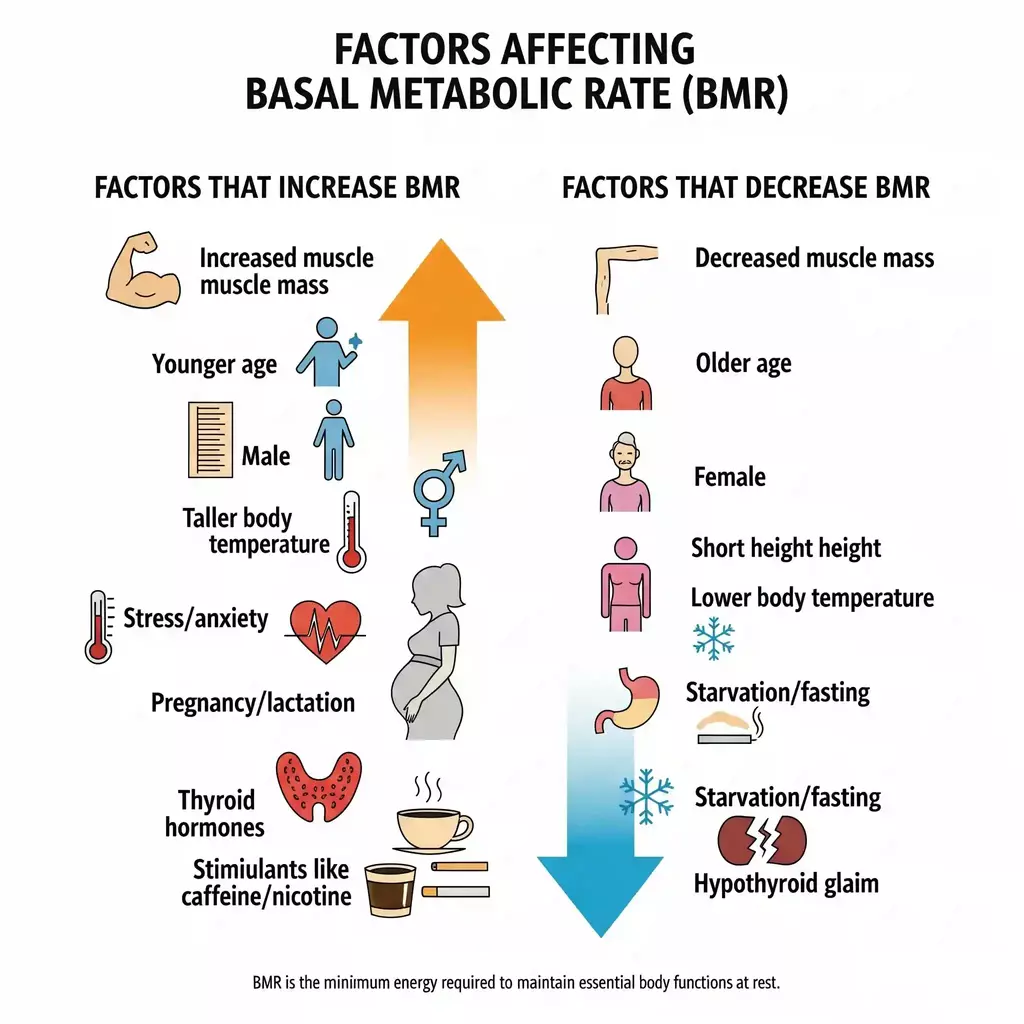
Multiple factors influence your BMR, explaining why caloric needs vary significantly between individuals:
Physiological Factors
- Age: BMR typically decreases by 1-2% per decade after age 20 due to muscle mass reduction.
- Gender: Men generally have higher BMRs than women due to greater muscle mass and less body fat.
- Body Composition: Muscle tissue requires more energy to maintain than fat tissue, so individuals with more muscle mass have higher BMRs.
- Body Size: Larger bodies require more energy for maintenance, resulting in higher BMRs.
Health and Environmental Factors
- Hormonal Function: Thyroid disorders and other hormonal imbalances can significantly impact BMR.
- Genetics: Some people naturally have faster or slower metabolisms due to genetic factors.
- Temperature: Exposure to cold environments can temporarily increase BMR as the body works to maintain core temperature.
- Nutritional Status: Severe calorie restriction can lower BMR as the body adapts to conserve energy.
Calculate Your BMR
Use our comprehensive BMR calculator below to determine your basal metabolic rate. Simply enter your age, gender, height, and weight to get an accurate estimate of your daily caloric needs at rest.
BMR Calculator
Get an instant calculation of your Basal Metabolic Rate to better understand your body’s energy needs.
[wellnesscalc_pro type=”bmr-calculator”]
This calculator uses scientifically validated formulas to provide you with an accurate BMR estimate. Understanding your BMR is the first step toward creating an effective nutrition and exercise plan tailored to your unique physiology.
Common BMR Calculation Formulas
Several scientific formulas have been developed to calculate BMR. Each uses slightly different variables and may be more accurate for certain populations. Here are the most widely used and respected formulas:
1. Mifflin-St Jeor Equation
Considered the most accurate for the general population, this formula was developed in 1990 and is recommended by the American Dietetic Association.
For men: BMR = (10 × weight in kg) + (6.25 × height in cm) – (5 × age in years) + 5
For women: BMR = (10 × weight in kg) + (6.25 × height in cm) – (5 × age in years) – 161
This equation is particularly accurate for normal-weight and overweight individuals and is widely used in clinical settings.
2. Harris-Benedict Equation
One of the earliest BMR formulas, developed in 1919 and revised in 1984, this equation is still widely used today.
For men: BMR = 88.362 + (13.397 × weight in kg) + (4.799 × height in cm) – (5.677 × age in years)
For women: BMR = 447.593 + (9.247 × weight in kg) + (3.098 × height in cm) – (4.330 × age in years)
While slightly less accurate than the Mifflin-St Jeor equation for some populations, it remains reliable for many individuals.
3. Katch-McArdle Formula
This formula takes into account lean body mass, making it particularly useful for athletes and those with higher muscle mass.
For all genders: BMR = 370 + (21.6 × lean body mass in kg)
You’ll need to know your body fat percentage to use this formula, as it requires calculating your lean body mass (total weight minus fat weight).
4. Cunningham Formula
Similar to the Katch-McArdle formula, this equation focuses on lean body mass and is often used for athletes.
For all genders: BMR = 500 + (22 × lean body mass in kg)
This formula tends to estimate slightly higher BMR values than Katch-McArdle and is favored in some sports nutrition contexts.
5. WHO/FAO/UNU Equations
Developed by the World Health Organization, these equations provide BMR estimates based on age ranges.
For men (18-30 years): BMR = (15.3 × weight in kg) + 679
For women (18-30 years): BMR = (14.7 × weight in kg) + 496
These formulas include different calculations for various age groups and are sometimes used in global nutrition research.
Comparing BMR Formula Accuracy
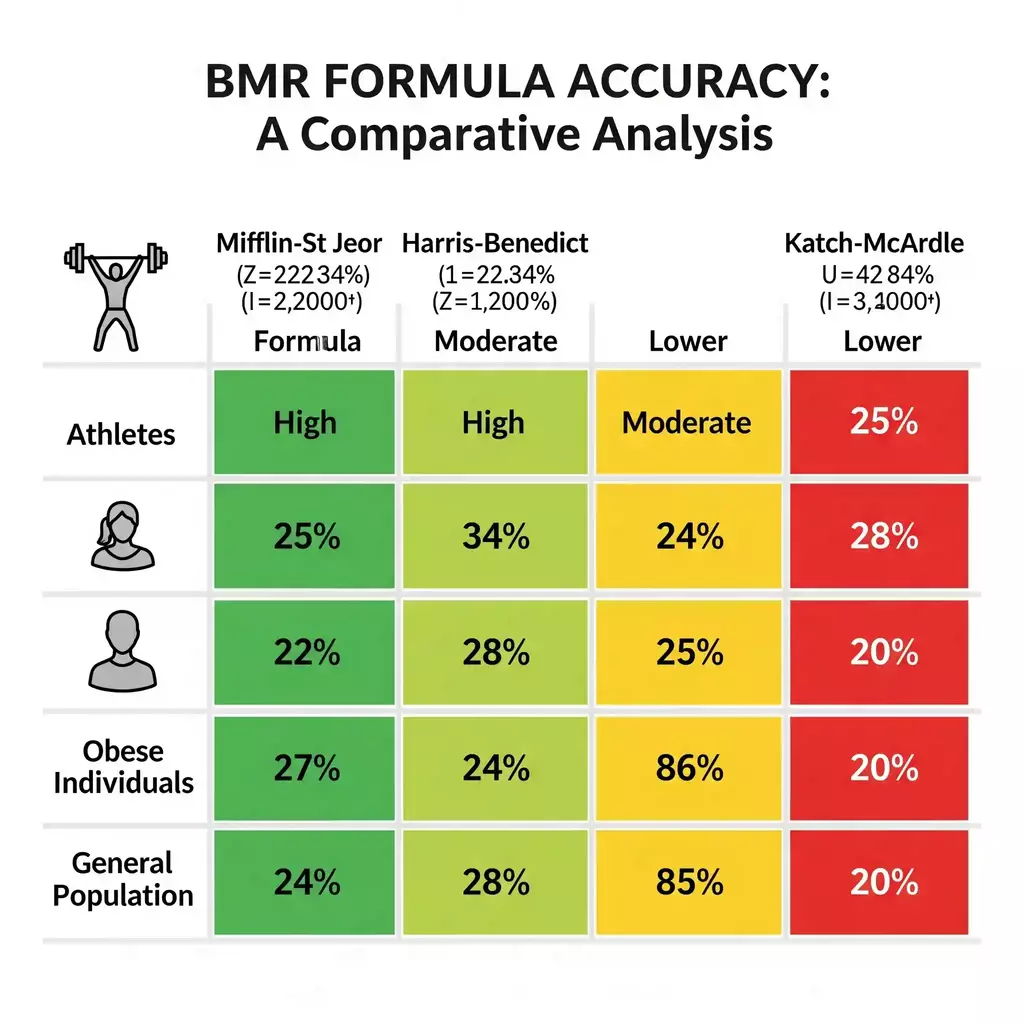
While all these formulas provide useful estimates, their accuracy varies depending on individual factors and population groups:
| Formula | Best For | Accuracy Level | Special Considerations |
| Mifflin-St Jeor | General population, normal to overweight individuals | Highest overall (±10%) | Recommended by most dietitians |
| Harris-Benedict | Normal weight individuals | Good (±15%) | Tends to overestimate for obese individuals |
| Katch-McArdle | Athletes, bodybuilders | Very good for athletic populations | Requires body fat percentage measurement |
| Cunningham | Elite athletes | Good for highly trained individuals | Requires accurate body composition data |
| WHO/FAO/UNU | Global population studies | Moderate (±20%) | Different equations for various age groups |
“The Mifflin-St Jeor equation has been shown to be the most accurate equation for estimating BMR in non-obese and obese healthy adults.”
How to Use the BMR Calculator
Our BMR calculator is designed to be user-friendly while providing accurate results. Follow these simple steps to calculate your basal metabolic rate:
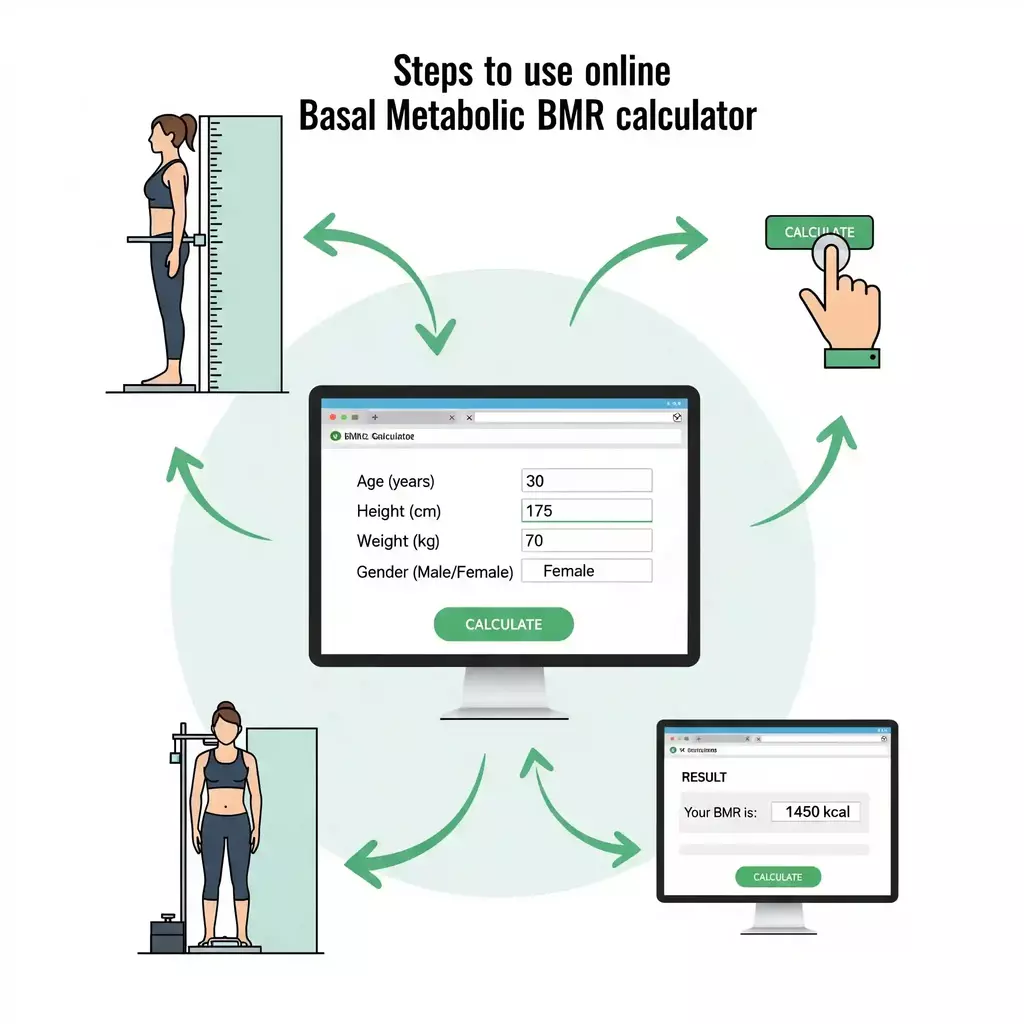
- Select your gender – Choose male or female as this significantly affects the calculation.
- Enter your age – Input your age in years, as metabolic rate decreases with age.
- Input your height – Enter your height in either centimeters or feet and inches.
- Enter your weight – Input your current weight in either kilograms or pounds.
- Click “Calculate” – The calculator will process your information using the Mifflin-St Jeor equation.
- Review your results – Your BMR will be displayed in calories per day.
Ready to Calculate Your BMR?
Get personalized insights into your body’s energy needs with our accurate BMR calculator.
Important Note: Remember that BMR calculations are estimates. For the most accurate measurement, clinical methods like indirect calorimetry would be required. However, these formulas provide a reliable starting point for most individuals.
From BMR to Total Daily Energy Expenditure (TDEE)
Your BMR is just the starting point for understanding your total caloric needs. To determine your Total Daily Energy Expenditure (TDEE), you need to account for your physical activity level.
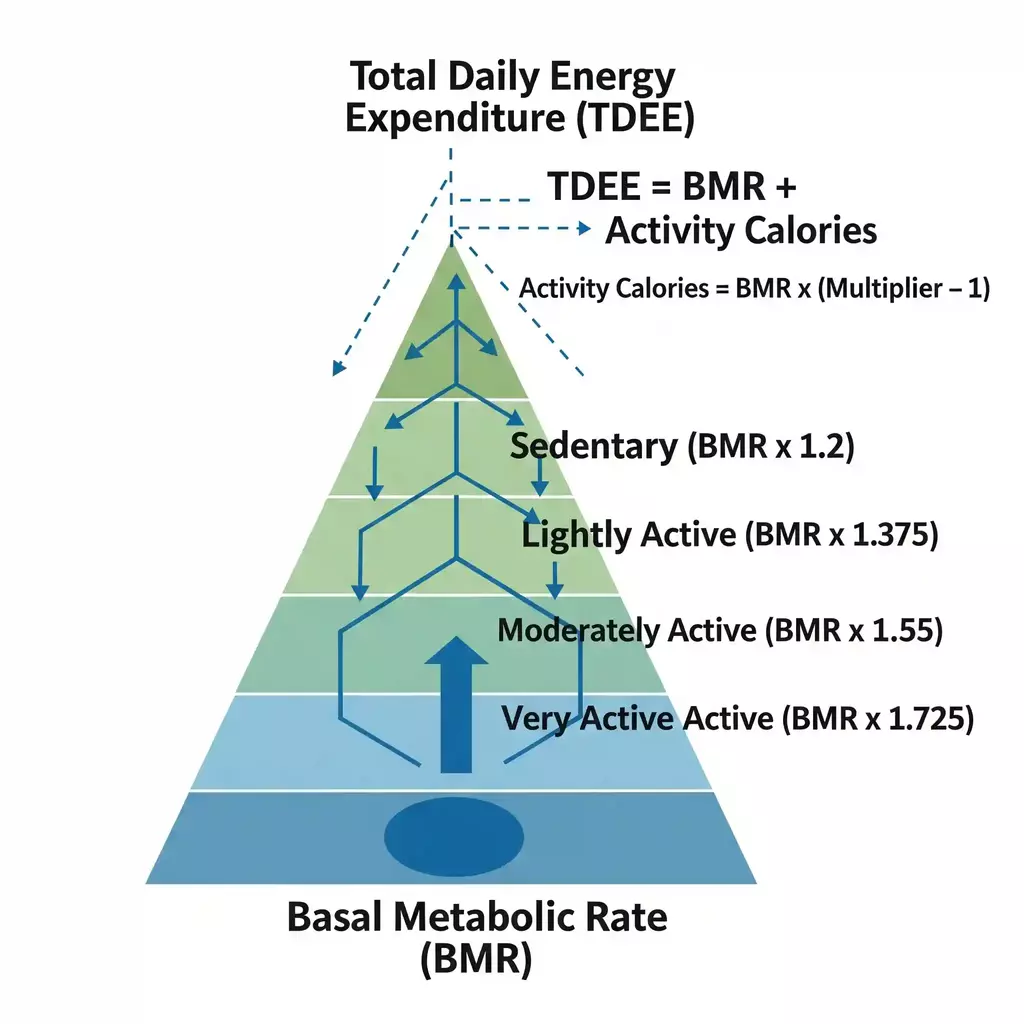
To calculate your TDEE, multiply your BMR by an activity factor that corresponds to your typical level of physical activity:
| Activity Level | Description | Multiplier |
| Sedentary | Little or no exercise, desk job | BMR × 1.2 |
| Lightly Active | Light exercise 1-3 days per week | BMR × 1.375 |
| Moderately Active | Moderate exercise 3-5 days per week | BMR × 1.55 |
| Very Active | Hard exercise 6-7 days per week | BMR × 1.725 |
| Extremely Active | Very hard exercise, physical job or training twice a day | BMR × 1.9 |
For example, if your calculated BMR is 1,500 calories and you are moderately active, your estimated TDEE would be 1,500 × 1.55 = 2,325 calories per day.
Practical Applications of Your BMR
Understanding your BMR has numerous practical applications for health, fitness, and weight management:
Weight Management

For weight loss, create a moderate calorie deficit by consuming 300-500 calories less than your TDEE. For weight gain, consume 300-500 calories more than your TDEE. Your BMR helps establish a safe minimum calorie intake to ensure you don’t restrict calories too severely.
Nutrition Planning

Knowing your BMR helps you develop a nutrition plan with appropriate macronutrient distribution. It provides a foundation for calculating protein needs (typically 0.8-1.2g per pound of body weight) and determining how to allocate remaining calories between carbohydrates and fats.
Exercise Programming
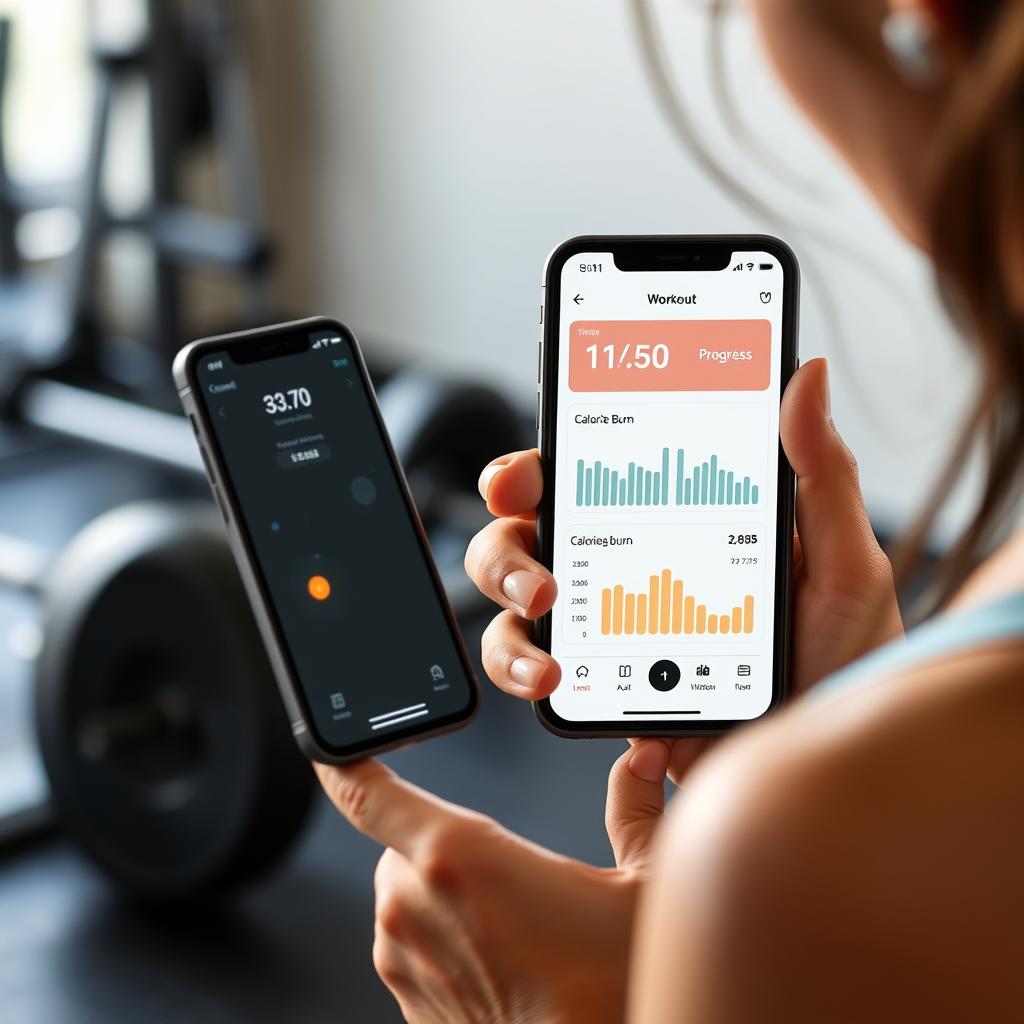
Your BMR informs how many calories you burn at rest, helping you estimate the additional calorie burn from exercise. This allows for more precise workout programming and recovery nutrition to support your fitness goals, whether building muscle or improving endurance.
Take Control of Your Health Journey
Calculate your BMR today to create a personalized nutrition and exercise plan based on your body’s unique needs.
Mobile Optimization for BMR Calculations
Our BMR calculator is fully optimized for mobile devices, ensuring you can calculate your basal metabolic rate anytime, anywhere. The responsive design adapts to any screen size while maintaining accuracy and ease of use.
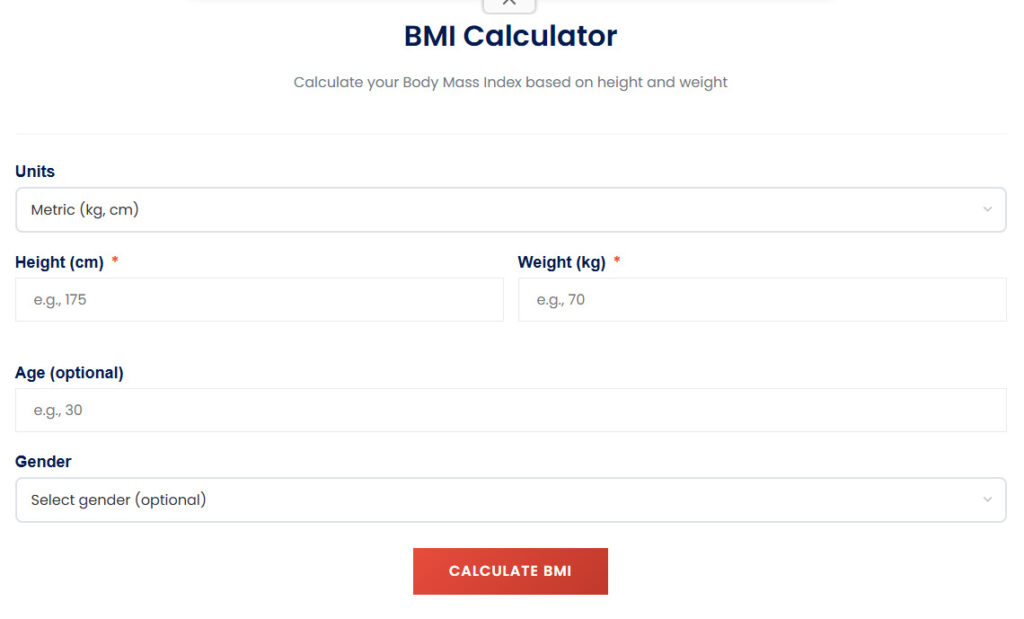
Mobile Features
- Touch-optimized input fields for easy data entry
- Simplified interface that works on any screen size
- Fast loading times even on slower connections
- Option to save your results for future reference
- Ability to switch between metric and imperial units
Usage Tips
- Bookmark the calculator page for quick access
- Use in portrait mode for optimal display on smartphones
- Enable screen rotation for larger display on tablets
- Check your results periodically as your weight changes
- Share your results with fitness professionals via screenshot
Understanding Your BMR: The Foundation of Health and Fitness
Your Basal Metabolic Rate provides crucial insight into your body’s energy needs and serves as the foundation for effective nutrition and exercise planning. By calculating your BMR using scientifically validated formulas, you gain a personalized understanding of your metabolism that generic calorie recommendations simply cannot provide.
Whether your goal is weight loss, muscle gain, athletic performance, or simply maintaining optimal health, knowing your BMR empowers you to make informed decisions about your diet and activity levels. Remember that while BMR calculations provide valuable estimates, they should be used as starting points that you can adjust based on your body’s actual response over time.
Ready to Discover Your Body’s Energy Needs?
Calculate your BMR now and take the first step toward a more personalized approach to nutrition and fitness.