
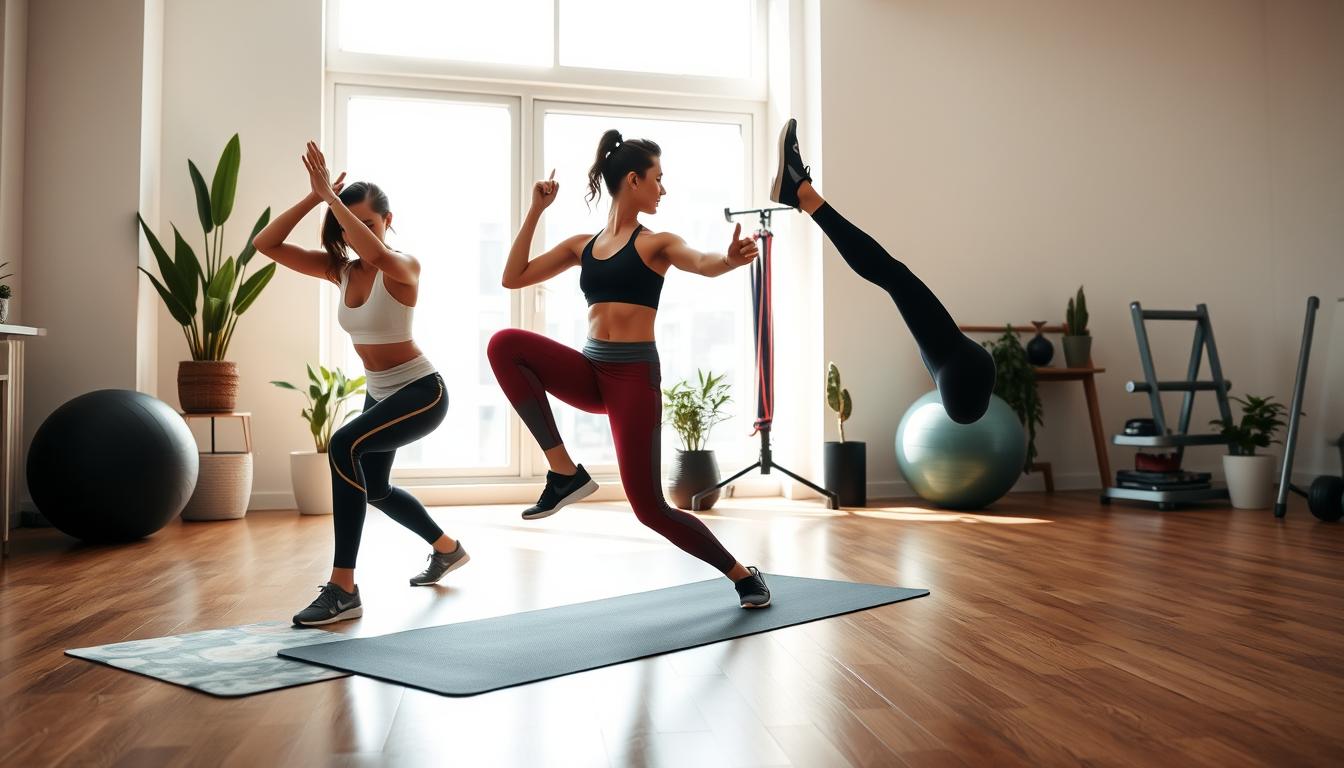
I remember when I couldn’t climb the stairs to my apartment. My knees wobbled, and my thighs burned. It made me realize how important leg exercises are.
Your legs carry you every day. They help you climb stairs, chase kids, and stay balanced. Yet, many of us ignore our leg strength. Strong legs mean living life without limits.
You don’t need a gym or fancy equipment to strengthen your legs. The best exercises can be done at home. They use basic movements that humans have done for centuries.
Building leg strength at home is my passion. Simple exercises target your glutes, quads, hamstrings, and calves. They create a strong foundation for everything you do. Home workouts for legs boost your metabolism, improve balance, and release hormones that benefit your whole body.
Key Takeaways
- Strong legs improve daily activities like walking, climbing stairs, and maintaining balance
- Effective leg exercises can be done at home without expensive equipment
- Training legs boosts metabolism and helps burn more calories throughout the day
- Basic movements like squats, lunges, and deadlifts target all major leg muscle groups
- Consistent leg workouts increase testosterone and growth hormone production
- Lower body fitness enhances coordination and flexibility for better overall movement
Understanding the Importance of Leg Exercises
Leg exercises are key to a good fitness plan. Your lower body has big, strong muscles. Doing Quad Strengthening Workouts and other leg exercises helps more than just look good. It also builds a strong base for all your movements.
Benefits of Strong Legs
Strong legs offer big muscle growth benefits. They make your body release important hormones like testosterone and growth hormone. This helps muscles grow not just in your legs but all over your body.
A study in the Journal of Strength and Conditioning found that squats before arm exercises can increase arm strength by up to 10%. This shows how leg training can boost strength all over your body.
Impact on Overall Fitness
Your athletic performance and daily tasks rely on strong legs. Whether you’re running, climbing stairs, or lifting heavy things, strong legs make it easier and safer. Hamstring Training is key to preventing injuries and boosting explosive power.
Leg Muscles: A Quick Overview
Knowing your leg muscles helps you work them better:
- Quadriceps: Four muscles on the front of your thigh that extend your knee
- Hamstrings: Three muscles on the back of your thigh that flex your knee
- Glutes: Your body’s powerhouse muscles that drive hip movement
- Calves: Lower leg muscles that provide stability and propulsion
Essential Equipment for Home Workouts
Building strong legs doesn’t need a fancy gym or expensive machines. The right home gym equipment lets you work out at home. You can choose from resistance tools or bodyweight exercises to reach your fitness goals.
Resistance Bands
Resistance bands are great resistance training tools that save space. They come in various strengths, fitting all fitness levels. Use them for squats, lunges, or curls to strengthen your legs.
Dumbbells
Dumbbells are key for adding weight to your leg workouts. A pair of adjustable dumbbells can make simple exercises tough. Use them for squats, lunges, or deadlifts to build muscle and strength.
Bodyweight Training
Bodyweight exercises are simple and don’t need any equipment. Your body’s weight is enough to build strong legs. Squats, bridges, and single-leg exercises are great for muscle growth and balance.
Squats: The Foundation of Leg Workouts
Squats are key for building strong legs. They work many muscles at once. This includes your quadriceps, hamstrings, glutes, and core. Squats are great for both beginners and seasoned athletes, improving strength and daily function.
Bodyweight Squats
Begin with bodyweight squats to build a strong base. Stand with your feet shoulder-width apart and toes slightly outward. Bend at the hips and knees, keeping your chest up and back straight.
Lower down until your thighs are almost touching the ground. Then, push through your heels to stand up again.
Goblet Squats
Goblet squats are a step up from bodyweight squats. Hold a dumbbell or kettlebell close to your chest. This helps improve your posture and engages your core more.
The weight makes it easier to keep your form right while strengthening your legs.
Squat Variations to Try
Try different squat variations to keep your workouts interesting and effective:
- Jump squats – Add explosive power to boost functional fitness
- Sumo squats – Wider stance targets inner thighs and glutes
- Pistol squats – Single-leg challenge for advanced practitioners
- Wall sits – Isometric hold builds endurance
Each variation brings unique benefits while keeping the core squat movement intact.
Lunges: Building Balance and Muscle
Lunges are great for strengthening your legs and improving balance. This unilateral training method works many muscles at once. It also challenges your balance and coordination.
By focusing on one leg at a time, lunges fix muscle imbalances. They improve functional movement patterns for everyday activities like walking and climbing stairs. This is also good for sports.
Forward Lunges
Forward lunges are the most common type. Start by stepping forward with one leg. Lower your hips until both knees bend at about 90 degrees.
Keep your front knee over your ankle and your back knee just above the floor. This targets your quadriceps, glutes, and hamstrings. The lunges benefits also include better hip flexibility and core stability.
Reverse Lunges
Reverse lunges are easier on the knees. Instead of stepping forward, you step backward. This makes the movement more stable.
This version focuses on your glutes and hamstrings. The backward motion helps keep your form better than forward lunges.
Lateral Lunges
Lateral lunges add a side-to-side element to your workout. Step out to the side, shifting your weight to one leg. Keep the other leg straight.
This strengthens your inner and outer thighs. It also improves lateral stability. Athletes find it helpful for sports that require quick changes in direction.
| Lunge Variation | Primary Muscles | Sets x Reps |
|---|---|---|
| Forward Lunges | Quadriceps, Glutes | 3 x 8-12 per leg |
| Reverse Lunges | Glutes, Hamstrings | 3 x 10-15 per leg |
| Lateral Lunges | Adductors, Abductors | 3 x 12-20 per leg |
Deadlifts: Targeting the Posterior Chain
Deadlifts are a top choice for working your posterior chain at home. They mainly target your hamstrings, glutes, and lower back. This exercise helps build strength that’s useful for everyday tasks and sports.
Conventional Deadlifts
The conventional deadlift starts with your feet hip-width apart and hands gripping a weight. Push your hips back while keeping your chest up and spine straight. Lower the weight down your legs until you feel a hamstring stretch.
Then, drive through your heels and push your hips forward to stand up again. This exercise strengthens your whole body, focusing on your hamstrings.
Single-Leg Deadlifts
Single-leg deadlifts test your balance and strengthen each leg. Stand on one foot and lift the other leg behind you as you hinge at the hip. Keep your standing knee slightly bent and lower your torso until it’s parallel to the floor.
This variation boosts stability and helps even out muscle strength between your legs.
Romanian Deadlifts
Romanian deadlifts focus on the hip hinge without lifting from the ground. Start standing with weight in your hands and knees slightly bent. Push your hips back and lower the weight along your thighs.
Stop when you feel a strong hamstring stretch, then squeeze your glutes to stand up again. This exercise allows for heavy weights to help grow your muscles.
Calf Raises: Strengthening Lower Legs
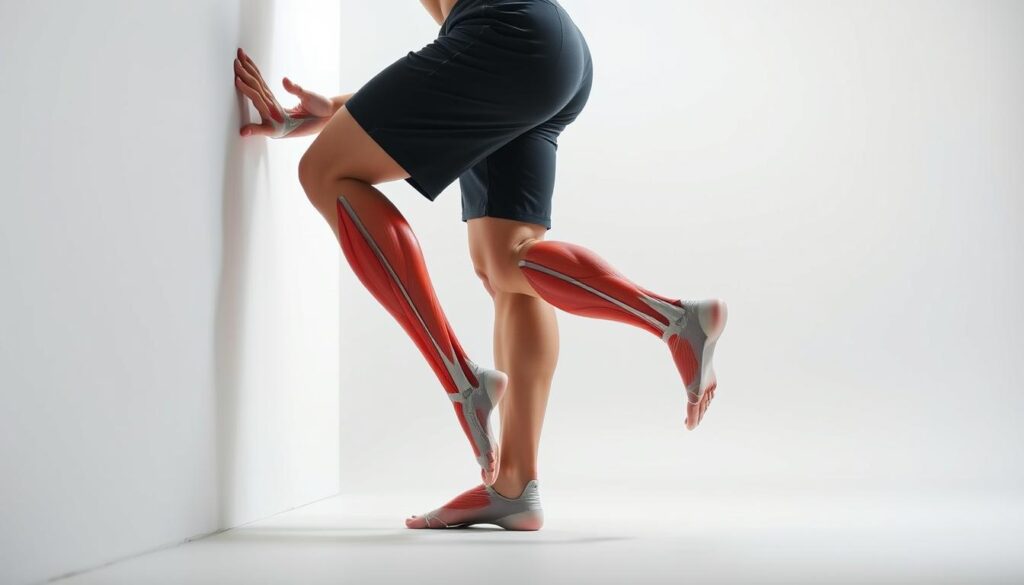
Calf raises are great for making your lower legs strong and defined. This exercise works on plantarflexion, which means pointing your toes down. Doing calf raises often will boost your jumping, running, and leg stability.
Standing Calf Raises
Standing calf raises work both the gastrocnemius and soleus muscles. Stand with your feet hip-width apart. Push through your toes to raise up.
Hold the top for 1-2 seconds, feeling your calves contract. Then, slowly lower back down.
Begin with just your body weight, aiming for 4 sets of 25-30 reps. Add dumbbells or a kettlebell as you get stronger. Try different toe angles to target different calf areas.
Seated Calf Raises
Seated calf raises focus on the soleus muscle. Sit on a chair with your feet flat. You can add weight on your thighs if you want.
Raise your heels and squeeze at the top. This movement is key for plantarflexion training.
Single-Leg Calf Raises
Single-leg calf raises test your balance and ensure even strength in both legs. Stand on one foot near a wall for support. Do all reps on one leg before switching.
This helps spot and fix any strength differences between your calves.
Step-Ups: A Dynamic Leg Exercise
Step-ups are a top choice for building lower body strength and balance. They mimic everyday actions like climbing stairs. This makes them great for improving functional strength. Each leg works separately, fixing muscle imbalances and boosting balance and coordination.
Box Step-Ups
The box step-up is a key exercise in this family. Begin with a box at knee height. Step up fully, using your heel, and then step back down slowly. This targets your quads and glutes, with your core helping to keep you stable.
Lateral Step-Ups
Lateral step-ups add a new twist to your Leg Day Routine. Stand next to the platform and step up sideways. This works different muscles than regular step-ups. It’s great for hip stability and strengthening the outer thigh.
Weighted Step-Ups
Adding weights to step-ups boosts your strength even more. Hold dumbbells or a single weight at your chest. This increases muscle work and helps you get stronger faster. Start with light weights and keep your form right.
| Step-Up Variation | Primary Muscles | Equipment Needed |
|---|---|---|
| Box Step-Ups | Quadriceps, Glutes | Sturdy Box or Bench |
| Lateral Step-Ups | Glutes, Hip Abductors | Platform or Step |
| Weighted Step-Ups | Quadriceps, Glutes, Hamstrings | Box, Dumbbells |
Glute Bridges: Engaging the Backside
Glute bridges are great for glute activation and strengthening the backside. They’re easy to do at home without any equipment. This exercise focuses on your glutes, unlike other exercises that might use stronger muscles.
They’re perfect for warming up before lifting heavy or for strengthening your glutes alone.
Standard Glute Bridge
The standard glute bridge is key for strengthening the backside. Lie on your back with knees bent and feet flat, hip-width apart. Then, press through your heels to lift your hips until your body is straight from knees to shoulders.
Squeeze your glutes at the top and hold for 1-2 seconds. Lower back down slowly. This exercise helps you learn proper hip extension and builds strength.
Single-Leg Glute Bridge
Single-leg glute bridges are next, adding a balance challenge. Lift one leg straight out while doing the bridge with the other. This makes the working glute work harder and shows any strength differences.
Keep your hips even to get the most glute activation.
Elevated Glute Bridge
Elevated glute bridges offer a deeper range of motion. Place your shoulders on a bench or couch while keeping your feet on the floor. This setup lets you flex your hips deeper and contract your glutes more.
For more challenge, add weight across your hips. This is great for those looking to increase their strength.
Plank Leg Raises: Core and Leg Combo
Plank leg raises combine two key fitness elements into one powerful exercise. This move turns a basic plank into a top core stability exercise by adding leg movements. Your abs work hard to keep balance while your legs move dynamically.
Basic Plank Leg Raise
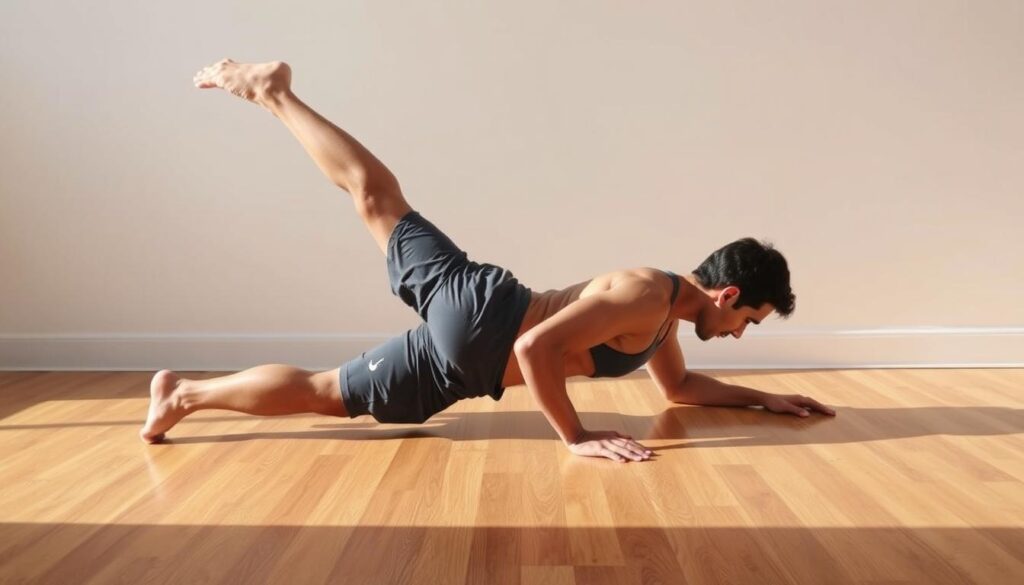
Begin in a forearm plank with elbows under shoulders. Keep your body straight from head to heels. Lift one leg about 6 inches off the ground, keeping hips square to the floor. Hold for 2 seconds, then lower slowly. Switch legs and repeat. This targets your glutes and hamstrings while your core keeps you stable.
Side Plank Leg Raise
Side plank leg raises boost lateral stability. Balance on one forearm with feet stacked. Lift the top leg as high as you can, pause, then lower. This variation works your obliques and outer hip muscles. These compound movements improve functional strength for daily activities and sports.
Variations for Difficulty
Make your plank leg raises harder with these options:
- Hold each leg raise for 5-10 seconds
- Add ankle weights for extra resistance
- Perform from straight-arm position
- Try diagonal leg lifts for full-body training
- Speed up tempo for cardio benefits
Each variation requires more control and builds endurance in core and leg muscles.
Bulgarian Split Squats: Off-Balance Challenge
Bulgarian split squats are a top choice for working out at home. They target your quads, glutes, and hamstrings. They also require you to stay stable, which is key.
Studies show they work your quads as well as back squats do. This is great for building strong legs without needing heavy weights.
Standard Bulgarian Split Squat
To start, you need little equipment. Stand with your back foot on a chair or couch, about knee height. Make sure your front foot is forward, so your knee is over your ankle.
Begin with just your body weight. Move slowly down until your front thigh is almost parallel to the ground. Then, push back up with your front heel.
These exercises are tough because they require balance. They also build strong legs.
Dumbbell Bulgarian Split Squat
When you get better, add weights for more challenge. Hold dumbbells at your sides or one at your chest. This adds to the workout without needing a barbell or gym.
Even light weights work well because they create more tension in your muscles.
Advanced Variations
Try these harder versions to take your workout to the next level:
- Deficit Bulgarian split squats: Use a platform to lift your front foot for more movement
- Pulse reps: Do small pulses at the bottom before going back up
- Jump Bulgarian split squats: Jump up for better power and athletic skills
Do these exercises in sets of 3-4, with 8-12 reps per leg. Rest for 60-90 seconds between sets to keep your form right.
Plyometric Exercises for Power
Plyometric exercises are a game-changer for boosting explosive leg training and athletic performance. These dynamic movements teach muscles to generate maximum force quickly. This power is essential for activities like sprinting, jumping, and quick changes in direction.
Box Jumps
Box jumps are key for power development. Start with a sturdy platform at knee height. Stand with feet shoulder-width apart, then explode upward using your hip extension to land softly on the box.
The focus is on the explosive push-off, not just reaching the height. Begin with 3-5 jumps per set, resting fully between each rep to maintain maximum power output.
Jump Squats
Jump squats combine squat mechanics with explosive movement. Lower into a regular squat position, then drive through your heels to jump as high as possible. Land softly with bent knees to absorb the impact.
This exercise recruits large muscle groups and enhances athletic performance by improving your vertical leap. Start with bodyweight only, performing 4-6 reps for 3 sets.
Lateral Bounds
Lateral bounds develop side-to-side explosive leg training that many athletes overlook. Push off one leg to jump sideways, landing on the opposite foot. Hold the landing briefly before bounding back.
This movement builds stability and power for cutting movements in sports. Perform 6-8 bounds per side, focusing on control and distance, not speed.
Incorporating Stretching and Flexibility
Leg workouts are more than just strength exercises. Flexibility training is key to keeping muscles and joints healthy. Stretching after workouts helps improve performance and lowers injury risk. It keeps muscles flexible and ready for the next workout.
Importance of Stretching
Stretching is essential for preventing injuries. Tight muscles are more likely to get hurt during exercise. Regular stretching boosts your range of motion and muscle efficiency. It’s most important after intense workouts to help muscles relax.
When you stretch, the timing is everything. Light movement before exercise gets you ready. But stretching after your workout is when it really helps. It improves flexibility and aids in recovery, reducing soreness.
Recommended Stretches for Legs
Focus on each major muscle group with these stretches:
- Quadriceps stretch: Stand on one leg, pull the other heel toward your glutes
- Hamstring stretch: Extend one leg forward, hinge at the hips
- Calf stretch: Press against a wall with one leg back
- Hip flexor stretch: Kneel in a lunge position, push hips forward
Hold each stretch for 30-60 seconds without bouncing. Breathe deeply to get the most out of the stretch and relax.
Cool Down Routine
A good cool down includes light movement and stretching. Start with five minutes of easy walking to slow down your heart rate. Then, use foam rolling to release muscle tension.
This helps remove waste and reduces soreness the next day. Finish with static stretches, focusing on tight areas.
Creating a Balanced Leg Workout Routine
Building strong legs needs smart planning and a good workout plan. Start with squats to wake up big muscles. Then, do hip-hinge moves like deadlifts. End with single-leg exercises.
This order lets you do heavy exercises when you’re most energetic.
Sample Weekly Workout Plan
For a good leg routine, do 3-5 exercises each time. Beginners, start with squats for 3 sets of 10 reps. Then, do Romanian deadlifts for 3 sets of 8 reps.
Finish with lunges for 3 sets of 12 reps per leg. Studies show training legs once or three times a week works well if you do the same amount of work. The key is to keep doing more over time.
Importance of Rest Days
Muscles grow when you rest, not when you work out. Make sure to have at least one day off between hard leg workouts. This time lets your muscles fix and get stronger.
Without rest, you might get hurt and won’t get as strong. Listen to your body and rest more if you need to.
Tracking Your Progress
Keep a workout log to see how you’re getting better. Write down what you do, like exercises, sets, reps, and weights. Also, note how you feel after each workout.
This helps you keep getting stronger. When you can do all sets easily, add 5-10 pounds or one more rep.