This site provides general health information for educational purposes only — not a substitute for professional medical advice. Always consult your doctor about your results.
Your Basic Metabolic Panel is a snapshot of your body's chemical balance — electrolytes, kidney function, and blood sugar in one draw. Here's what each of the 8 values means and how they work together.
9 min read
Reviewed by Dr. James Okafor, MD, PhD
Updated August 2026
😕Confused
📖Reading
😊Gets it!
basic metabolic panel results BMP what does it mean electrolytes
Google Search
Lab Results - PDF
My Health Portal
basic metabolic panel results BMP what does it mean electrolytes
The essentials — before you read the full guide below.
What the BMP includes
Sodium, potassium, chloride, bicarbonate (electrolytes), BUN, creatinine (kidney), glucose (blood sugar), and calcium. Eight tests, one blood draw.
Most critical values
Sodium and potassium are the most immediately dangerous when abnormal — serious arrhythmias and neurological problems can develop rapidly with severe electrolyte imbalance.
BMP vs CMP
The CMP includes everything in the BMP plus liver function tests (ALT, AST, ALP, bilirubin, albumin, total protein). BMP is ordered when liver screening isn't needed.
Fasting not always required
Glucose is more accurately measured fasting, but most BMP components are not fasting-dependent. Your doctor will specify if fasting is needed.
Reference Ranges
What does your number actually mean?
Use the interactive slider below, or read the range cards for a full clinical breakdown.
Basic Metabolic Panel (BMP) Reference Ranges
mmol/L (Sodium)
140
Critical Low
Low
Normal
High
Critical High
<125
⚑ Severe Hyponatraemia
Critically low sodium. Risk of cerebral oedema, seizures, and coma. Emergency management required.
125–134
⚠ Hyponatraemia
Low sodium. Causes include SIADH, heart failure, diuretics. Symptoms depend on rate of fall.
135–145
✓ Normal Sodium
Normal serum sodium. Core electrolyte balance maintained.
146–154
⚠ Hypernatraemia
Elevated sodium. Usually reflects dehydration or impaired water intake. Thirst and confusion are early signs.
>154
⚑ Severe Hypernatraemia
Dangerous dehydration or diabetes insipidus. Neurological deterioration. Requires immediate IV fluid management.
Enter your result
Drag to see what your Basic Metabolic Panel (BMP) means
140
—
Move the slider
The Science
How the 8 BMP values work together as a system
The BMP tests are not independent numbers — they form an interconnected system. Sodium and potassium control electrical signalling in nerves and muscles. Bicarbonate and chloride indicate acid-base balance. BUN and creatinine reflect kidney filtration. Glucose shows immediate metabolic status. Calcium regulates muscle, nerve, and cardiac function. Interpreting them together identifies patterns a single test cannot.
Anion Gap
Anion gap identifies hidden acid-base problems
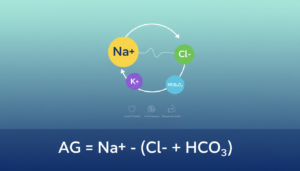
Calculated as Na − (Cl + HCO₃), the anion gap detects unmeasured acids. An elevated gap (>12 mEq/L) indicates metabolic acidosis from causes like ketoacidosis, lactic acidosis, or toxin ingestion — invisible if you only look at individual values.
eGFR
BUN and creatinine calculate kidney function
BUN and creatinine alone are insensitive kidney markers — they rise only after 50% of kidney function is lost. The BUN:creatinine ratio helps distinguish pre-renal (dehydration) from intrinsic kidney disease. eGFR, derived from creatinine, is the most useful kidney function estimate.
K⁺
Potassium has the narrowest safe range
Potassium 3.5–5.0 mEq/L is normal; levels outside 2.5–6.5 mEq/L can cause fatal cardiac arrhythmias. Diuretics (especially thiazides and loop diuretics) commonly cause hypokalaemia — making potassium monitoring critical for patients on these drugs.
C₆H₁₂O₆
glucose
HbA1c
Blood cell component
Molecule measured
= Test marker (Basic Metabolic Panel (BMP))
When to Test
Signs your doctor will order this test
These are the most common reasons a Basic Metabolic Panel (BMP) test is requested — from symptoms to routine screening.
🫀
Cardiac arrhythmia or palpitations
Potassium abnormalities directly affect cardiac conduction. BMP is ordered urgently with ECG when arrhythmia is suspected.
Urgent use
💊
On diuretics or ACE inhibitors
Diuretics alter sodium, potassium, and BUN. ACE inhibitors can raise potassium and creatinine. BMP monitoring is standard for patients on these medications.
Drug monitoring
😵
Confusion, weakness or muscle cramps
Electrolyte abnormalities (particularly sodium and potassium) cause neurological and muscular symptoms. BMP quickly identifies the metabolic cause.
Symptom screen
🩺
Pre-operative assessment
BMP is standard pre-operative screening — electrolyte and kidney function must be confirmed before anaesthesia and fluid management.
Pre-op standard
🏥
Inpatient monitoring
BMP is one of the most-ordered hospital panels — electrolytes and kidney function must be checked daily in many acute conditions.
Daily inpatient
🩸
Diabetes management
Glucose and kidney function (BUN, creatinine) are central to diabetes care. BMP screens for diabetic nephropathy and monitors glucose control.
Diabetes care
Testing Schedule
How often should you get tested?
Frequency depends on your current health status and your doctor's guidance.
1×per year
Healthy adults
Annual BMP as part of preventive health screening to establish metabolic baseline.
Dailyinpatient
Hospitalised patients
Electrolytes and kidney function are monitored daily in patients receiving IV fluids, diuretics, or with acute illness.
2–4×per year
Chronic kidney disease
eGFR and electrolytes monitored every 3–6 months — frequency increases as CKD progresses.
Varieswith dose
On diuretics or ACEi
BMP checked 1–2 weeks after initiating or changing diuretics or ACE inhibitors, then every 3–6 months when stable.
If Your Result Is Abnormal
Abnormal BMP: what each value points to next
Each abnormal value in the BMP has a specific downstream investigation pathway.
⚡
Electrolyte abnormality → ECG first
Any potassium outside 3.0–5.5 mEq/L or sodium outside 130–150 mEq/L should prompt an ECG to rule out cardiac involvement before further management.
Always ECG with K⁺/Na⁺ abnormality
🧪
Elevated BUN/creatinine → eGFR + urinalysis
High creatinine prompts eGFR calculation, urinalysis for protein/blood, and renal ultrasound if eGFR is below 60 mL/min/1.73m².
eGFR + urine protein
🩸
High glucose → fasting glucose + HbA1c
A BMP glucose above 7.0 mmol/L (or 126 mg/dL) fasting, confirmed on repeat testing, meets the diagnostic threshold for diabetes. HbA1c is next.
HbA1c to confirm diabetes
💊
Hyponatraemia → SIADH vs dehydration
Urine sodium and osmolality differentiate SIADH (urine Na >20 mEq/L) from hypovolaemic hyponatraemia (urine Na <20 mEq/L). This directs treatment — opposite management strategies.
Urine Na + osmolality
Related Articles
More clinician-reviewed guides
Other guides in this category — reviewed before publication.
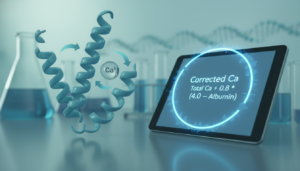
Learn the corrected calcium formula to accurately calculate calcium levels when albumin is low. Essential guide for healthcare professionals.
LML Editorial·Jun 22, 2026
31 min
Medical Disclaimer: This guide is for educational purposes only and does not constitute medical advice. Reference ranges may vary between laboratories. Individual factors can affect results. Always consult your doctor before making clinical decisions based on your lab results.
Partner With Us
Interested in contributing to Life Medical Lab? We work with a limited number of content partners on health and medical topics.


 Article