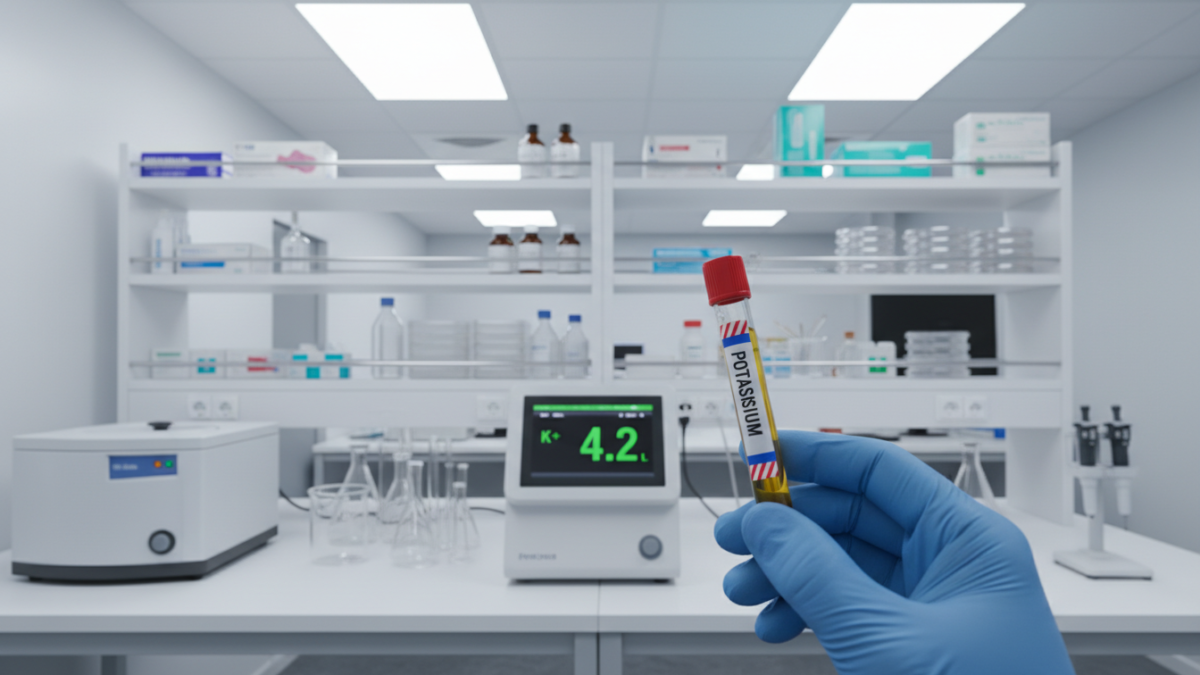
Every year, about 400,000 people in the U.S. end up in the hospital because of potassium problems. These issues can cause serious heart problems very quickly. Potassium is very important for our bodies to work right.
The potassium blood test checks how much K+ is in your serum potassium. It tells us how well your cells and body are doing. Normal levels are between 3.7 to 5.2 mEq/L (3.70 to 5.20 mmol/L).
Potassium helps your nerves and muscles work. It also helps move nutrients into cells and waste out. The electrolyte panel checks this to see how well you’re doing.
A hormone called aldosterone helps control potassium levels. The K+ test can show if you have too little or too much potassium. If the levels are off, it might mean you have health problems. Doctors will look at your test results to see what they mean for you, based on your health.
Key Takeaways
- The potassium blood test measures K+ concentration in serum, with normal ranges between 3.7-5.2 mEq/L (3.70-5.20 mmol/L) in standard laboratory references.
- Potassium ions facilitate essential cellular functions including nerve transmission, muscle contraction, and nutrient-waste exchange mechanisms.
- Aldosterone, a mineralocorticoid hormone produced by the adrenal cortex, primary regulates serum K+ levels.
- Abnormal values may indicate hyperkalemia (elevated) or hypokalemia (decreased) conditions requiring clinical evaluation.
- The electrolyte panel incorporates this measurement as a critical component for assessing metabolic and systemic health status.
- Laboratory reference ranges may vary based on testing methodology, age, biological sex, and individual clinical factors.
Understanding the Potassium Blood Test
Blood tests for potassium help doctors check the balance of electrolytes in the blood. This test is part of regular checks in many places. The metabolic panel lets doctors look at many biochemical markers at once.
Measuring serum potassium helps diagnose and treat many health issues. It tells doctors about heart function, kidney health, and acid-base balance. Knowing the right amount of this electrolyte is key to understanding a patient’s health.
Laboratory Procedure and Sample Collection
The potassium blood test takes a blood sample from a vein. Technicians usually take it from the inside of the elbow. If that’s hard, they might use veins on the back of the hand.
This test is part of several panels. The basic metabolic panel (BMP) is the most common. Doctors might also order other panels based on what they need to check.
| Panel Type | Components Measured | Clinical Applications | Potassium Inclusion |
|---|---|---|---|
| Basic Metabolic Panel | Sodium, potassium, chloride, bicarbonate, BUN, creatinine, glucose | Routine screening, electrolyte monitoring, kidney function assessment | Standard component |
| Comprehensive Metabolic Panel | BMP components plus liver function markers, protein, calcium | Extensive metabolic evaluation, pre-operative assessment | Standard component |
| Electrolyte Panel | Sodium, potassium, chloride, bicarbonate | Fluid balance disorders, acid-base disturbances | Primary focus |
| Chem 7 | Identical to basic metabolic panel | Emergency departments, hospitalized patients | Standard component |
The blood collection follows strict rules to keep the sample good. It only takes a few minutes. Patients don’t need to do much before it starts.
Clinical Significance and Measurement Rationale
Potassium is very important for our bodies to work right. Most of it is inside cells. This helps cells work well.
Potassium affects the heart and how it beats. The right amount is very important. Doctors watch it closely in people with heart or kidney problems.
The sodium-potassium pump keeps the right balance in cells. It uses energy to keep potassium inside and sodium outside. This is very important for cells to live and work.
Lab tests are the best way to check potassium levels. Symptoms might not show up until levels are very off. Testing regularly helps catch problems early.
Physiological Roles and Cellular Mechanisms
Potassium is the main ion inside cells. It helps cells talk to each other and move. This is how we move and think.
It does many important things:
- Nerve signal transmission: Potassium helps nerves send signals
- Muscle contraction regulation: It helps muscles move
- Cardiac rhythm maintenance: It keeps the heart beating right
- Cellular volume regulation: It helps cells stay the right size
- Nutrient and waste transport: It helps move things in and out of cells
The heart is very sensitive to potassium levels. Changes can affect how it beats. This is why doctors watch it closely.
Potassium helps keep the body’s acid-base balance. The kidneys help control this by getting rid of hydrogen ions. This keeps the body’s fluids balanced.
The metabolic panel helps doctors understand potassium levels. It includes other markers that help find the cause of problems. This helps doctors treat patients better.
Normal Potassium Levels for Adults
Healthy adults usually have serum potassium levels between 3.5 and 5.2 milliequivalents per liter. But, different labs might have slightly different ranges. This shows how important it is to keep the right balance of electrolytes in our bodies.
Doctors use these ranges to check if your blood work is normal. If your levels are not in this range, it could mean you have a health issue. They use these ranges to decide if you need more tests or treatment.
Standard Reference Range
The most common range for potassium in adults is 3.7 to 5.2 mEq/L. Some labs might use a range of 3.5 to 5.0 mmol/L. These small differences come from how labs measure and compare their results.
If your potassium level is above 5.1 milligrams per deciliter, it’s too high. If it’s below 3.5 mg/dL, it’s too low. These small changes can affect how well your heart and muscles work.
| Source Reference | Lower Limit (mEq/L) | Upper Limit (mEq/L) | Measurement Units |
|---|---|---|---|
| Standard Clinical Range | 3.7 | 5.2 | mEq/L or mmol/L |
| Alternative Laboratory Range | 3.5 | 5.0 | mmol/L |
| Critical Value Thresholds | <3.5 | >5.1 | mg/dL |
| Pediatric Reference (varies by age) | 3.4 | 4.7 | mEq/L |
Lab-specific ranges can vary by 0.2 to 0.3 mEq/L. Doctors look at results based on their lab’s specific range. This is because labs use different methods and equipment.
Reference intervals are the range of values seen in about 95% of healthy people. They are used to compare patient results in clinical practice.
Factors Influencing Normal Levels
The renin-angiotensin-aldosterone system (RAAS) helps keep potassium levels right. Aldosterone, made in the adrenal cortex, helps get rid of potassium through the kidneys. When potassium levels go up, aldosterone helps get rid of more.
The kidneys play a big role in getting rid of potassium. They remove about 90% of what we take in. If the kidneys don’t work well, it’s hard to keep potassium levels right.
Many things affect how potassium moves in and out of cells:
- Acid-base status – Changes in acid levels in the blood can move potassium in and out of cells
- Insulin activity – Helps cells take in potassium
- Catecholamines – Beta-2 adrenergic agonists help cells take in potassium
- Specimen type – Blood samples can change during clotting, affecting potassium levels
- Hemolysis – Breaking down red blood cells can raise potassium levels
Lab methods can make potassium levels seem different. How long blood sits before being tested can also change results. These factors explain why ranges can vary between labs.
Even if your potassium level is at the edge of normal, it might mean something. For example, a level of 3.6 mEq/L might be a big drop if you usually have 4.5 mEq/L. Doctors look at trends and individual differences, not just one number.
High Potassium Levels (Hyperkalemia)
Potassium levels above the standard range mean you have hyperkalemia. This is a serious condition with many causes. It happens when your potassium level is over 5.2 mEq/L.
High potassium levels can come on slowly or quickly. Each type has its own signs. Doctors need to know how it happened to help you.
Causes of Hyperkalemia
Many things can cause high potassium levels. Kidney problems are the top reason. When your kidneys don’t work well, they can’t get rid of potassium.
In kidney disease, your kidneys can’t remove potassium. This leads to too much potassium in your blood. People with bad kidney disease are at the highest risk.

Some medicines can also raise potassium levels. Certain medicines mess with how your body handles potassium:
- ACE inhibitors and ARBs lower aldosterone, making it harder to get rid of potassium
- Potassium-sparing diuretics like spironolactone stop potassium from leaving your body
- Beta-adrenergic blockers make it hard for cells to take in potassium
Some diseases also affect potassium levels. Addison disease and low aldosterone make it hard to get rid of potassium. This is because your kidneys can’t remove potassium properly.
Metabolic and respiratory acidosis make potassium levels go up. This is because hydrogen ions move into cells, taking potassium with them. This doesn’t change how much potassium you have in your body.
Tissue damage can also raise potassium levels. This includes injuries, tumors, and blood cell destruction. Crushed tissue injuries can also cause potassium levels to go up quickly.
Blood transfusions can add potassium to your body. Older blood products have more potassium. Too much potassium from food is rare in healthy people but can be a problem for those with kidney issues.
Pseudohyperkalemia is when potassium levels seem high but aren’t really. This can happen during blood tests. Things like hemolysis or using a tourniquet for too long can cause this.
Symptoms of High Potassium
High potassium levels can cause different symptoms. Slow increases might not show symptoms right away. But fast increases can cause noticeable problems.
Quick increases in potassium can cause serious symptoms. This is because your body can’t adapt fast enough. The speed of increase affects how bad the symptoms are.
“The neuromuscular and cardiac effects of hyperkalemia represent the primary clinical concerns, with symptoms ranging from subtle weakness to life-threatening arrhythmias.”
Neuromuscular symptoms are common with high potassium. Muscle weakness starts in the legs and can spread. You might feel tingling in your arms and legs.
In severe cases, you could lose muscle control. This can even affect your breathing. This is because of changes in muscle cell membranes.
Many people with mild to moderate high potassium don’t show symptoms. Tests often find it before you feel anything. This is why it’s important to check regularly if you’re at risk.
Risks Associated with High Levels
High potassium levels can harm your heart. It changes how your heart cells work. This can lead to serious heart problems.
As potassium levels go up, your heart’s electrical signals change. These changes can be serious:
| Potassium Level (mEq/L) | ECG Changes | Clinical Significance |
|---|---|---|
| 5.5 – 6.5 | Peaked T waves | Early cardiac effects, monitoring required |
| 6.5 – 7.5 | PR interval prolongation, P wave flattening | Progressive conduction delays, increased risk |
| 7.5 – 8.0 | QRS complex widening | Severe conduction abnormalities, urgent intervention needed |
| Above 8.0 | Ventricular fibrillation or asystole | Immediate life-threatening emergency |
Very high levels can stop your heart. This is a medical emergency. Quick action is needed to save your life.
High potassium can cause heart rhythm problems. These can happen without warning. The risk of sudden death goes up when levels are over 8.0 mEq/L.
High potassium can also cause other problems. It can make metabolic acidosis worse. Long-term, it can lead to heart disease and increase the risk of death in people with kidney problems.
Having high potassium and heart disease is very risky. People with heart problems are more at risk. Low calcium or magnesium can make things worse.
Low Potassium Levels (Hypokalemia)
Hypokalemia is a serious problem where the blood has too little potassium. It happens when the potassium level drops below 3.5 mEq/L. This can happen for a few reasons like not eating enough potassium, losing too much through urine or gut, or potassium moving inside cells.
How serious potassium deficiency is depends on how low the levels get and for how long. Mild cases might not show symptoms. But, very low levels can be very dangerous.
Causes of Hypokalemia
Not getting enough potassium from food is a big reason for low levels. Diarrhea and vomiting also cause a lot of potassium loss. This loss can lead to more potassium being lost in the urine.
Diuretics are medicines that make you lose more potassium. They work by making you pee more. This is why people taking these medicines need to watch their potassium levels.
- Loop diuretics such as furosemide and torsemide
- Thiazide diuretics including hydrochlorothiazide and indapamide
- Potassium-sparing diuretics when combined with other agents
Some diseases make you lose potassium too. Hyperaldosteronism and Cushing syndrome are examples. They make your body lose potassium in the urine.
Renal artery stenosis can also cause low potassium. It happens when the blood flow to the kidneys is blocked. This leads to more potassium being lost in the urine.
Magnesium is important for keeping potassium levels right. If you don’t have enough magnesium, you can lose potassium too.
Sometimes, potassium moves from outside cells to inside cells. This can happen with certain medicines or when you have too much acid in your blood. Hypokalemic periodic paralysis is a rare condition that makes potassium move suddenly.
Not eating enough potassium is rare in healthy people. But, it can happen in people with certain health problems or who don’t eat well.
Symptoms of Low Potassium
Low potassium can cause different symptoms. Mild cases might not show any signs. But, more severe cases can cause serious problems.
As potassium levels drop, muscles can get weak. This makes it hard to do things like climb stairs. You might also get muscle cramps or see your muscles twitch.
Very low potassium can make it hard to breathe. This is because the muscles that help you breathe get weak. In extreme cases, muscles can break down, which is very dangerous.
Low potassium can also mess with your gut. You might get constipated or have trouble moving food through your system. You might also pee a lot and feel thirsty all the time.
Low potassium can make your heart feel funny. You might feel like your heart is beating too fast or irregularly. This is because your heart is not working right when it doesn’t have enough potassium.
Risks of Low Potassium Levels
Low potassium can be very dangerous for your heart. It can make your heart beat in strange ways. This can lead to serious heart problems.
Changes in your heart can be seen on an ECG. These changes include:
- T wave flattening or inversion
- Prominent U wave appearance
- ST segment depression
- QT interval prolongation
Low potassium can make your heart beat too fast. This can lead to serious heart problems. Torsades de pointes, ventricular tachycardia, and ventricular fibrillation are all very dangerous.
If you have heart problems, low potassium is even more dangerous. It can make your heart problems worse. Taking certain medicines can also make low potassium more dangerous.
Low potassium can also raise your blood pressure. It can make it harder for your body to use insulin. In people with liver problems, low potassium can make their brain problems worse.
Low potassium can make you very weak and your heart can beat strangely. Finding and treating low potassium early is very important. People taking diuretics or with certain health problems need to have their potassium levels checked often.
Preparing for a Potassium Blood Test
Getting ready for a serum potassium test is important. It helps avoid mistakes and gives accurate results. Doctors look at your meds, if you’ve eaten, and your health history before the test.
Pre-Test Instructions
Checking your meds is key before the test. Some medicines can change your potassium levels or mess with the test. This includes diuretics, ACE inhibitors, and beta-blockers.
Don’t stop or change your meds without your doctor’s say-so. Stopping some meds can be risky. Usually, you keep taking your meds as usual, and the test results will take that into account.
How long you need to fast depends on the tests you’re having. For some tests, like a metabolic panel, you might need to fast for 6 to 12 hours. Just drink water during this time.
If you’re just getting a potassium test, you don’t need to fast. Food doesn’t usually change your potassium levels right away. Your doctor will decide if you need to fast based on your tests.
- Any symptoms that might suggest potassium problems
- Chronic conditions like kidney disease or diabetes
- All your meds and supplements
- Any recent diet changes or supplements
- Any past issues with potassium levels
What to Expect During the Test
The test is done by a trained person. You’ll sit or lie down with your arm out and supported. They’ll find a good spot to take the blood.
They might use veins in your elbow or hand. They’ll use a tourniquet to see the vein better. But they shouldn’t keep it on too long.
They’ll try not to keep the tourniquet on for more than a minute. This is to avoid getting false high potassium readings. They’ll clean the area with alcohol, then put in a needle.
They’ll use special tubes for the blood. These tubes help get the right kind of sample. The tourniquet comes off once they start getting blood.
After they get enough blood, they’ll take out the needle and apply pressure. This stops bleeding and helps prevent bruising. You might feel a little pain or discomfort.
You might feel some pain or bruising after the test. But it should go away in a few days. The whole process takes about 3 to 5 minutes.
They need to process the blood right away. If they don’t, it could give a false reading. This is because of potassium leaking from cells.
Interpreting Your Results
Potassium blood test results show numbers in milliequivalents per liter (mEq/L). Doctors compare these numbers to normal ranges. They also look at your symptoms and health conditions.
Laboratory reports show your potassium level and the normal range for that lab. How fast you get your results depends on the lab and how urgent your test is. Usually, results come in 24 to 72 hours. But, if it’s very urgent, you might get them in one to two hours.
Understanding Your Potassium Levels
The potassium normal range is usually 3.7 to 5.2 mEq/L. Some labs use 3.5 to 5.2 mEq/L. If your levels are in this range, it’s usually okay.
But, if your levels are too high or too low, it might mean you need medical help. This is more likely if you have heart problems or take certain medicines.
Abnormal potassium levels are classified by how severe they are. This helps doctors decide what to do next.
| Condition | Severity Level | Potassium Range (mEq/L) | Clinical Consideration |
|---|---|---|---|
| Hyperkalemia | Mild | 5.3 – 6.0 | Monitoring required |
| Hyperkalemia | Moderate | 6.1 – 7.0 | Prompt evaluation needed |
| Hyperkalemia | Severe | Above 7.0 | Medical emergency |
| Hypokalemia | Mild | 3.0 – 3.4 | Assessment indicated |
| Hypokalemia | Moderate | 2.5 – 2.9 | Close monitoring necessary |
| Hypokalemia | Severe | Below 2.5 | Urgent intervention required |
How serious abnormal results are depends on several things. These include how much your levels are off, how fast they changed, and if you have symptoms. Doctors also look at your other health conditions and medicines.
Pseudohyperkalemia is when test results look high but it’s not really high. This can happen if the blood sample is not handled right. If the results don’t match what you’re feeling, you might need another test.
Doctors look at your symptoms to understand your potassium levels. Hyperkalemia symptoms include muscle weakness and heart rhythm problems. Hypokalemia symptoms are muscle cramps and feeling weak.
Additional Tests You Might Need
After abnormal potassium results, you might need more tests. A metabolic panel checks many things like sodium and glucose. This electrolyte panel helps understand your overall health.
Depending on your first test, you might need other tests. These can include:
- Serum magnesium measurement: Needed for hypokalemia, as low magnesium makes it hard to correct potassium levels
- Arterial blood gas analysis: Checks acid-base balance that affects potassium levels
- Urinary potassium measurement: Helps find out if you’re losing potassium through your kidneys or other ways
- Electrocardiography (ECG): Important to see if your heart is affected by potassium levels
- Plasma renin and aldosterone levels: Tested when there’s a problem with aldosterone, a hormone
Testing your urine for potassium helps figure out why you might be low on potassium. If you’re losing a lot of potassium in your urine, it’s not just because of your kidneys. Doctors use special calculations to understand how your kidneys handle potassium.
In some cases, doctors might use imaging or tests for hormones. For example, a kidney ultrasound might be needed if there’s a problem with your kidneys. Tests for hormones like cortisol or thyroid function might be done if there’s a chance of an endocrine disorder.
Doctors might ask for another potassium test for many reasons. This can confirm if the first test was right or if there was a mistake. It also helps see how well treatments are working and if you need to keep an eye on your potassium levels.
Lifestyle Factors Affecting Potassium Levels
Serum potassium levels change with our lifestyle. This includes what we eat, how active we are, and our use of medicines. Many things affect how much potassium we have in our bodies. Knowing these helps us understand test results and find reasons for abnormal values.
Our lifestyle choices affect our electrolyte balance in complex ways. What we do every day affects how our body takes in, uses, and gets rid of potassium. Knowing this helps doctors make sense of lab results for each patient.
Diet and Nutrition
Most of our potassium comes from food. Western diets give us about 2000-4000 mg of potassium each day. Adults need 2600-3400 mg daily.
Potassium is found in many fruits, vegetables, and foods. Here are some big sources:
- Fruits: Bananas, oranges, cantaloupe, honeydew melon, apricots, mango, papaya, and guava
- Dried fruits: Raisins, dates, prunes, and figs
- Vegetables: Potatoes, sweet potatoes, tomatoes, winter squash, pumpkin, spinach, Swiss chard, beets, and beans
- Dairy products: Milk and yogurt
- Beverages: Orange juice, prune juice, and coffee
- Other sources: Nuts, seeds, whole grains, and salt substitutes with potassium chloride
For people with normal kidneys, what we eat doesn’t much affect our potassium levels. Our kidneys adjust to keep levels right. But, those with kidney problems might get too much potassium from food.
Sodium and potassium work together in our body. Sodium helps us hold water and blood pressure. Potassium helps balance sodium and keeps our blood vessels healthy.
How much sodium and potassium we eat matters for our heart health. Eating more potassium than sodium is good for us. Salt substitutes can help us get more potassium by replacing sodium with potassium chloride.
Exercise and Hydration
Exercise changes where potassium is in our body. When we move, potassium moves from our muscles into our blood. This happens because of the electrical signals in our muscles.
Exercising can raise our potassium levels. Light exercise might increase levels by 0.3-1.2 mEq/L. Hard exercise can raise levels up to 2.0 mEq/L. How much it changes depends on how hard we exercise and how much muscle we use.
After we stop exercising, our body quickly takes potassium back into our cells. This is thanks to special pumps in our cells. Right after exercise, we might have less potassium in our blood.
Not drinking enough water affects our electrolytes when we exercise a lot. Losing water through sweat doesn’t take away much potassium. But, not having enough water makes our body get rid of more potassium.
Drinking enough water is key for our kidneys to handle potassium. Not enough water makes our kidneys get rid of more potassium. But, too much water makes our kidneys keep more potassium.
Medication Effects
Medicines can change how much potassium we have in our blood. Different medicines work in different ways. Knowing this helps doctors understand lab results for patients on many medicines.
Diuretic medications have different effects:
- Loop diuretics (furosemide, bumetanide, torsemide) make our kidneys get rid of more potassium and can cause low potassium
- Thiazide diuretics (hydrochlorothiazide, chlorthalidone, indapamide) increase sodium and potassium loss in the kidneys
- Potassium-sparing diuretics (spironolactone, eplerenone, amiloride, triamterene) help our kidneys keep more potassium and can cause high potassium
Cardiovascular medications also affect our electrolytes:
- ACE inhibitors and angiotensin receptor blockers lower aldosterone, which reduces potassium loss in the kidneys
- Beta-blockers can make it harder for cells to take in potassium
Other medication classes with notable effects include:
- Nonsteroidal anti-inflammatory drugs may make our kidneys get rid of less potassium
- Insulin and beta-2 agonists help cells take in potassium
- Corticosteroids with mineralocorticoid activity increase potassium loss in the kidneys
- Calcineurin inhibitors used in transplantation can affect how our kidneys handle potassium
- Laxatives and enemas increase potassium loss in the gut
Digoxin toxicity can raise potassium levels by blocking the sodium-potassium ATPase pump. Drinking alcohol can lower potassium levels. This is because alcohol can lead to poor diet, magnesium loss, and more potassium loss in the kidneys.
Treatment Options for Abnormal Potassium Levels
When potassium levels are off, doctors need to step in. They look at how bad the imbalance is and if you’re showing symptoms. They also check your heart and what might be causing the problem.
How fast you need help depends on how bad the potassium issue is. If it’s really bad and affects your heart, you need help right away. For milder cases, doctors might take a slower approach.
Approaches for High Potassium Levels
For high potassium, doctors have to act fast to protect your heart. They choose treatments based on how bad it is and your health. There are different ways to treat high potassium.
Cardiac membrane stabilization is key for severe cases. Doctors give calcium to protect your heart quickly. This works fast.
Doctors also try to move potassium into your cells. They use insulin, beta-2 adrenergic agonists, and sodium bicarbonate for this. It helps for a little while until they can fix the problem for good.
To really fix high potassium, doctors focus on getting rid of it. They use:
- Diuretics to help your kidneys get rid of it
- Cation exchange resins to grab potassium in your gut
- Dialysis for really bad cases or when kidneys don’t work well
- Limiting potassium in your diet to prevent future problems
Doctors might also change your medicines if they’re causing high potassium. They look at your whole health to decide what to do.
Strategies for Low Potassium Levels
For low potassium, doctors look at how bad it is and if you’re feeling symptoms. They pick the right treatment based on your health.
Doctors give potassium back through food or IV. For mild cases, taking potassium by mouth is best. But for severe cases, an IV might be needed. How fast and how much you get depends on how bad it is.
They also give magnesium to help with potassium. Low magnesium makes it hard to fix potassium levels. They check your levels often to make sure they’re right.
| Clinical Severity | Typical Approach | Monitoring Considerations |
|---|---|---|
| Mild asymptomatic | Dietary modification or oral supplementation | Periodic laboratory assessment |
| Moderate symptomatic | Oral supplementation with closer monitoring | More frequent laboratory checks and clinical evaluation |
| Severe or critical | Intravenous replacement in monitored setting | Continuous cardiac monitoring and serial potassium measurements |
Fixing the cause of low potassium is key. This might mean changing your diet, stopping certain medicines, or treating other health issues. Doctors might also add special diuretics to help.
Doctors watch your heart closely when treating severe potassium problems. They consider your health, like your kidneys and heart, to decide the best course. They always make decisions based on your specific needs.
The Role of Healthcare Providers
Healthcare providers play a key role in understanding lab results. They order and interpret tests, using their knowledge to help patients. They decide how often to test based on each patient’s needs.
Small changes in potassium can affect nerves and muscles. Doctors are trained to diagnose and treat these issues. They look at test results in the context of each patient’s health.
When to Consult a Doctor
Seeing a doctor is important in many situations. If you have symptoms that might be related to potassium, you should get checked. Doctors can decide if you need to see them right away or later.
Some symptoms that mean you should see a doctor include:
- Unexplained muscle weakness or persistent muscle cramps
- Palpitations or irregular heartbeat sensations
- Persistent fatigue without apparent cause
- Paresthesias or abnormal sensations in extremities
- Muscle paralysis or significant weakness
People with certain health issues need regular check-ups. This includes those with kidney disease, heart failure, diabetes, adrenal disorders, and high blood pressure. Also, if you’re taking medicines that can affect potassium, you should see your doctor regularly.

Doctors might tell you to stop taking certain medicines before testing. This includes diuretics, ACE inhibitors, and immunosuppressants. If your potassium test shows something abnormal, you need to see a doctor to find out why.
Emergency medical attention is needed for severe symptoms. This includes muscle weakness, paralysis, severe palpitations, chest pain, or passing out. These signs can mean serious problems that need quick help.
Doctors might test your potassium if they think you have kidney disease, high blood pressure, or diabetic ketoacidosis. They decide when and how often to test based on your health. If you already have potassium problems, you need to keep getting checked to make sure your treatment is working.
Importance of Regular Monitoring
Lab tests are important for many reasons. They help find problems before you even notice symptoms. Doctors use these tests to see if treatments are working, to track how diseases are progressing, and to make sure medicines are safe.
How often you need to get tested depends on your health. If you’re healthy and your potassium levels are normal, you might only need a test once a year. But if you have kidney disease or other issues that can affect potassium, you might need to get tested more often.
| Clinical Situation | Typical Monitoring Frequency | Clinical Purpose |
|---|---|---|
| Stable chronic conditions | Annually | Routine health maintenance screening |
| Chronic kidney disease | Monthly to quarterly | Disease stage monitoring and stability assessment |
| New medication initiation | 1-2 weeks after dose changes | Medication safety and effect evaluation |
| Active management of abnormalities | Daily to monthly | Treatment efficacy assessment |
| Dialysis patients | Several times weekly | Treatment session monitoring |
How often you need to get tested depends on your health. Doctors look at your test results along with your other health issues, medicines, and symptoms. This helps them give you the best care.
Teams of doctors might work together on your care. Nephrologists help with kidney problems, endocrinologists deal with hormone issues, and cardiologists check your heart. Dietitians help with nutrition, and pharmacists manage your medicines. Your primary care doctor coordinates everything.
Doctors teach you about your test results and what symptoms to watch for. They keep records of your tests to track your health over time. This helps them and other doctors work together to take care of you.
Managing potassium levels is complex and serious. Doctors play a key role in finding and treating problems. Their work helps keep you healthy and safe.
Frequently Asked Questions About Potassium Tests
People often wonder about potassium blood tests. They ask about how often to test and what happens during the test. Knowing this helps both patients and doctors.
How Often Should You Get Tested?
How often you need a potassium test depends on your health. Healthy people usually get tested once a year. But, if you have kidney disease, you might need to get tested more often.
Those on certain medicines need a test after starting or changing doses. People with diabetes, high blood pressure, or heart problems should get tested yearly. If your potassium levels were once off, you might need to get tested more often. Doctors decide how often based on your health.
What Are the Risks Involved in the Test?
Getting a potassium test is generally safe. You might feel a little pain or get a small bruise where the needle goes in. But, these problems usually go away quickly.
Some people might feel dizzy or have a reaction during the test. Rarely, the needle might hit a blood vessel, causing it to break. This can make your potassium levels seem higher than they are. But, overall, getting a blood test is very safe.