Nearly 30% of all coagulation problems found in labs are linked to fibrinogen. Yet, a quick test can spot these issues fast. This test is called thrombin time, a precise method for checking one key clotting step.
Thrombin time, or TCT, shows how fast plasma clots after adding thrombin. It’s different from other tests because it focuses on fibrinogen’s role. This is the last step in making a clot.
The TT blood test uses plasma that’s been treated with citrate. Thrombin is added, and how long it takes to see a clot is noted. Normal times are between 12 and 19 seconds, but can vary slightly by lab.
Doctors order this test when they’re unsure about fibrinogen from initial tests. It’s a direct way to check fibrinogen, unlike tests that look at the whole clotting process. It’s important in many areas like hematology and critical care.
Key Takeaways
- Thrombin time measures how rapidly plasma clots after thrombin is added, with normal values ranging from 12 to 19 seconds.
- The TT blood test is all about fibrinogen, skipping other clotting factors.
- This test is used when fibrinogen issues are suspected from initial tests.
- It uses citrated plasma and a set amount of thrombin for accurate results.
- Thrombin time is key in hematology, before surgery, and for checking anticoagulants.
- Reference ranges for thrombin time can differ between labs because of different equipment and reagents.
What Is Thrombin Time?
Thrombin time is a test that checks how long it takes for a clot to form. It uses a special amount of thrombin added to blood. This test looks at the final step of blood clotting, where thrombin works on fibrinogen.
Definition and Overview
This test sees how fibrinogen turns into fibrin threads. Thrombin is added to blood, and how fast a clot forms is measured. If it takes too long, it might mean there’s a problem with fibrinogen or something else in the blood.
This test is special because it looks at just one part of blood clotting. It skips over other steps and focuses on how thrombin and fibrinogen work together. This is helpful when doctors need to know if there’s a problem with how much or how well fibrinogen works.
Importance in Hemostasis
Hemostasis is how the body stops bleeding after an injury. It has two main parts:
- Platelets stick together at the injury site, making a primary platelet plug.
- The coagulation cascade starts, making fibrin that holds the plug together.
Thrombin is key in this process. It turns fibrinogen into fibrin, which then forms a strong clot. Without enough thrombin or good fibrinogen, the clot won’t hold. Testing fibrinogen through thrombin time helps find problems in this important process.
The Role of Thrombin in Blood Coagulation
Blood coagulation is a series of protein reactions called the coagulation cascade. At its heart is the thrombin enzyme, a serine protease. It turns circulating proteins into a stable clot. Knowing this helps us understand thrombin time test results.
Mechanism of Action
When a blood vessel gets hurt, the hemostasis process starts. Platelets form an initial plug at the wound site. The coagulation cascade is then set off by a series of reactions involving clotting factors in blood plasma.
The thrombin enzyme comes from its inactive form, prothrombin (Factor II), through Factor Xa. Once active, thrombin does several important things in the hemostasis process:
- Changes fibrinogen (Factor I) into fibrin monomers
- Makes Factor XIII active, which stabilizes fibrin through cross-linking
- Increases its own production by activating Factors V, VIII, and XI
- Helps platelets stick together at the injury site
Interaction with Fibrinogen
Fibrinogen is a soluble glycoprotein in blood plasma. The thrombin enzyme cuts specific bonds on fibrinogen, releasing fibrinopeptides A and B. This turns fibrinogen into insoluble fibrin monomers.
These monomers then link up into long threads. Factor XIIIa cross-links these threads, making a strong mesh. This mesh traps red blood cells and platelets, forming a clot that stops blood loss.
| Stage | Key Component | Result |
|---|---|---|
| Prothrombin activation | Factor Xa, Factor Va | Thrombin generation |
| Fibrinogen cleavage | Thrombin enzyme | Fibrin monomer release |
| Fibrin stabilization | Factor XIIIa | Cross-linked fibrin mesh |
The clot stays strong until the tissue is fully healed. We need enough functional platelets and coagulation factors for good fibrin formation and hemostasis.
How Thrombin Time Is Measured
The TT blood test follows a set protocol in labs. A blood sample is taken from a vein in the arm or hand. It goes into a tube with sodium citrate to stop clotting early.
After taking the sample, it’s spun to separate plasma from cells. Thrombin reagent is then added to the plasma. The time it takes for a clot to form is measured in seconds.
Laboratory Procedures
Thrombin time testing needs careful steps for accurate results. The plasma is warmed to 37°C before adding thrombin. Clot formation is checked by light or mechanical means, depending on the device.
This test is very sensitive to heparin. It’s great for spotting heparin in blood samples.
Equipment and Reagents Used
For reliable testing, special tools and materials are needed. Here’s a list of what’s used in the TT blood test:
| Component | Purpose | Example |
|---|---|---|
| Coagulation Analyzer | Detects fibrin clot formation | Stago STA Compact Max |
| Sodium Citrate Tubes | Prevents premature coagulation | 3.2% buffered sodium citrate |
| Bovine Thrombin Reagent | Initiates clot formation in plasma | Standardized bovine thrombin solution |
| Centrifuge | Separates plasma from blood cells | Benchtop clinical centrifuge |
| Micropipettes | Ensures precise volume measurement | Calibrated automatic pipettes |
Each tool must meet quality standards from the College of American Pathologists (CAP). This ensures tests are accurate and consistent in all labs.
Normal Thrombin Time Ranges
Knowing the thrombin time normal range is key for understanding coagulation tests. These values help spot clotting problems. But, they can change based on the lab, the test materials, and the patient.
Reference Values in Adults
In the U.S., the normal thrombin time for adults is between 12 and 19 seconds. Labs like Mayo Clinic and Massachusetts General Hospital use these values. They adjust their tests based on the type of thrombin used.
A test within these values means fibrinogen is converting to fibrin normally. But, if it’s not, it’s important to check other tests too.
Variations in Different Populations
Many things can affect a person’s thrombin time result:
- Age — babies and older people might have different values
- Gender — some studies find small differences between men and women
- Health history — certain conditions can change results
- Testing method — how the test is done can affect the result
| Population Group | Approximate Range (Seconds) | Key Consideration |
|---|---|---|
| Healthy Adults | 12–19 | Standard reference values for most U.S. labs |
| Neonates (Full-Term) | 12–17 | Lower fibrinogen levels at birth |
| Elderly Adults (>65 years) | 13–20 | Age-related changes in coagulation parameters |
| Pregnant Women (Third Trimester) | 12–16 | Elevated fibrinogen may shorten time |
Doctors should use the laboratory-specific values on each test report. This helps deal with differences in testing sites.
Factors Affecting Thrombin Time Results
Many things can change thrombin time results. Knowing what causes these changes is key for doctors to understand them right. These factors include medicines, genetic issues, and things unique to each patient.
Medications Impacting Results
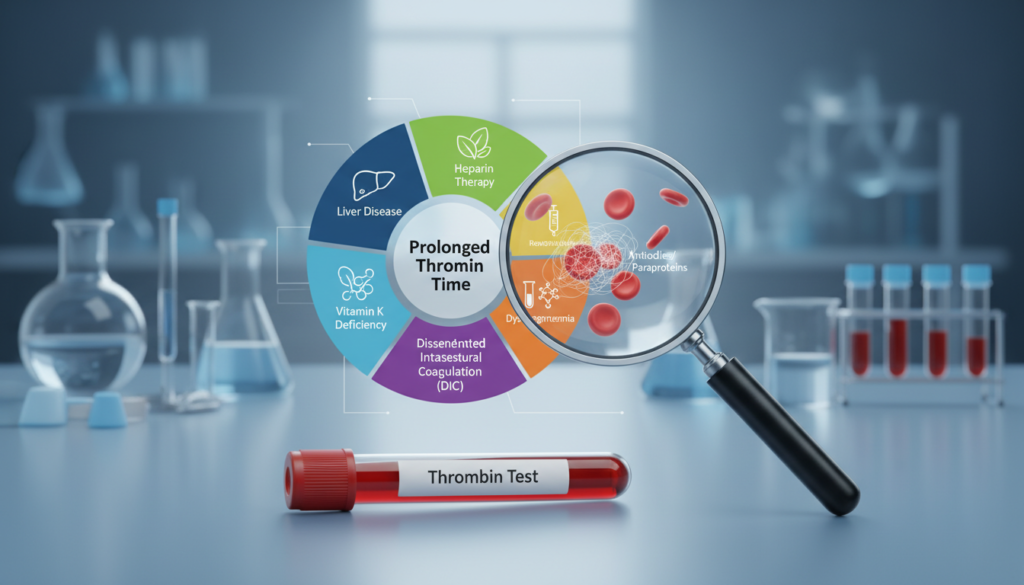
Medicines that thin the blood are a big reason for test issues. Drugs like heparin, warfarin, and dabigatran can make results take longer. These medicines stop the blood from clotting right.
Using bovine thrombin in surgery can also cause problems. It can lead to antibodies that mess with test results later. It’s important to know all medicines, including vitamins and herbs, before getting a blood test.
Genetic Factors
Some genetic problems can also affect thrombin time. For example, dysfibrinogenemia and afibrinogenemia make it hard for blood to clot. Other conditions like multiple myeloma can also mess with blood clotting.
| Genetic Condition | Mechanism of Impact | Expected Effect on Thrombin Time |
|---|---|---|
| Dysfibrinogenemia | Abnormal fibrinogen structure | Prolonged |
| Afibrinogenemia | Absent fibrinogen production | Markedly prolonged |
| Multiple myeloma | Paraprotein interference with fibrin polymerization | Prolonged |
Lifestyle Influences
Fibrinogen levels go up when the body is fighting off an infection or injury. This can make it harder to see if there are other problems with blood clotting. It adds to the challenge of understanding test results.
Clinical Indications for Ordering Thrombin Time
Thrombin time testing is used in certain situations. Doctors order it when patients show signs of abnormal clotting. This includes bleeding too much, getting bruises easily, or losing pregnancies early.
The test is important for diagnosing coagulation disorders and checking anticoagulant levels. It’s used in many different medical settings.
Evaluation of Coagulation Disorders
Thrombin time is a key tool in diagnosing coagulation disorders. It’s very helpful when looking at conditions that affect fibrinogen. Inherited fibrinogen disorders, like afibrinogenemia and dysfibrinogenemia, are often tested with this.
Other conditions can also lead to thrombin time testing. These include:
- Liver diseases — cirrhosis, hepatitis, and hepatocellular carcinoma
- Renal cell carcinoma
- Multiple myeloma
- Systemic lupus erythematosus
- Ulcerative colitis
If PT or aPTT times are longer than expected, thrombin time might be needed. This helps find the cause.
Monitoring Anticoagulant Therapy
Thrombin time is also used to monitor anticoagulant therapy, mainly with heparin. It checks for heparin in blood and spots accidental sample contamination from heparin flushes. This is a big worry in labs.
| Clinical Indication | Primary Purpose | Associated Conditions |
|---|---|---|
| Unexplained bleeding or bruising | Coagulation disorder diagnosis | Fibrinogen deficiency, liver disease |
| Prolonged PT or aPTT | Identifying clotting pathway defects | Dysfibrinogenemia, DIC |
| Heparin therapy evaluation | Anticoagulant monitoring | Thromboembolism management |
| Suspected sample contamination | Preanalytical quality control | Heparin catheter flush interference |
Thrombin Time in Comparison to Other Coagulation Tests
Thrombin time checks how fibrinogen turns into fibrin. It looks at just one part of the clotting process. Coagulation panel tests, on the other hand, check many parts of the clotting process. This gives a clearer picture of what’s happening in the body.
Prothrombin Time (PT)
PT/INR tests the extrinsic and common coagulation pathways. It checks factors I, II, V, VII, and X. It’s key for checking warfarin therapy and finding vitamin K–dependent factor problems. Unlike thrombin time, PT/INR looks at more than just fibrinogen.
Reptilase time is useful with thrombin time. A normal reptilase time with a long thrombin time means heparin contamination, not a fibrinogen problem.
Activated Partial Thromboplastin Time (aPTT)
aPTT tests the intrinsic and common pathways. It checks factors VIII, IX, XI, XII, and others. It’s mainly used for monitoring unfractionated heparin therapy. aPTT and thrombin time both show heparin effects but in different ways.
| Feature | Thrombin Time | PT/INR | aPTT |
|---|---|---|---|
| Pathway Assessed | Common (fibrinogen → fibrin) | Extrinsic and Common | Intrinsic and Common |
| Heparin Sensitivity | High | Minimal | High |
| Warfarin Monitoring | Not applicable | Primary use | Not applicable |
| Fibrinogen Focus | Direct | Indirect | Indirect |
When thrombin and reptilase times both go up, it might mean low fibrinogen or fibrinogen problems. Looking at coagulation panel tests together helps doctors figure out what’s wrong more accurately.
Conditions Associated with Prolonged Thrombin Time
A prolonged thrombin time often points to specific clinical conditions. These conditions range from chronic organ dysfunction to acute systemic disorders. Many fibrinogen disorders present with mild or no symptoms at all. An abnormal result may be found during routine lab work or after unexpected bleeding.
Liver Disease
The liver is the primary site of fibrinogen synthesis. When liver function declines, the body produces less fibrinogen or creates structurally abnormal variants. Conditions such as cirrhosis, hepatitis, and hepatocellular carcinoma are all linked to impaired clotting factor production.
Liver disease coagulation abnormalities tend to worsen as the disease progresses toward end-stage liver failure. Malnutrition, which frequently accompanies chronic liver conditions, compounds the problem. It limits the raw materials needed for protein synthesis. Abnormal fibrinolysis may occur as well, further impairing stable fibrin clot formation and extending the thrombin time result.
Disseminated Intravascular Coagulation (DIC)
DIC is a complex condition in which widespread clotting and bleeding happen at the same time. Excessive activation of the coagulation cascade leads to rapid consumption of fibrinogen and other clotting factors. This depletion directly prolongs the thrombin time.
DIC diagnosis relies on a combination of laboratory findings. The following markers are typically evaluated together:
- Thrombin time
- Platelet count
- Fibrinogen level
- D-dimer concentration
- Prothrombin time (PT) and activated partial thromboplastin time (aPTT)
| Condition | Primary Mechanism | Effect on Fibrinogen |
|---|---|---|
| Cirrhosis | Decreased hepatic synthesis | Reduced or dysfunctional fibrinogen |
| DIC | Excessive clotting factor consumption | Severely depleted fibrinogen levels |
| Hepatitis | Inflammatory liver damage | Variable reduction in fibrinogen output |
Recognizing these conditions early through coagulation testing, including thrombin time, supports timely clinical assessment. Understanding how anticoagulant therapies interact with these results is explored in the next section.
Thrombin Time in Anticoagulation Management
Thrombin time is key in managing anticoagulation therapy. It’s very sensitive to certain drugs, making it useful in some cases. The test changes based on the drugs in the patient’s blood.
Use in Warfarin Therapy
Warfarin affects vitamin K–dependent clotting factors but not fibrinogen to fibrin conversion. So, thrombin time stays within normal limits with warfarin. PT and INR are the main tools for checking warfarin.
Dabigatran, a direct thrombin inhibitor, greatly increases thrombin time. A special test, plasma-diluted thrombin time, is suggested for dabigatran monitoring. But, dabigatran levels are usually checked directly for monitoring.
Assessment in Heparin Use
Thrombin time is very sensitive to unfractionated heparin (UFH). This makes it a top choice for heparin monitoring. Even small amounts of heparin can cause a big change in the test.
Things that can add heparin to blood samples include:
- Active intravenous heparin infusion during blood collection
- Flushing intravenous catheters with heparin
- Heparin-like substances or fibrin degradation products
| Anticoagulant | Effect on Thrombin Time | Primary Monitoring Test |
|---|---|---|
| Warfarin | Minimal to none | PT/INR |
| Unfractionated Heparin | Markedly prolonged | aPTT / Anti-Xa |
| Dabigatran | Significantly prolonged | Diluted thrombin time / Drug level |
| Low-Molecular-Weight Heparin | Variable, mild prolongation | Anti-Xa assay |
It’s important to know why thrombin time is long for good heparin monitoring. This helps in managing anticoagulation therapy in different situations.
Understanding Abnormal Thrombin Time Results
When thrombin time values are not normal, a careful plan is needed to find the cause. Abnormal results might show low fibrinogen levels, bad fibrinogen, or inhibitors. Many people with these issues don’t show symptoms or have mild ones. This means they might be found by chance during other tests.
Clinical Symptoms
Many with long thrombin times don’t show bleeding signs. They might be found after bleeding too long after surgery or dental work. Symptoms can include:
- Easy bruising without clear trauma
- Prolonged bleeding from minor cuts or wounds
- Excessive bleeding during or after surgical procedures
- Mucosal bleeding, such as nosebleeds or gum bleeding
Further Diagnostic Testing
When thrombin time results are abnormal, more tests are done to find the cause. This careful step-by-step approach helps find the problem quickly and accurately.
| Test Type | Purpose | Clinical Setting |
|---|---|---|
| Fibrinogen Activity Assay (Clauss Method) | Measures functional fibrinogen concentration | Routine clinical laboratories |
| Fibrinogen Antigen Assay | Quantifies total fibrinogen protein present | Specialized coagulation laboratories |
| Liver Function Tests | Evaluates hepatic synthetic capacity | Routine clinical laboratories |
| Genetic Molecular Testing | Identifies mutations in inherited fibrinogen disorders | Reference and genetic laboratories |
Testing might also include family members if inherited disorders are suspected. Genetic tests are key in finding congenital dysfibrinogenemia or afibrinogenemia. They help watch for problems in relatives.
Thrombin Time and Surgical Considerations
Thrombin time is very important before surgery. It shows if there’s a problem with blood clotting that doctors might not see. Many people with low fibrinogen levels seem fine until tests show a problem.
Preoperative Evaluation
Before surgery, doctors check thrombin time to see if there’s a risk of bleeding. This test finds issues like dysfibrinogenemia and hypofibrinogenemia. Finding these problems early helps doctors plan better.
- Thrombin time finds problems with fibrinogen that other tests miss
- People who have bled a lot without reason need special tests
- Test results help decide when and if to do surgery
Management During Surgery
Knowing the thrombin time during surgery helps doctors make quick decisions. If the time is long, doctors might give special blood products. This helps keep the patient stable during bleeding.
Using products made from animal parts during surgery is also important. These products can cause problems with future tests.
| Surgical Scenario | Thrombin Time Relevance | Clinical Implication |
|---|---|---|
| Elective surgery | Preoperative coagulation screening | Identifies occult fibrinogen disorders |
| Emergency surgery | Rapid assessment of coagulation status | Guides transfusion strategy |
| Post-bovine sealant exposure | Potential false prolongation | Requires alternative test interpretation |
Testing thrombin time is key to safe surgery. Knowing its limits helps doctors use it right.
Limitations of Thrombin Time Testing
No single test can fully show how blood clots. Thrombin time testing has its own limits. Knowing these is key for correct test results in medical care.
Specificity and Sensitivity Concerns
Thrombin time tests are done in a lab. They don’t perfectly match the real body’s clotting process. This difference is a big limitation.
Tests that check how well fibrinogen works have become more common. These tests are found in many labs. This means thrombin time is not as needed for checking fibrinogen anymore.
- Thrombin time can’t pinpoint the exact cause of clotting problems.
- Some tests for bleeding disorders need special tools and supplies. These are not always available in doctor’s offices.
- Results can vary between labs because of different equipment and materials.
False Positive and Negative Results
Wrong sample handling can lead to false test results. Heparin from IV lines can make thrombin time look longer. This is not a real clotting issue.
Some mild fibrinogen problems might not show up in tests. It’s important to consider the patient’s age, gender, and health when looking at test results. This helps tell real problems from small changes.
Getting accurate blood clot tests means looking at the whole picture of each patient’s health.
Knowing the limits of thrombin time helps doctors use it with other tests. This is discussed in the next section on new testing methods.
Advances in Thrombin Time Testing Techniques
The field of coagulation testing has grown a lot in recent years. New methods have made thrombin time tests faster, more accurate, and useful in clinics. These new ways go beyond old clot-based tests and fix many old problems.
Point-of-Care Testing
Now, we have devices for quick coagulation tests at the bedside or in emergencies. These small devices use a little blood and give results in minutes. This makes it easier to make quick decisions in surgery and critical care.
One big step is the plasma-diluted thrombin time (dTT) method for POC devices. It checks specific anticoagulant levels, like dabigatran, quickly.
New Diagnostic Technologies
New clotting-based tests are better at checking fibrinogen activity than old tests. They also let us measure anticoagulant drug levels more accurately. Labs like Mayo Clinic and ARUP Laboratories now use these new tests in their panels.
Massachusetts General Hospital Pathology Service uses these new tests in their coagulation tests. International labs, like AmbarLab, offer over 3,000 tests, including advanced coagulation tests.
| Testing Approach | Sample Volume | Turnaround Time | Primary Application |
|---|---|---|---|
| Traditional Thrombin Time | Standard venous draw | 1–4 hours | General coagulation screening |
| Diluted Thrombin Time (dTT) | Standard venous draw | 1–3 hours | Dabigatran level estimation |
| Point-of-Care Coagulation | Capillary or small venous sample | 2–10 minutes | Bedside or emergency assessment |
| Functional Fibrinogen Assay | Standard venous draw | 1–4 hours | Fibrinogen activity evaluation |
These new tests are changing how we find and track coagulation disorders. They are helping us get better at preparing patients and understanding test results.
Patient Preparation for Thrombin Time Testing
Getting ready for a blood test is key to getting good results. Doctors give clear instructions before the test. It’s important to share all health details to get the best test results.
Pre-Test Instructions
Instructions for the test stress the importance of telling about all substances that affect blood clotting. This includes:
- Prescription anticoagulant and antiplatelet medications
- Over-the-counter drugs like aspirin or ibuprofen
- Herbal products, vitamins, and dietary supplements
- Any illicit substance use
Telling about all medicines helps doctors understand the test results better. Not sharing any information can lead to wrong conclusions about blood clotting.
What to Expect During the Procedure
The blood test is done by a trained person using a needle in your arm or hand. You might feel a little pinch or sting.
The blood goes into special tubes to stop it from clotting too soon. Here are some possible risks:
| Potential Risk | Frequency | Typical Duration |
|---|---|---|
| Bruising at puncture site | Common | Several days |
| Mild soreness | Common | 24–48 hours |
| Lightheadedness | Occasional | Minutes |
| Localized infection | Rare | Variable |
| Excessive bleeding | Rare | Variable |
Following the instructions and preparing well helps get accurate test results. This is very important for understanding the test results.
Interpretation of Thrombin Time Results
To understand thrombin time results, we need to know a lot about each patient. This includes their medical history, current medicines, and any health issues they have. Only experts can figure out what these results mean in each case.
Role of Healthcare Professionals
Doctors, hematologists, and lab experts all play a part in understanding these results. If a thrombin time is over 19 seconds, it could mean low fibrinogen levels or other problems. Things like heparin or argatroban can also affect the results.
Proteins from diseases like multiple myeloma or amyloidosis can also mess with the test. And, if a patient has antibodies from surgery, that’s something to consider too. Doctors have to think about all these things to know what the results really mean.
| Thrombin Time Finding | Possible Cause | Clinical Significance |
|---|---|---|
| Mildly prolonged (15–19 seconds) | Low-dose heparin effect | May require medication review |
| Moderately prolonged (20–25 seconds) | Hypofibrinogenemia or dysfibrinogenemia | Warrants further fibrinogen assays |
| Markedly prolonged (>25 seconds) | Significant fibrinogen deficiency or strong inhibitors | Urgent evaluation needed |
Patient Communication Guidelines
Talking about thrombin time results in a way that’s easy to understand is key. Doctors should say if the results are normal or not. They should also talk about what tests might be needed next.
- Explain what the test measures in simple terms
- Clarify whether results are normal or abnormal
- Outline any recommended follow-up testing
- Address patient concerns about bleeding or clotting symptoms
Talking openly helps patients make better choices and builds trust with their doctors.
Future Directions in Thrombin Time Research
The world of coagulation research is always changing. This brings new chances for better treatments and tests. Thrombin time testing is at the center of these changes. It could change how we find and watch coagulation problems in the future.
Emerging Therapeutic Implications
Scientists are studying how blood clots in the placenta and its link to pregnancy loss. They can now find genetic problems that cause inherited fibrinogen disorders. This helps doctors test and treat these problems better.
They are also looking at how to better watch people on direct oral anticoagulants. Fibrinogen’s role in inflammation is getting more attention. This could help us understand how inflammation affects blood clotting tests.
Scientific progress in hemostasis diagnostics relies on the integration of molecular biology with traditional laboratory methods to achieve greater clinical accuracy.
Innovations in Coagulation Science
Research on antibodies against bovine thrombin is getting better. Now, there are special labs that can test for coagulation disorders in ways that were not possible before.
New treatments aim to make tests more sensitive and useful for more people. Some key areas being studied include:
- Next-generation molecular diagnostics for hereditary fibrinogen defects
- Expanded point-of-care platforms for real-time coagulation monitoring
- Artificial intelligence integration in coagulation result interpretation
| Research Area | Current Status | Anticipated Impact |
|---|---|---|
| Genetic Fibrinogen Disorder Identification | Molecular testing in development | Improved diagnostic specificity |
| Direct Oral Anticoagulant Monitoring | Protocol refinement ongoing | Broader therapeutic applications |
| Bovine Thrombin Antibody Research | Active clinical investigation | Enhanced post-surgical safety |
| AI-Assisted Result Interpretation | Early-stage exploration | Faster, more accurate analysis |
Conclusion: The Significance of Thrombin Time in Healthcare
Thrombin time is key in clinical lab tests. It shows how fibrinogen works and the end of the clotting process. It’s important for checking how blood clots and for spotting bleeding issues.
It also checks if heparin is in the blood. This makes it a very useful tool for doctors.
Summary of Key Points
Normal thrombin time is between 12 and 19 seconds. If it’s longer, it means there’s a problem. This test is part of a bigger set of tests to check blood clotting.
Things like medicines and genes can change the results. You need special tools and trained people to get the right results.
Final Thoughts on Its Role in Patient Care
Doctors need to understand thrombin time results well. Alone, they don’t tell the whole story. But together with other tests, they help doctors make the right choices.
Research keeps improving how we test blood clotting. This helps us understand and treat problems better.