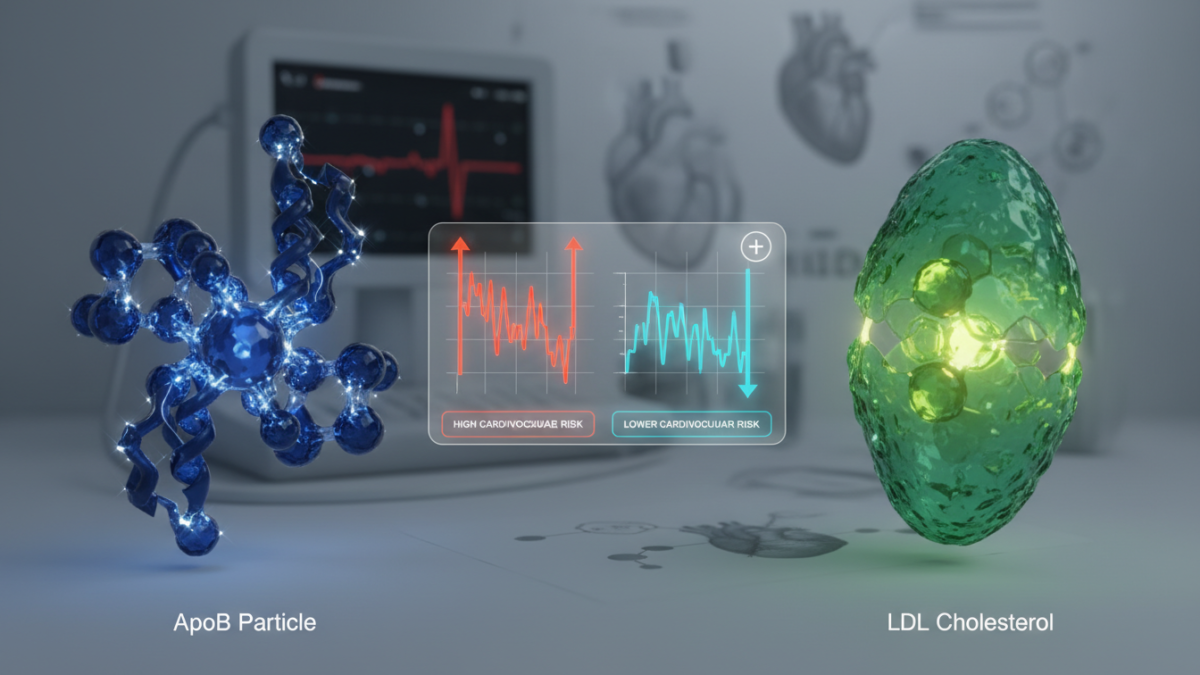
Heart disease is the top killer in the U.S., taking about 700,000 lives yearly. Doctors used to focus on low-density lipoprotein cholesterol (LDL-C) as the main “bad cholesterol” marker. But, new studies suggest apolipoprotein B (ApoB) might be a better sign of who’s at risk for artery plaque.
The debate on ApoB vs LDL has grown in recent years. The American Heart Association found that ApoB testing might better show who’s at risk for heart disease than LDL-C alone. This is because ApoB counts all harmful particles in the blood, not just the cholesterol they carry.
LDL-C measures cholesterol inside LDL particles. ApoB counts all particles that can harm arteries. Even if two people have the same LDL-C, their ApoB levels can differ greatly. This makes ApoB a key tool in predicting heart disease.
It’s vital for both patients and doctors to understand these risk markers. The right test can help decide treatments and catch risks that standard tests might miss. This article compares ApoB and LDL-C, looks at their value in medicine, and discusses their role in preventing heart attacks and strokes.
Key Takeaways
- ApoB measures the total number of atherogenic particles, while LDL-C measures only the cholesterol content within LDL particles.
- Recent American Heart Association research suggests ApoB may be a stronger predictor of atherosclerotic cardiovascular disease than LDL-C.
- Two patients with identical LDL-C levels can have very different ApoB levels — and very different risk profiles.
- Apolipoprotein B testing is becoming a more widely recommended tool for evaluating cardiovascular disease risk markers.
- Combining ApoB and LDL-C results gives clinicians a more complete picture when selecting heart disease predictors for treatment planning.
- Standard lipid panels may miss elevated cardiovascular risk that ApoB testing can reveal.
What the Test Measures
Blood lipid testing has changed a lot. Now, it looks at more than just one number. Two important markers, ApoB and LDL cholesterol, tell us different things. Knowing what each test shows is key to understanding heart disease risk.
Understanding ApoB
Apolipoprotein B (ApoB) is a protein found on harmful lipoproteins in our blood. These include VLDL, IDL, LDL, and Lipoprotein(a). Each particle has one ApoB molecule. This means ApoB counts all harmful particles in our blood.
Labs use special tests to measure ApoB. The American College of Cardiology says ApoB might be better than standard tests for heart risk.
“Measuring ApoB gives clinicians a single number that reflects the total burden of atherogenic particles, regardless of their size or cholesterol content.”
Understanding LDL
LDL cholesterol (LDL-C) shows how much cholesterol is in LDL particles. It doesn’t count the number of particles. Standard tests measure cholesterol in LDL particles.
It’s important to understand the difference. Two people can have the same LDL-C but different ApoB counts. One might have fewer large LDL particles, while the other has many small ones. The person with more particles is at higher risk, even with the same LDL-C.
| Feature | ApoB | LDL-C |
|---|---|---|
| What it measures | Total atherogenic particle count | Cholesterol mass in LDL particles |
| Particles captured | VLDL, IDL, LDL, Lp(a) | LDL only |
| Measurement method | Immunoassay or NMR | Calculated (Friedewald) or direct assay |
| Reflects particle number | Yes | No |
This comparison shows why doctors look at both ApoB and LDL cholesterol. It helps them understand lipid disorders and heart risk better.
Why It Is Ordered
Doctors order ApoB and LDL tests for certain reasons. Each test helps find out who might be at risk for heart attack or stroke. The choice depends on a patient’s health and medical history.
Assessing Cardiovascular Risk
Both tests help check the risk of heart disease. ApoB testing is key for those with insulin resistance, type 2 diabetes, or metabolic syndrome. It’s useful because particle numbers can be high even when cholesterol looks normal.
A study of 616 people with normal blood sugar found something interesting. Even with LDL-C under 100 mg/dL, 13.9% had bad apoB/apoA-I ratios and lipid profiles. This shows why ApoB testing is important.
The ACC/AHA (2018), ESC/EAS (2019), and NLA (2021) all recommend ApoB measurement to refine cardiovascular risk assessment, particular when triglycerides are elevated or metabolic syndrome is present.
Evaluating Lipid Disorders
The debate between LDL-C and ApoB-100 is important for diagnosing lipid disorders. LDL-C might not catch high-risk patients with high particle counts but normal cholesterol.
| Clinical Scenario | LDL-C Utility | ApoB Utility |
|---|---|---|
| Type 2 Diabetes | May underestimate risk | Captures elevated particle number |
| Metabolic Syndrome | Often appears normal | Reveals hidden atherogenic burden |
| High Triglycerides (>150 mg/dL) | Less reliable estimate | More accurate risk predictor |
| Familial Hypercholesterolemia | Useful for screening | Confirms particle-driven risk |
Knowing the differences helps doctors pick the right test. This makes it easier to understand the results against normal ranges.
Normal Reference Range
Understanding your cholesterol numbers is key to knowing your heart health. ApoB and LDL have specific ranges. These ranges change based on your risk level. The values below are guidelines used in the U.S. and Europe.
ApoB Normal Values
ApoB testing counts atherogenic particles in your blood. The 2019 ESC/EAS guidelines say an optimal ApoB level is under 90 mg/dL for most adults. For those at high risk, aim for under 80 mg/dL. Very-high-risk individuals should target under 65 mg/dL.
The apoB-to-apoA-I ratio is a strong predictor of heart disease. There are gender-specific targets:
- Males: ratio less than 0.9
- Females: ratio less than 0.8
LDL Normal Values
LDL cholesterol is a common marker in cholesterol tests. The National Cholesterol Education Program has five LDL-C categories:
| LDL-C Range (mg/dL) | Classification |
|---|---|
| Below 100 | Optimal |
| 100–129 | Near Optimal |
| 130–159 | Borderline High |
| 160–189 | High |
| 190 and above | Very High |
LDL particle number (LDL-P) is also reported in nmol/L. Aim for an LDL-P under 1,000 nmol/L. A useful tip: LDL-P is about ten times the LDL-C value when they match. If they don’t, it might mean you need more tests.
What High Levels May Indicate
High levels of ApoB or LDL can harm your arteries. ApoB and LDL tell different stories about heart disease risk. Even if other numbers seem fine, high levels in one or both can be a warning sign.
Implications of High ApoB
A high ApoB particle number means more harmful particles in your blood. Numbers over 120 mg/dL show a big risk for artery blockages. Each particle can cause inflammation in your arteries.
Studies show that LDL particle count is more important than cholesterol mass. For example, a person with LDL-C of 90 mg/dL but an ApoB of 120 mg/dL is at high risk. Standard tests might not catch this danger.
Implications of High LDL
LDL levels over 190 mg/dL are a big heart risk. High lipids can cause plaque buildup, narrowing arteries and reducing blood flow. This can lead to heart attacks or strokes.
LDL-C doesn’t tell the whole story. About 40% of people with good apoB/apoA-I ratios have high LDL-C. This shows why looking at just one marker can be misleading.
- ApoB particle number captures risk that LDL-C may miss
- Discordant results between ApoB vs LDL require closer evaluation
- Targeted cholesterol medication strategies — including statins, PCSK9 inhibitors, and lifestyle changes — can significantly reduce elevated levels
What Low Levels May Indicate
Seeing low levels of ApoB and LDL-C is often a positive sign. It means there are fewer particles that can clog arteries. But, it’s not that simple. Low levels on one marker don’t always mean the same on the other. Knowing what each low value means helps doctors better understand heart risk.
Implications of Low ApoB
An ApoB level below 80 mg/dL is good news. It means there are fewer particles that can cause artery blockages. This is because ApoB counts the total number of harmful particles in the blood.
Studies show people with lower apoB/apoA-I ratios have healthier lipids. This is true even if their LDL-C is higher than 130 mg/dL. This shows why ApoB testing is important for understanding heart risk.
“Particle count, not just cholesterol content, drives atherosclerotic disease progression.” — National Lipid Association, 2023
Implications of Low LDL
An LDL-C below 100 mg/dL is seen as protective. Doctors use this as a goal for treatment. But, a normal LDL-C doesn’t always mean you’re safe.
Some people with LDL-C under 100 mg/dL are at high risk. This is because they have a lot of small, dense LDL particles. The link between LDL-C and apoB/apoA-I ratio is not strong enough to rely on one alone.
| Marker | Low-Risk Threshold | What It Reflects | Limitation at Low Levels |
|---|---|---|---|
| ApoB | <80 mg/dL | Total atherogenic particle count | Rare genetic conditions can cause very low levels |
| LDL-C | <100 mg/dL | Cholesterol carried by LDL particles | May miss high particle counts in small dense LDL |
The difference between LDL-C and ApoB-100 shows why using just one number is not enough. Using both markers gives doctors a better picture. This helps them look at other biomarkers like total cholesterol and HDL.
Related Biomarkers
ApoB and LDL cholesterol are not alone in assessing heart health. Other markers are also important. Doctors often use a panel of tests to get a full picture of heart health.

Total Cholesterol Overview
Total cholesterol combines LDL-C, HDL-C, and VLDL into one number. It’s a basic marker but can be misleading. High total cholesterol might be due to HDL, which is good.
The Comprehensive Heart Health Test by Labcorp OnDemand tests many markers at once. It includes triglycerides, Lipoprotein(a), and LP-IR scores. NMR LipoProfile technology measures LDL particle number and ApoB together, giving precise data.
HDL Cholesterol Overview
HDL cholesterol is called “good” cholesterol. It helps remove cholesterol from artery walls. Higher HDL levels mean lower heart risk.
Low HDL is common in metabolic syndrome and high triglycerides. This often hides true risk. The apoB/apoA-I ratio is useful, as apoA-I is on HDL particles.
| Biomarker | What It Measures | Clinical Relevance |
|---|---|---|
| Total Cholesterol | LDL-C + HDL-C + VLDL-C combined | Broad screening marker |
| HDL Cholesterol | Protective lipoprotein levels | Inversely related to heart risk |
| Triglycerides | Blood fat from diet and metabolism | Elevated in metabolic syndrome |
| Lipoprotein(a) | Genetically determined lipoprotein | Inherited cardiovascular risk |
| ApoA-I | Primary protein on HDL particles | Used in apoB/apoA-I ratio |
| LP-IR Score | Lipoprotein insulin resistance index | Metabolic dysfunction assessment |
Factors That Affect Results
Many things can change how ApoB vs LDL markers show up in tests. Knowing these factors helps both patients and doctors understand lipid panel results better. How well you prepare for the blood test and natural differences in your body are key to getting accurate results.
Patient Preparation
Labs usually ask for a 9- to 12-hour fast before taking blood for lipid panels. Eating recently can raise triglycerides, which can make LDL-C look higher than it is. ApoB tests are less affected by fasting, making them a good choice when you can’t fast.
Tell your doctor about any medicines, supplements, or illnesses you have. Things like statins, fibrates, and high-dose fish oil can change your lipid levels. Also, being dehydrated or exercising hard before the test can affect the results.
Biological Variability
Conditions like insulin resistance, type 2 diabetes, and metabolic syndrome can cause discordance. This means ApoB levels might go up even when LDL-C looks fine. This is why doctors often look at ApoB vs LDL for people at risk.
Other things that can change test results include:
- Age and sex — apoB/apoA-I ratio cutoffs differ between men and women
- Body mass index and ethnicity
- Smoking status
- Active inflammatory states that alter lipoprotein metabolism
- Previous cardiovascular events
| Factor | Effect on LDL-C | Effect on ApoB |
|---|---|---|
| Non-fasting state | May overestimate or underestimate | Minimal impact |
| Insulin resistance | Often appears normal | Typically elevated |
| High triglycerides | Calculated value becomes unreliable | Remains accurate |
| Inflammatory conditions | May decrease transiently | May increase due to altered particle metabolism |
Knowing these factors makes cholesterol tests more reliable. This helps doctors make better decisions for their patients.
Clinical Context Considerations
Lipid test results are never just numbers. They are part of a bigger picture of a patient’s health. Doctors look at blood pressure, smoking, diabetes, and age to understand risk levels.
Patient Risk Factors
The Pooled Cohort Equations, backed by the American College of Cardiology (ACC), use many factors to predict 10-year cardiovascular risk. These factors include more than just one lab test. For example, a patient with metabolic syndrome might have normal LDL-C but high ApoB particle number.
These numbers show a higher risk of small, dense atherogenic particles. Risk-enhancing factors adjust these calculations. These include:
- Chronic kidney disease
- Persistent elevation of triglycerides (≥175 mg/dL)
- South Asian ancestry
- Premature menopause (before age 40)
- Inflammatory conditions such as rheumatoid arthritis or lupus
“Clinicians should use risk-enhancing factors to guide decisions about statin therapy initiation in borderline- and intermediate-risk patients.” — 2019 ACC/AHA Guideline on Primary Prevention of Cardiovascular Disease
Family History and Genetics
A family history of early heart disease is a big warning sign. It means there’s a strong genetic risk. Lipoprotein(a) levels are mostly genetic and are missed by standard lipid tests.
Genetic variants can change how cholesterol is made and particles are produced. The ACC suggests using ApoB particle number for high-risk families. This helps make treatment plans more tailored to each patient’s needs.
Limitations of the Test
No single lab test can tell the full story of heart health. Both ApoB and LDL-C measurements assess risk. But neither one directly diagnoses heart disease. A healthcare provider must look at the whole picture before making decisions.
Interpretation Challenges
Comparing LDL-C versus ApoB-100 can be tricky. Sometimes, the two markers show different things. For example, a patient might have an LDL-C of 160 mg/dL but an ApoB of 90 mg/dL.
This mismatch means the patient might have fewer harmful particles than LDL-C suggests. It could lower their actual risk.
Heart problems come from many factors, not just lipid numbers. Blood pressure, inflammation, insulin resistance, and lifestyle habits matter too. Relying on just one biomarker, like ApoB vs LDL, can’t show the whole picture of heart risk.
Testing Accuracy
How accurate a test is can depend on the lab and method used. Here are some key differences:
| Factor | Apolipoprotein B Testing | LDL-C Testing | NMR LDL-P Testing |
|---|---|---|---|
| Method | Immunoassay | Friedewald calculation or direct assay | NMR spectroscopy |
| Lab Availability | Widely available | Standard at all labs | Primarily LabCorp NMR LipoProfile |
| Inter-Lab Variability | Moderate | Low to moderate | Low (single platform) |
| Fasting Required | No | Sometimes | Preferred |
Apolipoprotein B testing immunoassays are common but results can vary. LDL-C calculations might not be accurate when triglycerides are over 400 mg/dL. This is according to the 2019 European Heart Journal consensus statement. These issues show why doctors should look at both LDL-C and ApoB-100 together.
Conclusion
ApoB and LDL-C are key markers for heart disease risk. This article shows a shift in how we look at lipid tests. Knowing the strengths and weaknesses of each test helps us make better choices.
Summary of Key Points
ApoB counts every harmful particle in your blood. It gives a fuller picture than LDL-C, which only looks at cholesterol. For people with normal LDL-C but high small, dense particles, ApoB is very useful. It reveals hidden cardiovascular risk that standard tests might miss.
Guidelines from top organizations now favor ApoB for measuring heart risk. Studies show ApoB is more closely linked to heart disease than LDL-C alone.
- ApoB captures risk from LDL, VLDL, IDL, and Lp(a) particles in a single measurement
- LDL-C remains widely available and well-studied but can underestimate risk
- Discordance between ApoB and LDL-C is common in metabolic syndrome and diabetes
Future Directions in Cardiovascular Risk Assessment
The field is moving toward precision medicine. This combines ApoB testing with other markers for a detailed risk profile. Future care will integrate metabolic, inflammatory, and genetic data with traditional tests.
| Approach | Markers Used | Goal |
|---|---|---|
| Traditional Lipid Panel | LDL-C, HDL-C, Triglycerides | Basic risk screening |
| Advanced Lipid Testing | ApoB, LDL-P, Lp(a) | Refined particle-level risk |
| Precision Medicine | ApoB, LP-IR, hsCRP, Genetic Scores | Personalized risk stratification |
As research grows, we’ll see more accurate and actionable insights. This will help us better understand and manage heart disease risk.
References
Research on lipid panel alternatives has changed how doctors check for heart disease risk. Big groups have made rules and statements about the best marker for heart risk. Here are the main sources, sorted by type.
Medical Literature and Guidelines
The ACC/AHA 2018 cholesterol guidelines talk about the importance of particle number in managing lipids. This is true for patients on nonstatin therapies. The ESC/EAS 2019 consensus says ApoB is the best marker for heart risk particles.
The National Lipid Association made a 2021 statement about ApoB targets for high-risk patients. It suggests using ApoB in everyday practice. The European Atherosclerosis Society says ApoB is the most accurate single measure of heart risk particles.
The American Heart Association’s research shows ApoB is more linked to heart disease than LDL cholesterol. This is important for understanding heart disease risk.
Clinical Studies on ApoB and LDL
Research in JAMA Cardiology and Circulation shows that LDL-C and ApoB can show different risks. A study with 616 subjects found that the apoB/apoA-I ratio is better at finding hidden heart risks. This shows the importance of looking beyond just LDL-C.
A big UK Biobank study followed over 41,000 people for 10 years. It found 9,663 major heart events and 1,754 coronary artery disease events. When ApoB was higher than LDL particle number, the risk of coronary artery disease was 2.5 times higher at 30%. Risk was higher at every level tested, starting at 2%.