
About 2 to 3 million Americans take warfarin each year. Studies show they spend 30 to 40 percent of their time outside the safe range. This highlights the importance of the INR blood test in anticoagulation care.
The international normalized ratio is a value from the prothrombin time test. It measures how long it takes for plasma to clot with calcium and tissue thromboplastin. The INR standardizes this using a formula: the patient’s PT divided by the control PT, raised to the power of the International Sensitivity Index (ISI).
Before the INR, prothrombin time results varied a lot. Different reagents and devices caused these differences. The World Health Organization introduced the INR to fix this problem. It lets doctors compare results from any lab with confidence.
In healthy adults not on anticoagulation, INR values are usually 1.1 or below. For those on vitamin K antagonists like warfarin, the target range changes. An INR that’s too high or too low poses risks, making accurate interpretation key in practice.
Key Takeaways
- The INR blood test standardizes prothrombin time results across all laboratories using the ISI-based formula.
- Normal INR in healthy individuals without anticoagulation is typically 1.1 or below.
- The international normalized ratio was developed to correct inconsistencies caused by different lab reagents and equipment.
- Prothrombin time measures the seconds required for plasma clot formation and serves as the basis for INR calculation.
- Patients on vitamin K antagonists require regular INR monitoring due to the narrow therapeutic window.
- Roughly 30 to 40 percent of warfarin patients fall outside their target INR range at any given time.
What is the INR Blood Test?
The INR blood test checks how fast blood clots. It’s key for people on certain medicines. It makes sure test results are the same everywhere.
Definition of INR
INR means International Normalized Ratio. It comes from a test called prothrombin time. The World Health Organization made it to make test results the same everywhere.
For people who are healthy, the INR should be between 0.8 and 1.2.
Purpose of the Test
This test helps doctors keep an eye on patients on certain medicines. It checks if the blood is clotting right. Doctors use it to make sure the blood is safe.
“The INR system was developed to standardize reporting of prothrombin time results worldwide, ensuring consistent clinical interpretation.” — World Health Organization Guidelines on Oral Anticoagulation Monitoring
How the Test is Performed
There are two ways to get an INR result:
- Venous blood draw — Blood is taken into special tubes. The tubes are filled to 90% and mixed well. The test should be done within 24 hours.
- Point-of-care fingerstick — A small blood sample is put on a special strip. The strip starts a clotting reaction and shows when it’s done. The result can be off by ±0.5 INR units.
Both ways are good for checking blood clotting. The choice depends on where the test is done and how often it’s needed.
Understanding Normal INR Ranges
The INR scale measures blood clotting time. For people not on blood thinners, INR values are around 1.0. This is true for any lab or test sensitivity. But, for those on blood thinners, the range goes up based on their health needs.
Optimal Levels for Healthy Adults
Healthy people without clotting problems usually have INR values close to 1.0. This shows normal clotting. Values between 0.8 and 1.2 might happen because of lab differences. But, a value near 1.0 is usually okay.
Levels for Patients on Anticoagulants
The right INR range changes based on health needs. For common uses like preventing strokes or blood clots, it’s between 2.0 and 3.0.
People with artificial heart valves need specific targets. Here are some ranges for different valve types and positions:
| Valve Type / Position | INR Warfarin Target |
|---|---|
| On-X bileaflet mechanical aortic (first 3 months) | 2.0–3.0 |
| On-X bileaflet mechanical aortic (after 3 months) | 1.5–2.0 |
| Bileaflet mechanical aortic (excluding On-X) | 2.5 |
| Mechanical aortic with added thromboembolic risk | 3.0 |
| Mechanical mitral (including On-X) and tricuspid | 3.0 |
INR values over 4.9 are very high and can lead to serious bleeding.
Factors That Influence INR Results
Many things can change INR levels. These include:
- Changes in vitamin K from diet
- Medications that affect warfarin
- Problems with the liver or kidneys
- Genetic differences in CYP2C9 and VKORC1
Knowing these factors helps understand INR results better. This is discussed more in sections on diet and drug interactions.
The Role of INR in Anticoagulant Therapy
INR testing is key in vitamin K antagonist therapy. It helps doctors decide on the right dose of anticoagulants. It also checks if a patient is in a safe range. Knowing how warfarin works with blood clotting is important for these tests.
Warfarin and Its Mechanism of Action
Warfarin stops the γ-carboxylation of vitamin K-dependent clotting factors. These are factors II, VII, IX, and X. Each factor takes a different time to work in the blood.
This means warfarin’s full effect takes about a week to show up.
| Clotting Factor | Approximate Half-Life |
|---|---|
| Factor VII | 6 hours |
| Factor IX | 24 hours |
| Factor X | 36 hours |
| Factor II (Prothrombin) | 60–72 hours |
Dosing and Ongoing Assessment
Warfarin dosing is very personal. It’s not just about body weight. Things like genetics, diet, and other medicines also play a part. Regular checks are needed to make sure the INR is right.
- Initial INR testing happens several times a week
- It gets less frequent as the dose settles
- Then, tests are done every 3–4 weeks
Adjusting Based on INR Results
Warfarin’s effect is very narrow. Even small dose changes can affect INR a lot. Monitoring warfarin helps catch any changes quickly.
This lets doctors adjust the dose to keep risks low.
Risks of Abnormal INR Levels
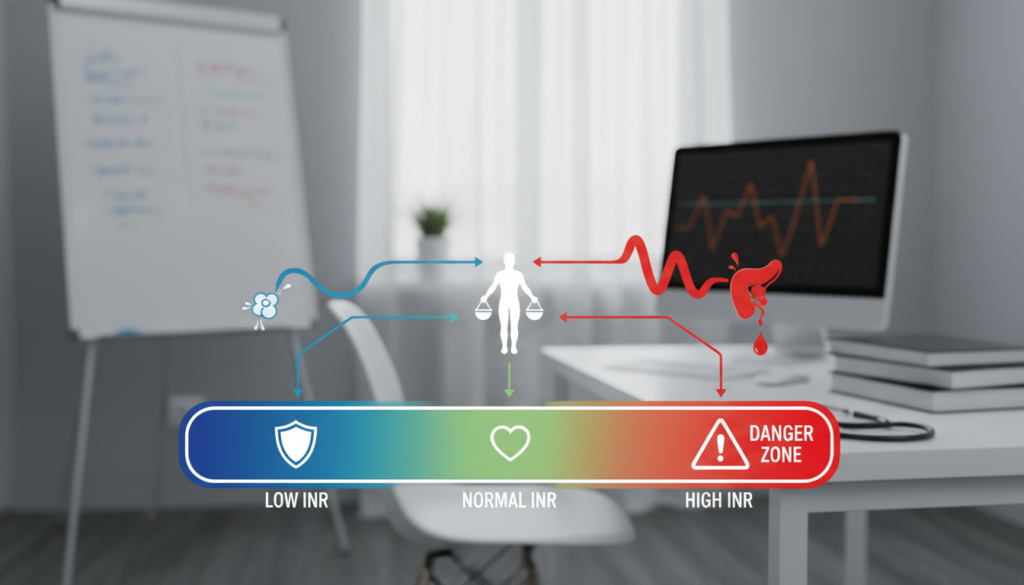
INR values that are too high or too low can be dangerous. It’s important to know when these levels are a problem. Both high and low INR levels can be risky for patients.
Consequences of High INR
A high INR means blood clots slowly. This makes it harder for blood to clot, increasing the risk of bleeding. If the INR is over 4.9, the risk of serious bleeding grows.
High INR can cause:
- Intracranial hemorrhage
- Gastrointestinal bleeding
- Hematuria (blood in urine)
- Prolonged bleeding from minor wounds
Consequences of Low INR
A low INR means blood clots too quickly. This is a problem for people taking anticoagulant therapy. A study in the New England Journal of Medicine found a 3-fold risk of blood clots returning.
Low INR can lead to:
- Deep vein thrombosis
- Pulmonary embolism
- Stroke
Symptoms to Watch For
It’s important to know the signs of abnormal INR levels. The table below shows symptoms for each condition.
| Condition | Associated Symptoms | Clinical Significance |
|---|---|---|
| High INR (bleeding risk elevated) | Unusual bruising, blood in stool or urine, prolonged nosebleeds | Potential hemorrhagic emergency |
| Low INR (clotting risk elevated) | Leg swelling, chest pain, sudden shortness of breath | Possible thromboembolic event |
| Critically high INR (above 4.9) | Severe headache, confusion, vomiting blood | Life-threatening hemorrhage |
Spotting these symptoms early helps doctors act fast. Knowing when INR levels are dangerous helps keep patients safe.
How Diet Affects INR Levels
Warfarin works by blocking vitamin K in the body. This affects how blood clots. Knowing how diet impacts this is key for managing blood thinners.
Foods That Influence Anticoagulation
Some foods, like kale and spinach, can change INR levels. These foods have a lot of vitamin K:
- Kale, spinach, and collard greens
- Broccoli, Brussels sprouts, and cabbage
- Edamame and soybeans
- Parsley and watercress
- Green tea
Drinking cranberry or grapefruit juice might also affect warfarin. But, the science is not clear. Drinking too much alcohol can also mess with INR levels.
Importance of Consistency in Vitamin K Intake
It’s not about cutting out all vitamin K foods. What matters most is eating the same amount every day. This helps keep INR levels steady. By keeping track of vitamin K and INR, doctors can better manage treatment.
Herbal Supplements and Their Impact
Some herbal products can mess with warfarin’s effect. Ginseng, St. John’s Wort, and coenzyme Q10 are examples. Most multivitamins have vitamin K and E, which can affect blood clotting.
Any big change in diet, supplements, or alcohol use needs a doctor’s advice before starting.
Understanding how diet affects INR levels helps in managing blood thinners better. It leads to better health outcomes in the long run.
Blood Tests and INR Monitoring Frequency
Regular PT/INR tests are key to safe use of anticoagulants. How often to test INR depends on many things. These include how long you’ve been on the therapy, the dose, and your health.
The American College of Chest Physicians (ACCP) stresses the need for patient education. They say it’s important for patients to be involved in testing.
Initial Monitoring After Starting Warfarin
At the start of therapy, you’ll need to have PT/INR tests several times per week. This helps doctors find the right dose for you. As your INR values get closer to the target, tests will be less often.
Routine Monitoring Guidelines
After you find a stable dose, tests are needed every three to four weeks. You can get tested at clinics, point-of-care sites, or even at home. The ACCP says tests should not be more than four weeks apart if your INR is stable.
| Phase of Therapy | PT/INR Testing Frequency | Clinical Rationale |
|---|---|---|
| Initial (first 1–2 weeks) | 2–3 times per week | Dose titration and response assessment |
| Early stabilization (weeks 3–8) | 1–2 times per week | Confirming dose consistency |
| Stable maintenance | Every 3–4 weeks | Ongoing therapeutic range verification |
When to Test More Frequently
There are times when you need more tests. These include:
- Starting or stopping drugs that affect warfarin
- Being sick, having an infection, or a stomach problem
- Changing what you eat, which affects vitamin K
- Seeing signs of bleeding or clotting
It’s important to know these situations. They can affect your INR levels, as we’ll see in the next parts of this article.
INR Testing Methods
There are many ways to measure the International Normalized Ratio (INR). Each method has its own time, accuracy, and how easy it is for patients to get. Knowing these differences helps pick the best way to check INR, like when looking at common blood test codes like PT/INR.
In-Clinic Tests vs. Home Testing Kits
A lab INR test is the gold standard for checking blood clotting. It takes blood from a vein, sends it to a lab, and then processes it. It can take hours or even a whole day to get results.
Point-of-care INR devices use a small blood sample from a finger. You get results in just minutes. Home testing kits work the same way, letting you check your INR at home. But, you need to meet certain rules set by insurance and doctors to use them.
Accuracy and Reliability of Different Methods
Point-of-care INR devices might show too high or too low INR values. They can make mistakes, like when you have certain antibodies. But, some devices have checks to make sure they work right, like using resazurin.
Pros and Cons of Each Testing Method
| Feature | Laboratory INR Test | Point-of-Care INR / Home Testing |
|---|---|---|
| Accuracy | Highest (gold standard) | Slightly lower; variable at extremes |
| Turnaround Time | Hours to one day | Minutes |
| Convenience | Requires clinic or lab visit | Performed at bedside or home |
| Cost per Test | Lower per individual test | Higher device and strip costs |
| Testing Frequency | Less frequent due to logistics | Allows more frequent measurements |
| Patient Mobility Impact | Challenging for limited mobility | Ideal for homebound patients |
INR home testing and point-of-care devices have big benefits:
- They give quick results for making decisions.
- They help patients stick to their treatment plans.
- They can lower the risk of blood clots and bleeding.
- They are great for patients who can’t easily go to a lab.
Understanding INR in Special Populations
Some groups need extra care when looking at INR values. Age, organ function, and how the body handles drugs all play a part. These factors make it harder to understand INR in certain cases.

INR Monitoring in Elderly Patients
Monitoring INR in older adults is tricky. They face changes in liver function, take more drugs, and eat differently. This makes them more sensitive to certain medicines.
Older people often need more frequent testing to keep their INR in the right range. Their bodies process drugs and proteins differently, leading to unpredictable effects.
Adjustments for Kidney Disease
For those with kidney disease, checking INR is key. Kidney problems affect how drugs are removed and how blood clots. This can make INR levels go up.
- Less drug removal can make anticoagulants stronger
- Uremia makes platelets less sticky, raising bleeding risk
- Medicines for kidney issues can change how warfarin works
Considerations for Liver Disease Patients
Interpreting INR in liver disease is tricky. The liver makes clotting factors and breaks down warfarin. People with liver problems often have higher INR values, even without taking anticoagulants.
This situation is tricky. High INR values don’t always mean the blood is clotting less. The risk of blood clots can stay high, even with high INR levels. The usual INR tests aren’t perfect for liver problems.
| Population | Primary INR Challenge | Clinical Consideration |
|---|---|---|
| Elderly (≥65 years) | Increased drug sensitivity | More frequent monitoring intervals |
| Chronic Kidney Disease | Altered drug elimination | Platelet dysfunction and bleeding risk |
| Liver Disease | Baseline INR elevation | INR does not reflect true coagulation status |
Interpreting INR Results
Getting INR results right is key to checking how blood clots in people on or off blood thinners. The number shows how long it takes for blood to clot compared to a standard. Each number means something different based on the patient, the goal range, and their health.
What Different INR Levels Indicate
First, we need to know what each INR number means. An INR of 1.0 is normal. Numbers above the goal mean blood clots too slowly, which can lead to bleeding. Numbers below the goal mean blood clots too fast, which can cause clots.
| INR Range | Clotting Status | Primary Clinical Concern |
|---|---|---|
| Below 1.0 | Hypercoagulable | Elevated thrombotic risk |
| 1.0 | Normal coagulation | Baseline reference value |
| 1.1–1.9 | Mildly prolonged | Subtherapeutic if on anticoagulants |
| 2.0–3.0 | Therapeutic (most indications) | Balanced anticoagulation |
| Above 4.0 | Significantly prolonged | Increased hemorrhagic risk |
Understanding the Clinical Implications
INR results mean more than just checking blood thinners. For people not on blood thinners, an odd INR might show vitamin K issues, clotting problems, or other health issues. Things like poor digestion or long antibiotic use can also affect vitamin K levels.
The American College of Cardiology stresses that INR results must be seen as part of the whole picture, not just a number.
Importance of Communication with Healthcare Providers
Getting INR results right needs all the facts. Tell your doctor about all meds, supplements, and diet changes. These can change how tests work and help doctors make better choices.
Common Medications That Affect INR
Many drugs can change the INR value. Warfarin drug interactions are a big worry in anticoagulant therapy. Warfarin is broken down by cytochrome P450 enzymes. Any drug that changes these enzymes can affect blood clotting in unpredictable ways.
Drug Interactions with Warfarin
Some drugs can make INR go up or down. Here are some examples from medical studies:
| Effect on INR | Drug Class | Examples |
|---|---|---|
| Increases INR | Antibiotics | Cotrimoxazole, metronidazole, fluoroquinolones, macrolides |
| Increases INR | Antifungals | Fluconazole |
| Increases INR | Cardiac agents | Amiodarone |
| Increases INR | SSRIs | Fluoxetine, sertraline |
| Decreases INR | Antiepileptics | Carbamazepine, phenobarbital, phenytoin |
| Decreases INR | Herbal supplements | St. John’s Wort |
| Decreases INR | Immunosuppressants | Azathioprine |
Antibiotics often affect INR because they change gut bacteria. This is important because gut bacteria help make vitamin K. NSAIDs like ibuprofen and naproxen can also increase bleeding risk.
Importance of Medication Reviews
It’s key to check all medications regularly. This includes prescription drugs, supplements, and over-the-counter items. Adding a new drug to a warfarin regimen needs careful review for possible interactions.
Adjusting Doses Based on New Medications
When a new drug is added or stopped, watch INR levels closely. Warfarin interactions can take time to show up. Testing often during these times helps catch problems early.
Managing INR for Optimal Health
To keep INR stable, patients and doctors must work together. Keeping INR in the right range helps avoid blood clots and bleeding. Things like when you take your medicine, what you eat, and regular check-ups are important.
Strategies for Maintaining Stable INR Levels
Sticking to your warfarin schedule is key. Taking it at the same time every day helps your body absorb it better. If you miss a dose, talk to your doctor within eight hours.
Things that can change your INR include:
- Changes in how much vitamin K you eat
- New or different medicines
- Health problems with your liver or kidneys
- Not taking your medicine as planned
Importance of Regular Check-Ups
Regular blood tests help catch any INR problems early. This helps keep your blood thinning safe and effective. How often you need these tests depends on your health.
| Clinical Scenario | Suggested Monitoring Frequency | Primary Objective |
|---|---|---|
| Newly initiated anticoagulant therapy | Every 2–3 days | Establish therapeutic range |
| Stable therapeutic INR over 4+ weeks | Every 4–6 weeks | Confirm ongoing stability |
| Recent dose adjustment or new medication | Within 3–7 days | Assess impact on INR |
| Acute illness or dietary change | Within 3–5 days | Detect possible INR change |
Partnering with Healthcare Providers
Good communication with your healthcare team is vital. Tell them about any diet changes, new medicines, or missed doses. This helps your doctor adjust your treatment as needed.
Current Guidelines for INR Management
Many professional groups have set INR management guidelines in the U.S. These rules cover how to collect blood samples, test accuracy, and patient roles in monitoring. Keeping up with these guidelines is key for safe and effective treatment.
Recent Updates in Anticoagulation Guidelines
The Clinical and Laboratory Standards Institute (CLSI) updated its 2017 guidelines. They say blood samples should go into light blue top tubes with 3.2% sodium citrate. Tubes need to be at least 90% full for accurate results.
Also, be aware that heparin from vascular devices can mess up INR results.
Quality checks in the U.S. and Europe compare local lab results to a median target. Results should be within 15% of the median to be considered good.
Recommendations for Healthcare Professionals
The American College of Chest Physicians (ACCP) warfarin guidelines highlight the role of patient involvement. When patients are active in their care, outcomes improve and costs are lower.
| Guideline Source | Focus Area | Key Recommendation |
|---|---|---|
| CLSI (2017) | Specimen Collection | 3.2% sodium citrate tubes filled to 90% capacity |
| ACCP | Patient Involvement | Engage patients in INR testing and dosing decisions |
| External QA Programs | Laboratory Accuracy | Results within ±15% of peer group median |
Patient Education and Support Resources
Good anticoagulation plans need patients who know why they’re getting regular tests. The ACCP offers easy-to-understand materials on the importance of INR tests.
Patient self-testing and self-management programs have shown real benefits in keeping INR levels in the right range.
Having access to warfarin guidelines and support programs helps patients and doctors work together better. This is important for the future of INR testing.
Future Trends in INR Testing
The world of anticoagulation monitoring is changing fast. New tech and medicines are changing how we check and manage blood clotting. Soon, INR testing will use smarter devices, more DOACs, and focus on what’s best for each person.
Advances in Point-of-Care Testing
POC devices are getting better at giving accurate results. They now have electronic quality control systems and check test strips. This makes sure readings are right at the moment they’re taken.
Letting patients test themselves can help control INR better. It also lowers the chance of bad events. This is shown in the Journal of Thrombosis and Haemostasis.
Innovations in Anticoagulant Therapy
DOACs like rivaroxaban and dabigatran are changing how we treat blood clots. They don’t need regular INR checks like warfarin does. Warfarin is best for some, like those with mechanical heart valves.
But for everyone on vitamin K antagonists, checking INR is key.
| Feature | Warfarin (VKA) | DOACs |
|---|---|---|
| Routine INR Monitoring | Required | Not required |
| Dietary Restrictions | Vitamin K consistency needed | Minimal |
| Drug Interactions | Numerous | Fewer |
| Mechanical Heart Valve Use | Approved | Not approved |
Potential for Personalized Medicine
Genetics are helping us tailor anticoagulation. Genes like CYP2C9 and VKORC1 affect how warfarin works. Soon, we might use genetic info to set the right dose for each person.
Research is ongoing to improve how we monitor and treat blood clots. This includes better INR tests and new ways to manage anticoagulation.
Conclusion on INR Blood Test Importance
The INR blood test is key for those on long-term anticoagulation. It helps manage conditions like atrial fibrillation and venous thromboembolism. Knowing its importance helps keep patients safe from bleeding or clotting.
Key Takeaways for Patients
Regular INR tests help adjust medication safely. Learning about what affects INR results is important. This includes diet, medications, and being sick.
Seeing signs of bleeding or clotting early is critical. It means getting help quickly.
Encouraging Proactive Health Management
Working closely with healthcare teams is important. It helps keep treatment on track. Staying on schedule with blood tests and talking about health changes is key.
Being involved in your care can prevent serious issues. It’s a proven way to improve health outcomes.
Resources for Further Information
There are many trusted resources for anticoagulation information. The American Heart Association has lots of educational materials. Pathology Tests Explained has clear info on INR testing.
State and federal health departments also offer helpful guides. These guides are available in many languages, helping patients across the U.S.