Nearly 2 to 3 million Americans take anticoagulant medications each year. The prothrombin time PT test is key to check if their blood clots safely. This test is vital in many places like emergency rooms and clinics.
A PT blood test shows how fast blood clots. Normal times are between 9 and 14 seconds. But, times can vary by lab.
The test looks at how the blood clots through the extrinsic pathway. This pathway involves fibrinogen, factor V, factor VII, factor X, and prothrombin itself.
To make clotting times the same everywhere, the International Normalized Ratio (INR) was created. A normal INR is between 0.8 and 1.2 for people not on blood thinners. This helps doctors compare test results from different labs.
Getting a blood sample is easy. A healthcare worker takes it with a needle or a fingerstick. It only takes less than five minutes.
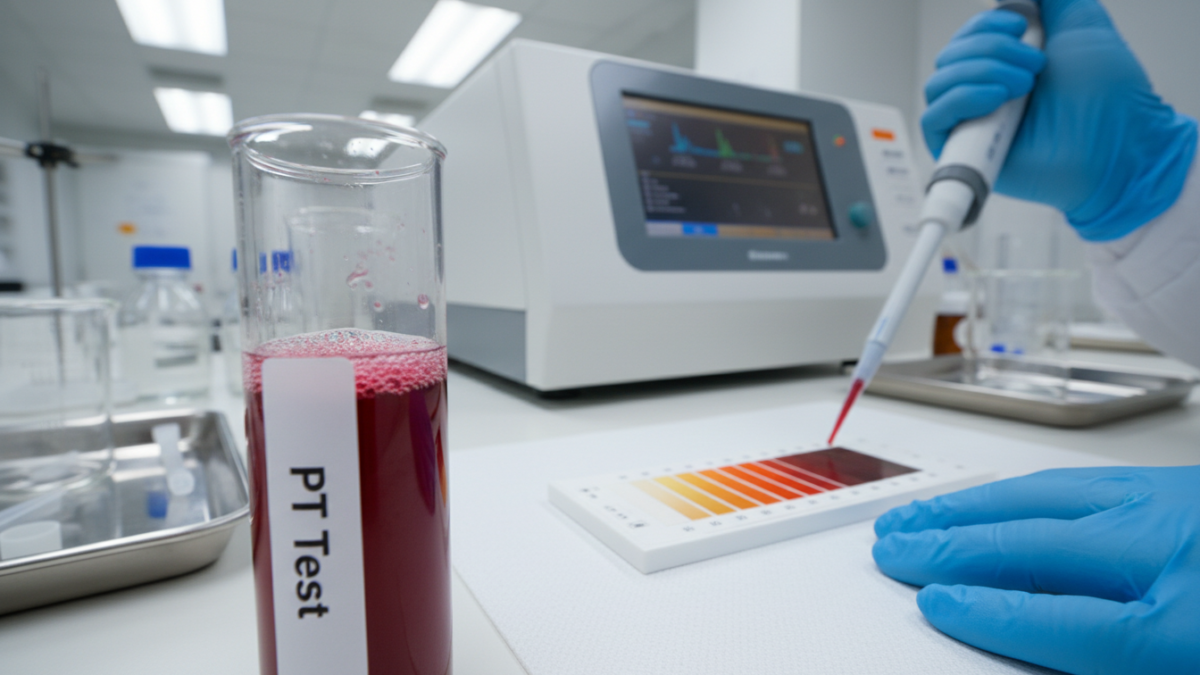
After getting the sample, it’s tested with special reagents. These reagents start the clotting process and measure how long it takes in seconds.
PT test results are very useful. They help check if warfarin is working, find bleeding disorders, see how the liver is doing, and check vitamin K levels. They also make sure blood clots right before surgery. This makes the PT test very important in medicine.
Key Takeaways
- The prothrombin time PT test measures how many seconds blood takes to form a clot, with normal values generally between 9 and 14 seconds.
- A PT blood test evaluates the extrinsic coagulation pathway involving fibrinogen, factors V, VII, X, and prothrombin.
- The International Normalized Ratio (INR) standardizes clotting time results across laboratories, with a normal range of 0.8 to 1.2.
- Sample collection for the test requires less than five minutes through venipuncture or fingerstick methods.
- Prolonged PT may indicate issues related to liver function, vitamin K deficiency, bleeding disorders, or anticoagulant therapy.
- The PT test is among the most commonly ordered coagulation assessments in both inpatient and outpatient settings across the United States.
What is Prothrombin Time (PT)?
Prothrombin time is a key test in medicine. It shows how long it takes for blood to clot. It helps check the extrinsic and common pathways of blood clotting.
This test is important for understanding blood clotting factors. It helps see if the body can stop bleeding too much.
Definition of Prothrombin Time
Prothrombin time measures how long it takes for plasma to clot. It uses tissue factor and calcium. It checks the activity of several blood clotting factors.
Prothrombin (Factor II) is a key protein made by the liver. It’s important in this process.
The PT test looks at these clotting factors:
- Factor II (prothrombin)
- Factor V (proaccelerin)
- Factor VII (proconvertin)
- Factor X (Stuart-Prower factor)
- Factor I (fibrinogen)
The normal range for PT is 11 to 13.5 seconds. But, this can change based on the test used.
Importance in Blood Coagulation
Blood clotting factors work together in a cascade. Each factor activates the next one. Problems with these factors can cause bleeding or blood clots.
| Clinical Application | Purpose |
|---|---|
| Coagulation deficiency screening | Identifies reduced or absent clotting factor activity |
| Anticoagulant therapy monitoring | Evaluates warfarin dosing effectiveness |
| Liver function assessment | Reflects hepatic synthesis capacity of clotting proteins |
| Preoperative evaluation | Screens for bleeding risk before surgical procedures |
PT testing helps find problems like vitamin K deficiency or bleeding disorders. It’s used to check if the liver is working right. It’s also used before surgery to see if there’s a risk of bleeding.
How is the PT Test Conducted?
The PT blood test has two main parts: getting a blood sample and testing it. Each step is done carefully to get right results. Knowing these steps helps us understand how blood clotting is checked.
Sample Collection Process
The usual way to get blood is venipuncture. A phlebotomist puts a small needle in a vein in your arm. Blood goes into a tube with sodium citrate to keep it good.
This whole thing takes less than five minutes.
There’s also a fingerstick method for quick tests. A lancet pricks your finger, and a blood drop is put on a strip. This is often used for people on warfarin who need to check their levels often.
Laboratory Methods for Testing
When the blood gets to the lab, it’s split from the rest of the blood. Then, calcium chloride and tissue thromboplastin are added. The time it takes for a clot to form is measured.
Coagulometers do this by watching for changes as the clot forms. The results are given in seconds and as an INR. The INR makes sure results are the same no matter where they’re tested.
- Prothrombin time in seconds
- International Normalized Ratio (INR), which standardizes results across different laboratory testing methods and reagent systems
| Collection Method | Setting | Sample Type | Typical Turnaround |
|---|---|---|---|
| Venipuncture | Hospital or outpatient lab | Citrated plasma | 1–2 hours |
| Fingerstick (Point-of-Care) | Clinic or home | Whole blood on test strip | Under 1 minute |
“The PT assay remains one of the most widely performed coagulation screening tests in clinical laboratories worldwide.” — American Society for Clinical Pathology
The PT blood test uses the INR system to make sure results are the same everywhere. This is key for doctors to understand the results correctly.
Understanding Normal PT Range
Understanding prothrombin time results is key. The PT normal range changes based on the lab, reagents, and methods used. This part talks about standard values and what affects PT results.
Defining Normal Values
The PT normal range is usually 9 to 13 seconds or 10 to 14 seconds. This depends on the thromboplastin reagent and the equipment used. Each lab sets its own range after doing its own tests.
For people not on blood thinners, the International Normalized Ratio (INR) is between 0.8 to 1.2. The INR helps make PT results more consistent across labs.
| Parameter | Reference Range | Clinical Context |
|---|---|---|
| Prothrombin Time (PT) | 9–14 seconds | Varies by laboratory methodology |
| INR (non-anticoagulated) | 0.8–1.2 | Standardized across laboratories |
Factors Affecting PT Values
Many things can change PT values. Eating foods rich in vitamin K, like green leafy veggies, affects coagulation factors II, VII, IX, and X.
Some fats, like those in soybean oil, can also affect vitamin K absorption. Drinking alcohol can harm the liver’s ability to make clotting proteins.
- Medications such as aspirin and corticosteroids
- Herbal supplements with anticoagulant properties
- Individual variability in drug metabolism
- High-fat dietary patterns
These factors mean lab ranges need careful thought. This is important when comparing results with other coagulation tests.
Implications of Prolonged PT
A high prothrombin time means blood clots slower than it should. If PT is over 14 seconds, it points to a problem in the extrinsic or common coagulation pathway. Finding out why PT is high is key to figuring out what’s wrong.

Possible Causes of Increased PT
Many things can make PT go up. Liver diseases like cirrhosis, hepatitis, and liver failure lower clotting factor production. Vitamin K deficiency also affects the production of factors II, VII, IX, and X.
Warfarin, a blood thinner, is a common reason for high PT. It’s used to prevent blood clots. Conditions like celiac disease or inflammatory bowel disease can also raise PT by reducing vitamin K absorption.
Associated Health Conditions
Many health issues can lead to high PT. Here are some main ones:
- Disseminated intravascular coagulation (DIC) uses up clotting factors, causing bleeding and clotting problems
- Inherited bleeding disorders affect factor levels or function
- Bone marrow problems, like leukemia, can lower factor production
- Autoimmune diseases can mess with the coagulation process
| Prolonged PT Cause | Mechanism | Affected Clotting Factors |
|---|---|---|
| Liver Disease | Decreased factor synthesis | I, II, V, VII, IX, X |
| Vitamin K Deficiency | Impaired factor carboxylation | II, VII, IX, X |
| Warfarin Therapy | Vitamin K antagonism | II, VII, IX, X |
| DIC | Consumption of clotting factors | Multiple factors |
| Malabsorption Syndromes | Reduced vitamin K uptake | II, VII, IX, X |
According to the American Society of Hematology, prolonged PT results should always be interpreted in conjunction with clinical history and complementary coagulation studies.
Finding the cause of high PT helps doctors do the right tests. It helps them understand what’s wrong with the blood.
Symptoms Indicating Prolonged PT
A prolonged prothrombin time often shows signs before lab tests confirm it. Spotting bleeding disorder symptoms early is key. It helps figure out when to do a PT test and what tests to run.
Common Signs to Watch For
Many signs can point to a coagulation problem linked to prolonged PT. These symptoms can be mild or severe, and they can happen anywhere:
- Unexplained or excessive bruising from minor contact
- Prolonged bleeding from small cuts or wounds
- Recurrent or unusually heavy nosebleeds
- Spontaneous gum bleeding without dental trauma
- Abnormally heavy menstrual periods (menorrhagia)
- Visible blood in urine (hematuria) or stool (hematochezia)
- Joint swelling and pain suggestive of hemarthrosis
When many signs show up at once or don’t go away, it’s time to think about a PT test.
When to Seek Medical Attention
Some symptoms need quick medical help. The table below shows symptoms and how urgent they are.
| Symptom | Possible Significance | Urgency Level |
|---|---|---|
| Persistent bleeding from wounds | Clotting factor deficiency | Moderate |
| Multiple unexplained bruises | Platelet or factor dysfunction | Moderate |
| Blood in urine or stool | Internal bleeding source | High |
| Leg swelling with pain | Deep vein thrombosis | High |
| Chest pain with breathing difficulty | Pulmonary embolism | Emergency |
| Sudden weakness, speech difficulty | Stroke | Emergency |
Knowing these symptoms and when to test for PT helps get the right diagnosis fast. This is important for treatment.
How to Prepare for a PT Test
Getting ready for a PT test is very important. Some foods, drinks, and medicines can change how blood clots. Knowing this before the test helps get accurate results.
You don’t need to fast for just a PT test. It’s best to take the test in the morning. This helps keep the results the same if you need to test again.
Dietary Restrictions
Vitamin K affects how blood clots and can change PT test results. You might need to avoid foods high in vitamin K before the test. Foods like kale, broccoli, and liver are examples.
- Kale and turnip greens
- Broccoli and spinach
- Liver and soy products
- Chickpeas and green tea
Drinking alcohol can also affect blood tests. Tell your doctor if you’ve had alcohol recently. This helps them understand your test results better.
Medications to Avoid
Telling your doctor about all your medicines is important. This includes prescription drugs, over-the-counter medicines, vitamins, and supplements. It’s also important to mention any illegal drugs.
| Substance Category | Examples | Effect on PT |
|---|---|---|
| Anticoagulants | Warfarin | Prolongs PT significantly |
| Anti-inflammatory Agents | Aspirin | Alters platelet function and coagulation |
| Corticosteroids | Prednisone | May affect clotting factor synthesis |
| Supplements | Vitamin K, fish oil | Shortens or prolongs PT depending on type |
If you take warfarin, wait until after the test to take your dose. This helps the test show your body’s real state, not just the medicine’s effect.
Accurate coagulation testing depends not only on laboratory precision but on thorough pre-analytical preparation by both clinician and patient.
Knowing what foods and medicines to avoid is key for good PT test results. This information helps doctors make better treatment plans for you.
Treatment Options for Abnormal PT Results
When prothrombin time is not normal, doctors do a full check-up. They look at why it’s off, the patient’s history, and how bad it is. A team of doctors, like hematologists and hepatologists, work together to find the best way to fix it.
Addressing the Underlying Causes
Fixing abnormal PT starts with finding and fixing the main problem. This can be liver disease, not enough vitamin K, or genetic clotting issues. For people on warfarin, doctors adjust the dose based on INR levels to keep it right.
- INR below the target range may prompt a dose increase of the anticoagulant.
- INR above the target range may necessitate dose reduction or temporary discontinuation.
- Hepatic conditions require management of the underlying liver disease itself.
“Correction of prolonged PT should be guided by clinical context, not the laboratory value alone.” — American Society of Hematology, Clinical Guidelines
Medications to Improve Coagulation
There are medicines that help when PT is off.
| Agent | Clinical Use | Route |
|---|---|---|
| Vitamin K (Phytonadione) | Corrects vitamin K deficiency-related prolongation | Oral or intravenous |
| Fresh Frozen Plasma (FFP) | Replaces multiple clotting factors acutely | Intravenous infusion |
| Clotting Factor Concentrates | Targets specific factor deficiencies (e.g., Factor VII) | Intravenous infusion |
Getting advice from specialists is key. Every case of abnormal PT needs a special plan. Doctors keep checking lab results and how the patient is doing to make decisions.
PT Test in Comparison to Other Coagulation Tests
The PT test is one of several tests used to check the blood’s clotting process. Each test looks at a different part of clotting. Knowing how PT and INR compare helps us understand their uses in medicine.
Difference Between PT and INR
PT measures how fast plasma clots through the extrinsic pathway. INR, or International Normalized Ratio, makes PT results the same everywhere. This is because it uses the International Sensitivity Index (ISI).
So, when we compare PT and INR, we see that INR makes results more consistent. This is important for comparing tests worldwide.
How PT Relates to aPTT
PT and aPTT are two different tests. PT looks at the extrinsic pathway. aPTT, on the other hand, looks at the intrinsic pathway. It checks factors VIII, IX, XI, and XII.
Doctors often use both tests together. This gives a full picture of how blood clots. Here’s a list of tests and what they check:
| Test | Pathway Assessed | Normal Range | Primary Clinical Use |
|---|---|---|---|
| PT | Extrinsic | 11–13.5 seconds | Warfarin monitoring, liver function |
| aPTT | Intrinsic | 25–35 seconds | Heparin monitoring, factor deficiencies |
| Thrombin Time | Common (final) | 14–19 seconds | Fibrinogen conversion assessment |
| D-Dimer | Fibrinolysis | <500 ng/mL | Thromboembolism screening |
| Anti-Factor Xa | Common | 0.5–1.0 IU/mL (therapeutic) | LMWH therapy monitoring |
Choosing the right test depends on what the doctor needs to know. By using PT and aPTT together with other tests, doctors get a complete view of blood clotting.
Monitoring PT in Patients
Checking prothrombin time often is key for those on blood thinners and with clotting issues. The prothrombin time test shows how fast blood clots. It gives results in seconds and INR values. Keeping INR in a safe range helps avoid bleeding or clots.
Conditions Requiring Regular Assessment
Many situations need ongoing PT and INR checks. These include:
- Atrial fibrillation patients aiming for an INR of 2.0–3.0
- Mechanical heart valve patients needing a higher INR
- Those with deep vein thrombosis and pulmonary embolism on anticoagulants
- Liver disease patients, as PT shows liver function
- Disseminated intravascular coagulation in the acute phase
Knowing blood test codes like PT/INR ensures the right tests are ordered and billed correctly.
Frequency of Testing
How often to test PT depends on the patient’s health and treatment stage. Here’s a common testing schedule for warfarin monitoring:
| Clinical Phase | Typical Testing Interval | Rationale |
|---|---|---|
| Warfarin initiation | Daily to every 2–3 days | Quick dose changes are needed |
| Early stabilization | Weekly | INR is getting closer to the target |
| Stable therapeutic INR | Every 4 weeks | Results are consistent |
| Diet or medication change | Within 3–7 days of change | New factors may affect INR |
| Acute illness or hospitalization | Daily | There’s a higher risk of INR changes |
Home monitoring devices let some patients test themselves between lab visits. This helps catch INR changes sooner. Adjusting PT testing frequency is based on each patient’s health and clotting values.
Lifestyle Changes for Healthy PT Levels
Some lifestyle changes can help keep prothrombin time stable. For those on anticoagulation therapy, daily habits are key. Eating, moving, and what you use can affect your liver and clotting factors.
Dietary Recommendations
Vitamin K foods like kale and spinach are important for blood clotting. Patients on warfarin should eat these foods in the same amounts every day. This keeps their INR and PT stable. Eating too much or too little can mess with blood clotting.
Drinking too much alcohol can hurt your liver. This makes it hard for your body to make clotting factors. Drinking water helps keep your blood flowing right.
| Dietary Factor | Effect on PT/INR | Clinical Consideration |
|---|---|---|
| Green leafy vegetables | May decrease PT if intake increases suddenly | Maintain consistent daily portions |
| Alcohol | May prolong PT through liver impairment | Limit consumption to protect hepatic function |
| Hydration | Supports stable blood viscosity | Ensure adequate fluid intake daily |
Exercise Guidelines
Exercise is good for your blood vessels and lowers clot risk. It helps your blood flow better and can help you manage your weight. This makes it easier to get the right dose of anticoagulants.
Quitting smoking is very important for your blood. Smoking damages your blood vessels and changes how platelets work. Taking your medicine as directed is also key to keeping your PT levels right.
Advanced Testing for Prothrombin Function
When a PT test shows odd results, doctors might do more tests. These tests look for rare clotting problems and inherited conditions. They can’t be found with just a basic PT test.
Additional Tests for Clotting Disorders
There are many tests for blood clotting. A thrombin time test checks how well fibrinogen works. It also looks at how much fibrinogen is in the blood.
Tests for specific clotting factors can find exact problems. Lupus anticoagulant tests find inhibitors that make clotting take longer. But, they don’t cause bleeding.
Special labs do mixing studies to figure out if a problem is a deficiency or an inhibitor. They also check protein C, protein S, and antithrombin levels. This helps find out if someone is at risk for blood clots.
| Test Name | Purpose | Primary Clinical Use |
|---|---|---|
| Thrombin Time | Evaluates fibrinogen function | Fibrinogen disorders |
| Factor Assays | Measures specific factor levels | Identifying factor deficiencies |
| Lupus Anticoagulant | Detects acquired inhibitors | Antiphospholipid syndrome |
| Mixing Studies | Differentiates deficiencies from inhibitors | Abnormal PT/aPTT workup |
| Protein C/S Levels | Evaluates natural anticoagulants | Thrombophilia screening |
Genetic Testing Options
Genetic tests are key in finding inherited clotting problems. They look for Factor V Leiden and the prothrombin gene mutation (G20210A). Both increase the risk of blood clots.
Inherited thrombophilias account for a significant proportion of unexplained venous thrombotic events in patients under 50 years of age.
Genetic tests are very important if there’s a family history of clotting. They work with advanced coagulation tests to understand a patient’s blood clotting. This helps doctors know the risk and how to monitor it over time.
Frequently Asked Questions About PT Test
Many people have questions about PT tests. They want to know about testing and what the results mean. Here, we answer the most common questions and clear up any confusion.
Common PT Testing Questions
One big question is about the difference between lab tests and quick tests. Quick tests give results fast, in just minutes. Lab tests take longer, sometimes hours.
Some tests use blood from a finger prick. This is handy for people on blood thinners who need to check their levels often.
Lab results can look different because of how they’re made. Each lab has its own idea of what’s normal. Always check the lab’s results to understand your PT test.
| Testing Method | Sample Type | Turnaround Time | Primary Use |
|---|---|---|---|
| Laboratory-Based PT | Venous blood draw | Hours to 1 day | Comprehensive coagulation assessment |
| Point-of-Care PT/INR | Finger stick capillary blood | Minutes | Anticoagulant therapy monitoring |
Misconceptions About PT Results
Some think a normal PT means no bleeding disorders. But, PT only checks a few parts of blood clotting. It’s not enough to find all problems.
The INR is just for checking warfarin levels. It’s not for checking blood clotting in people not on warfarin. This can cause confusion if not understood.
- PT is not the same as bleeding time, which is not reliable or useful.
- If PT is high and you’re not on blood thinners, it could mean liver problems or lack of vitamin K.
- You need to test again to confirm any abnormal results before making any decisions.
Knowing what PT tests can and can’t do is key to making good medical decisions.
Conclusion: The Importance of Knowing Your PT Level
The PT test is very important in medicine. It shows how well blood clots and if there’s a risk of bleeding or clotting. Normal PT values are between 9 and 14 seconds, but each lab has its own range. The PT/INR test is key for checking how well blood clots, which is important for patients on warfarin.
Summary of Key Points
A long PT can mean liver disease, vitamin K lack, or problems with clotting factors. It also shows if medicines are affecting blood clotting. Before surgery, a PT test helps find out if there’s a risk of bleeding.
Testing includes PT, aPTT, and special tests when needed. PT results are best understood with symptoms, medical history, and other lab tests.
Encouragement for Regular Check-ups
Checking PT and INR regularly is key to avoid bleeding or clotting problems. Diet, alcohol, and some medicines can change these results. There are home PT/INR test kits, but always check with a doctor.
Working together, patients and doctors can decide how often to test and make the best choices for each person.