
Basophils are a small part of our white blood cells, making up less than 1%. They are often overlooked in blood tests. But, they play a big role in allergies and inflammation, affecting many people.
Basophils are made in the bone marrow and take about a week to grow. They live in the blood for about 60 hours. Each cell has special stuff inside that helps fight off infections and control blood flow.
A blood test checks how many basophils are in your blood. The normal number is between 0 and 300 cells per microliter. But, this number can change based on age, sex, and the test used.
Basophils are the least common white blood cells. They were hard to study before. But now, thanks to new technology, we know more about their role in our immune system. Learn more about basophils and their in our blood tests.
Key Takeaways
- Basophils represent less than 1% of all white blood cells, making them the rarest granulocyte in circulation.
- The basophils normal range in a standard blood test is 0 to 300 cells per microliter, with slight variation across laboratories.
- These cells contain granules filled with histamine, heparin, and peroxidase, which play a direct part in immune and allergic responses.
- A basophils blood test is typically performed as part of a complete blood count with differential.
- Reference intervals for basophil counts depend on factors such as age, sex, and laboratory-specific methodology.
- Abnormal basophil levels — whether elevated or low — may indicate conditions that warrant further clinical investigation.
What Are Basophils?
Basophils are the rarest white blood cells in humans. They make up less than 1% of all white blood cells. Despite being few, they play a big role in our immune system. Knowing about basophils in CBC results means learning about their biology and role.
Definition and Function of Basophils
Basophils are granulocytes—white blood cells with chemical-filled granules. These granules look deep purple under a microscope. Basophils are about 5 to 10 micrometers wide and have a unique S-shaped nucleus.
They have markers like CD45 and CD123. CD203c is special for basophils. Interleukin-3 (IL-3) helps grow and multiply basophils in the bone marrow.
Types of White Blood Cells
There are five main types of white blood cells in our blood. Each has a different job in fighting off infections. To spot basophils in CBC tests, we need to know how they differ from the others.
| Cell Type | Category | Approximate % of WBCs | Primary Role |
|---|---|---|---|
| Neutrophils | Granulocyte | 55–70% | Bacterial infection defense |
| Lymphocytes | Agranulocyte | 20–40% | Adaptive immunity |
| Monocytes | Agranulocyte | 2–8% | Phagocytosis and antigen presentation |
| Eosinophils | Granulocyte | 1–4% | Parasitic and allergic response |
| Basophils | Granulocyte | <1% | Allergic and inflammatory mediation |
Importance in Immune Response
Basophils help our immune system in many ways. They watch for parasites and abnormal cells. When they’re activated, they release histamine and heparin. This helps fight off infections.
“Basophils, long considered redundant, are now recognized as key orchestrators of both innate and adaptive immune responses.”
— Journal of Allergy and Clinical Immunology, 2022
Knowing about different white blood cells helps us understand basophils better. The next part will talk about the basophils blood test, its purpose, and how it works.
The Basophils Blood Test
A basophils blood test is part of a complete blood count with differential. It checks basophil levels with other white blood cells. Blood tests are the only way to find out if basophils are not normal.
Purpose of the Basophils Test
This test checks how well the immune system works. It looks at each white blood cell type in the blood. Doctors use it for allergies, inflammation, or blood problems.
How the Test is Conducted
Modern tests use automated analyzers for a 5-part differential count. These tools measure cell size and type. They also check cell details and use special stains.
- The Coulter principle to measure cell volume and diameter
- Flow cytometry to assess internal cellular complexity and granularity
- Light scatter and high electromagnetic radiofrequency for cell identification
- Cytochemistry with specialized dyes for staining distinct cell populations
The Clinical and Laboratory Standards Institute (CLSI) H20-A2 standard uses a blood smear. It requires two control tests every eight hours for accuracy.
Preparation for the Test
No special prep is needed for the test. A healthcare pro takes a small blood sample from your arm. The lab analyzes it, and results come in 24 hours.
Normal Basophil Range
Understanding basophil levels is key. We need to know the normal ranges to see if a patient’s count is okay or not. Remember, normal ranges can vary between labs, tests, and health conditions.
Understanding Basophil Levels
In healthy adults, basophils should be between 0 to 300 cells per microliter of blood. This is about 0% to 2% of all white blood cells. For adults, the count usually ranges from 0.01 × 10⁹/L to 0.08 × 10⁹/L.
If a count is over 0.1 × 10⁹/L, or more than 2% of white blood cells, it’s called basophilia. If it’s less than 0.01 × 10⁹/L, it’s basopenia.
Factors Influencing Basophil Count
Many things can change the basophil counts reported by labs:
- How counts are done (manual vs. automated)
- The type of patients being tested
- How the blood sample is handled and processed
- Any medicines or health issues the patient might have
Always check the lab’s specific ranges for the best results.
Age and Gender Differences
Basophilia or basopenia doesn’t favor one gender over the other. But, in babies and older people, the expected count might change a bit.
| Age Group | Absolute Basophil Count (×10⁹/L) | Percentage of WBC Differential |
|---|---|---|
| Neonates (0–28 days) | 0.00–0.06 | 0%–1% |
| Children (1–17 years) | 0.01–0.07 | 0%–1.5% |
| Adults (18–64 years) | 0.01–0.08 | 0%–2% |
| Older Adults (65+ years) | 0.01–0.08 | 0%–2% |
Elevated Basophil Levels
An absolute basophil count over 200 cells/µL is a clear sign of basophilia. This can happen for many reasons, some good, some not so good. Knowing what causes basophilia is key to understanding it.
Possible Causes of High Basophils
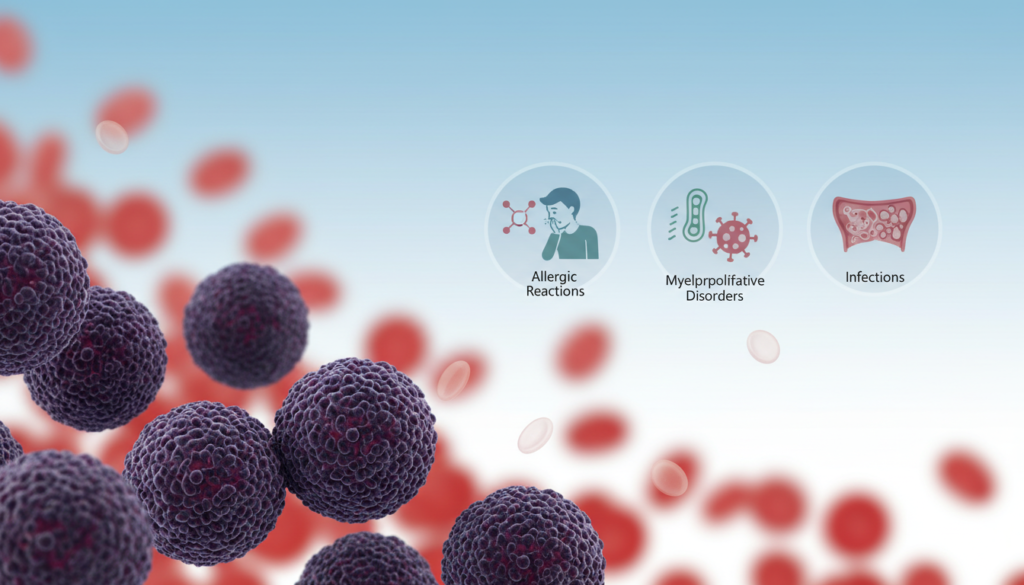
High basophils can come from many sources. Allergies to drugs, food, or things we breathe in are common. So are infections like the flu, chickenpox, and tuberculosis.
Chronic inflammation, like in inflammatory bowel disease or atopic dermatitis, also plays a role. Autoimmune conditions are another big contributor.
- Allergic reactions (drug, food, or environmental)
- Chronic infections (influenza, tuberculosis)
- Autoimmune and inflammatory disorders
- Myeloproliferative neoplasms (chronic myeloid leukemia, polycythemia vera, primary myelofibrosis, essential thrombocythemia)
- Hypothyroidism
Recognizing the Signs
The symptoms of high basophils are often not clear. You might feel feverish, tired, or just not feel right. Itching all over and swollen spleen are signs too.
Feeling hot, tired, or just not feeling well can be signs. Swollen spleen and itching after a warm shower might mean more.
Conditions Associated with Elevated Basophils
Some diseases are linked to high basophils. The table below shows these conditions and their signs.
| Condition | Category | Key Clinical Features |
|---|---|---|
| Chronic Myeloid Leukemia | Neoplastic | Basophils ≥20% of WBCs in accelerated phase; left-shifted neutrophilia |
| Polycythemia Vera | Neoplastic | Overproduction of red blood cells; thrombotic risk |
| Hypothyroidism | Endocrine | Weight gain, constipation, hoarse voice, brittle hair |
| Autoimmune Inflammation | Inflammatory | Inflamed joints, fever, hair loss, muscle pain |
| Atopic Dermatitis | Allergic/Inflammatory | Chronic skin inflammation, pruritus, eosinophilia |
Low Basophil Levels
A low basophil count is called basopenia. It happens when basophils are less than normal. Knowing why this happens is key to understanding blood tests.
Causes of Low Basophil Count
Many health issues can lead to low basophils. Some common reasons include:
- Hyperthyroidism — too much thyroid hormone can lower basophils
- Acute hypersensitivity reactions — severe allergies can quickly use up basophils
- Acute infections — infections can also lower basophils
- Autoimmune conditions — diseases like lupus can move basophils away from blood
- Fibrotic diseases — diseases like myelofibrosis can also lower basophil counts
Symptoms of Basopenia
Basopenia itself doesn’t have symptoms. But, the disease causing it does. For example, too much thyroid hormone can make you lose weight and sweat a lot. Allergies can cause hives and itching. Infections often make you feel sick and hurt.
Health Implications of Low Levels
Low basophils can mean your immune system isn’t working right. They can make healing take longer. Also, they play a role in long-lasting hives.
| Condition | Mechanism of Basopenia | Common Clinical Signs |
|---|---|---|
| Hyperthyroidism | Excess thyroid hormone suppression | Tachycardia, weight loss, sweating |
| Anaphylaxis | Rapid basophil degranulation | Hives, respiratory distress, hypotension |
| Myelofibrosis | Bone marrow scar tissue formation | Fatigue, splenomegaly, anemia |
| Systemic Lupus Erythematosus | Basophil migration to lymph nodes | Joint pain, rash, fatigue |
Finding out why basophils are low is important. It helps doctors figure out what’s wrong and how to treat it.
Interpreting Basophil Test Results
Understanding blood test results needs a careful method. It mixes new tech with doctor’s skills. Basophil tests are part of a bigger blood count check. First, the blood is analyzed in many steps before doctors get the results.
How Results are Analyzed
Special machines sort white blood cells by their size and how they scatter light. If a cell can’t be sorted right, the machine asks for a human check. A skilled person then looks at the blood under a microscope.
Looking at the blood under a microscope is key. It finds cells that machines might miss. This is important when basophil counts are off or when cells look strange.
When to Consult a Healthcare Provider
If basophil counts seem odd, doctors might call the team right away. This is because it could mean a serious myeloid neoplasm. If basophilia lasts more than six months, or with chronic anemia, more tests are needed.
Basophilia that doesn’t go away, with more neutrophils, might mean leukemia. It’s important to check the genes quickly.
Follow-Up Tests
If basophil counts stay high, more tests might be needed. These tests check for specific genes or proteins. Here are some common tests:
| Follow-Up Test | Target Mutation or Marker | Primary Associated Condition |
|---|---|---|
| BCR-ABL1 FISH | Philadelphia chromosome | Chronic myeloid leukemia |
| JAK2 V617F screening | Janus kinase 2 mutation | Polycythemia vera, primary myelofibrosis |
| CALR mutation analysis | Calreticulin gene mutation | Essential thrombocythemia, primary myelofibrosis |
| MPL mutation analysis | Thrombopoietin receptor mutation | Essential thrombocythemia, primary myelofibrosis |
| Bone marrow biopsy with karyotyping | Chromosomal abnormalities | Suspected myeloid neoplasms |
The JAK2 mutation is common in polycythemia vera. CALR or MPL mutations are found in some cases of other diseases. Each marker helps doctors figure out what’s wrong.
Basophils and Allergies
Basophils play a big role in allergies. They are key players in allergic reactions. Their actions lead to the signs we see in allergies.
Role of Basophils in Allergic Reactions
Immunoglobulin E (IgE) sticks to basophils. When an antigen meets this IgE, degranulation happens. This releases histamine, causing blood vessels to widen and swell.
Basophils also make cytokines like IL-4 and IL-13. These cytokines bring more immune cells to the area. They help in both quick and slow allergic reactions.
“Basophils, though comprising less than 1% of circulating leukocytes, exert outsized influence in orchestrating allergic inflammation.” — Journal of Allergy and Clinical Immunology, 2022
Tests for Allergies and Basophils
There are tests to check basophils and allergies:
- Basophil Activation Test (BAT) — shows how basophils react to allergens
- Complete Blood Count with Differential — counts basophils in the blood
- Serum IgE Testing — checks for IgE levels
| Condition | Basophil Involvement | Primary Mechanism |
|---|---|---|
| Atopic Dermatitis | Skin infiltration | Histamine release causing itch and inflammation |
| Allergic Asthma | Airway accumulation | Bronchoconstriction via inflammatory mediators |
| Venom Hypersensitivity | Systemic activation | Histamine-induced muscle spasm and swelling |
Treatment Options for Allergy-Induced Basophilia
Doctors manage high basophil counts in allergies. Antihistamines help with symptoms. Staying away from allergens is key.
Watching basophil levels is important. This helps doctors make the right choices for long-term allergies.
Basophils in Chronic Conditions
Basophil counts are important for more than just quick allergic reactions. They are often high in many long-term illnesses. Knowing about basophilia in chronic conditions helps doctors find and treat the root cause of the problem.
Link to Chronic Inflammatory Diseases
High basophil counts are seen in many inflammatory diseases. For example, inflammatory bowel disease and chronic skin problems often have high basophils. Myeloproliferative neoplasms also show high basophils.
These include chronic myeloid leukemia, polycythemia vera, primary myelofibrosis, and essential thrombocythemia. Each has its own signs and symptoms related to abnormal blood cell making.
| Myeloproliferative Condition | Primary Pathology | Associated Symptoms |
|---|---|---|
| Chronic Myeloid Leukemia | Excessive white blood cell production | Fatigue, night sweats, splenomegaly |
| Polycythemia Vera | Red blood cell overproduction | Fatigue, weakness, shortness of breath |
| Primary Myelofibrosis | Fibrous tissue replaces marrow | Anemia, bone pain, enlarged spleen |
| Essential Thrombocythemia | Excess platelet production | Blood clotting, tingling in extremities |
Parasites like Toxocara, Ascaris, Strongyloides, and Borrelia burgdorferi (Lyme disease) can keep basophils active for a long time. This is part of how the body fights off these parasites.
Association with Autoimmune Disorders
Basophilia is seen in many autoimmune diseases. This includes systemic lupus erythematosus and rheumatoid arthritis. These diseases often show high basophil counts when they are active.
- Joint inflammation and swelling
- Systemic fever
- Hair loss
- Muscle pain and fatigue
Studying basophils and autoimmune diseases is ongoing. This research is important for understanding these conditions better.
Research on Basophils
Basophils have become a big focus in science. Research now covers many areas, like hematology and immunology. New studies keep showing us things we didn’t know before.
Recent Studies on Basophil Function
Studies have found CD203c as a special marker for basophils. This marker is key in diagnosing certain types of leukemia. It helps tell basophils apart from other cells more accurately.
Basophils make and store histamine, which is important in allergic reactions. They also make substances that help fight off parasites and cancer. But, they don’t have many enzymes, like some other cells do.
Basophils take about seven days to grow in the bone marrow. Once they’re out, they live for about 60 hours.
Future Directions in Basophil Research
New studies are looking into how certain cytokines affect basophils. They want to know more about how things like interleukin-3 and interleukin-5 help them grow.
| Research Focus | Key Finding | Clinical Relevance |
|---|---|---|
| CD203c Marker Identification | Basophil-specific surface antigen | Chronic myeloid leukemia diagnosis |
| Cytokine Production | Histamine synthesis and storage | Hypersensitivity reaction pathways |
| Maturation Timeline | 7-day bone marrow development | Hematopoietic disorder assessment |
| Circulation Lifespan | Approximately 60 hours | Immune surveillance capacity |
| Interleukin-3 Influence | Stimulates basophil proliferation | Basophilia etiology understanding |
Studies on how basophils help fight off parasites and cancer are very exciting. They help us understand our body’s defense better.
Lifestyle Considerations
Many lifestyle factors affect how basophils work. Diet, stress, and exercise all play a part. Knowing these helps manage blood cells better.
Diet and Basophil Levels
Some foods can change how basophils work. Foods like shellfish, nuts, and dairy can cause problems. They can make basophils release histamine.
Also, some medicines can change basophil counts. Doctors often check these when blood tests show issues.
Stress Impact on Basophils
Stress can make basophils more active. This is because stress activates the HPA axis. This can lead to more basophils in the blood.
Long-term stress can cause ongoing inflammation. This can change how basophils are made and affect the immune system.
Exercise and Immune Health
Exercise can change how blood cells work. A study in the Journal of Sport and Health Science (2019) found that moderate exercise helps. But too much exercise can cause problems.
| Factor | Effect on Basophils | Mechanism |
|---|---|---|
| Food Allergen Exposure | Increased activation | IgE-mediated histamine release |
| Acute Psychological Stress | Transient elevation | HPA axis immune activation |
| Moderate Exercise | Balanced counts | Improved leukocyte circulation |
| Environmental Allergens | Increased degranulation | Allergen-triggered immune response |
| Chronic Inflammation | Sustained elevation | Prolonged cytokine signaling |
Knowing about lifestyle factors helps doctors understand test results. Regular checks are key to catching problems early.
Conclusion
Basophil levels show how well our immune system is working and if there are diseases. Blood tests during yearly check-ups give us important info on white blood cells, like basophils. Knowing the value of these tests helps find problems early.
Importance of Monitoring Basophil Levels
Watching basophil levels closely is key to finding blood diseases like myeloproliferative neoplasms and some leukemias. If basophils stay high for more than six months, it’s time for a detailed check-up. But, if they go up because of an allergy, they usually go back to normal once the cause is found.
Why is watching basophils important? It helps find blood cancers and chronic inflammation early. It also helps track how our immune system is doing over time. It helps doctors decide what tests to do next and check how well treatments are working.
Consulting with Healthcare Professionals
Talking to a doctor is key to understanding basophil test results. Doctors look at your medical history, symptoms, and test results to make a diagnosis. If they think you might have a blood cancer, they might suggest more tests.
| Clinical Scenario | Recommended Action | Specialist Involvement |
|---|---|---|
| Basophilia lasting over 6 months | Comprehensive hematologic evaluation | Hematologist |
| Allergy-related basophil elevation | Allergy-specific diagnostic testing | Allergist/Immunologist |
| Suspected myeloproliferative disorder | Bone marrow biopsy and molecular testing | Hematologist/Oncologist |
| Persistently low basophil count | Assessment of thyroid function and stress factors | Endocrinologist |
Working together, doctors and other healthcare teams give the best care. Knowing how important blood tests are helps catch problems early. This leads to better care and management plans in the long run.
FAQs about Basophils Blood Test
Many blood test questions come up when people look at their complete blood count results. This section answers common questions about basophils. It clears up misunderstandings about basophil testing and what the results mean.

Common Questions and Answers
Good lab test info helps both patients and doctors understand basophil values better. Here are answers to some common blood test questions.
| Question | Answer |
|---|---|
| What does a 1% basophil count mean? | A 1% basophil count is normal. Most people have basophil percentages between 0.5% and 1% on a differential count. |
| Is an absolute basophil count of 0.01 normal? | An absolute count of 0.01 × 10⁹/L is usually normal. It falls within the range of 0.01–0.08 × 10⁹/L, depending on the lab. |
| What conditions cause low basophils? | Acute infection is the most common reason. Systemic lupus erythematosus, hyperthyroidism, and anaphylaxis also lower basophil counts. |
Myths and Misconceptions
Many myths exist about basophil testing. It’s important to clear up these misconceptions for accurate lab test info.
- Myth: Basophil testing needs special preparation. Fact: No special prep is needed. A routine CBC with differential is enough for basophil measurement.
- Myth: Basophils only work in allergic reactions. Fact: Basophils help fight parasites, heal wounds, and prevent blood clots by releasing heparin.
This FAQ is a helpful guide. For more questions, it’s best to talk to a healthcare provider.
Additional Resources
Reliable basophil resources are key for deepening our understanding of basophils. Many established institutions and peer-reviewed journals offer detailed information on basophil biology, diagnostics, and immunology.
Where to Learn More about Basophils
The National Library of Medicine and the National Institutes of Health have vast databases. NCBI Bookshelf hosts StatPearls, a clinical reference from StatPearls Publishing in Treasure Island, Florida. It covers basophil physiology, diagnostic criteria, and related hematologic conditions.
The Clinical and Laboratory Standards Institute publishes the H20-A2 standard. This document outlines reference methodology for leukocyte differential counts, including basophils.
Recommended Reading and Websites
Many peer-reviewed journals offer valuable basophil resources. The following publications feature relevant medical references and laboratory information:
| Publication | Focus Area | Content Type |
|---|---|---|
| Journal of Leukocyte Biology | Basophil differentiation | Original research studies |
| Clinical and Experimental Allergy | Basophil allergy mechanisms | Clinical research articles |
| Archives of Pathology and Laboratory Medicine | Diagnostic pathology | Peer-reviewed research |
| Blood Transfusion | Basophil immunology | State-of-the-art reviews |
| Leukemia | Basophilic leukemia classification | Diagnostic criteria papers |
| Journal of Clinical Laboratory Analysis | Hematology analyzer technology | Technical methodology studies |
These sources offer evidence-based information for accurate basophil test interpretation. Accessing credible medical references helps us understand basophil-related findings better.
Final Thoughts
Basophils are a small but important part of our immune system. They make up less than 1% of white blood cells. A normal count is between 0 and 300 cells per microliter.
A complete blood count with differential is the best way to measure basophils. This test gives us accurate numbers.
Recap of Key Information
High basophil counts can mean allergies, infections, or inflammation. Low counts might show thyroid issues, hypersensitivity, or infections. Each change needs a doctor’s careful look.
Doctors will decide if more tests are needed. This helps them understand what the numbers mean.
Encouragement for Proactive Health Management
Getting blood tests every year is important. It helps find problems early. This is very helpful for people with long-term health issues.
It’s also good for those with allergies or autoimmune diseases. Basophil changes can show how their condition is doing. Talking to your doctor about these tests is key.
Knowing about basophil levels helps you take care of your health. But, always talk to your doctor. They can help make sense of the numbers and decide what to do next.