The complete blood count represents one of the most frequently ordered laboratory investigations in clinical medicine. It provides quantitative and qualitative data on circulating blood cells.
This standard panel includes a measured red cell count, hemoglobin, and hematocrit. It also features calculated red cell indices, a platelet count, and a white cell count. Most modern analyzers automatically generate a leucocyte differential.
The blood test serves as both a screening tool during routine health evaluations and a monitoring instrument for established conditions. Automated analyzers produce standardized results used across medical specialties.
Interpretation requires consideration of reference ranges, clinical context, and patient demographics. This reference guide presents evidence-based information on components and interpretive considerations.
Key Takeaways
- The CBC is one of the most commonly performed laboratory tests in medicine.
- It measures the quantity and size of red blood cells, white blood cells, and platelets.
- Automated analyzers provide standardized results for consistent evaluation.
- This blood test functions as a key screening and monitoring tool for health.
- Accurate interpretation depends on clinical context and established reference ranges.
- The guide offers factual information about results without treatment recommendations.
- Healthcare professionals use CBC data alongside patient history and physical exams.
CBC Explained: Test Overview
Laboratories perform the complete blood count analysis using automated systems that process a venous blood sample. This cbc test provides a quantitative profile of the body’s primary blood cells.
Definition and Scope of CBC Testing
A healthcare professional collects a blood sample from an arm vein. The sample is placed in a special tube to prevent clotting.
The standard test measures red cell count, hemoglobin, and hematocrit directly. It also counts white cells and platelets. Modern analyzers calculate additional indices and provide a white cell differential.
Role of Automated Analyzers in CBC Interpretation
Automated hematology analyzers use impedance and light scatter to count and size cells. This ensures fast, standardized results.
Quality control procedures verify accuracy. Automated flagging alerts staff to any results needing manual review.
| Parameter | Measurement Method | Typical Unit |
|---|---|---|
| Red Blood Cell Count | Impedance Counting | million/µL |
| Hemoglobin | Colorimetric Assay | g/dL |
| Hematocrit | Calculated/Impedance | % |
| White Blood Cell Count | Flow Cytometry | thousand/µL |
| Platelet Count | Optical Light Scatter | thousand/µL |
What the Test Measures
A CBC provides numerical data on the quantity and quality of red cells, white cells, and platelets. This profile details the concentration and physical traits of these vital blood cells.
Key Components: Red Blood Cells, White Blood Cells, and Platelets
Red blood cells are the oxygen carriers. Their count shows how many are in a sample. Hemoglobin is the iron-rich protein inside them that binds oxygen.
Hematocrit is the percentage of blood volume taken up by these cells. Together, they indicate the blood’s oxygen-carrying capacity.
White blood cells are the body’s infection fighters. The total white blood cell count sums all types. A differential breaks it into five major white blood cell types.
Platelets are tiny cell fragments crucial for clotting. The platelet count measures their number to assess bleeding risk.
Associated Indices and Biomarkers
Several calculated indices give more detail. The Mean Corpuscular Volume (MCV) shows the average size of a red blood cell.
Mean Corpuscular Hemoglobin (MCH) indicates the average hemoglobin per cell. MCHC measures hemoglobin concentration relative to cell size.
The Red Cell Distribution Width (RDW) quantifies size variation among red blood cells. Understanding these blood test codes is key, as detailed in our guide on unraveling the mystery of blood test.
Why the Test is Ordered
The decision to order a CBC is based on specific clinical scenarios and patient health needs. This blood test is a cornerstone of both preventive and diagnostic medicine.
It is commonly part of a routine physical to establish a baseline. Providers use it to screen for hidden conditions affecting blood cells.
Diagnostic Purposes and Monitoring Applications
When symptoms suggest a problem, the test aids in diagnosis. Unexplained fatigue, fever, bruising, or weight loss can prompt an order.
These signs may point to anemia, an infection, or a blood disease. The results help narrow down the possible causes.
Monitoring is another key application. For patients on chemotherapy or radiation, regular checks are essential.
These treatments can harm bone marrow. Serial CBC testing tracks how blood cell counts are affected.
Managing chronic health problems also relies on this panel. Conditions like kidney disease often alter cell counts over time.
Regular testing allows care teams to adjust treatment plans. It is also standard before surgery to assess risk.
Infectious disease workups and cancer surveillance are other critical uses. The test provides vital data for ongoing patient care and diagnosis.
Normal Reference Range
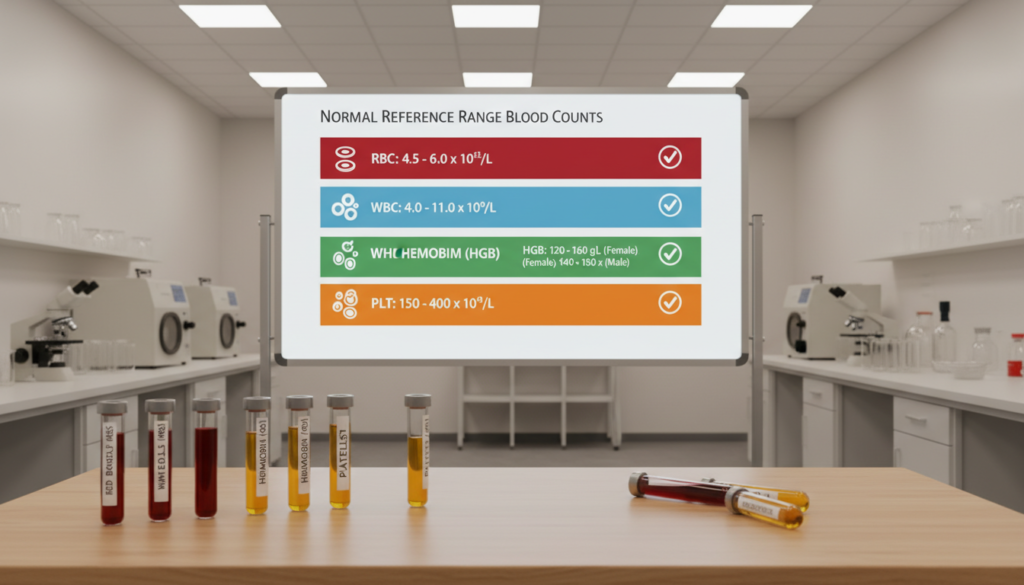
Each component measured in a blood count has a standard range considered normal. These reference intervals provide a benchmark for evaluating test results. They are based on studies of healthy populations.
Gender-Specific Ranges and Units
Key parameters show gender differences. For adult males, hemoglobin typically ranges from 13.8 to 17.2 grams per deciliter. For females, the range is 12.1 to 15.1 grams per deciliter.
Hematocrit, the volume percentage of blood occupied by red cells, also varies. Males usually range from 40.7% to 50.3%. Females range from 36.1% to 44.3%.
The red cell count differs too. Males often have 4.6 to 6.2 million cells per microliter. Females typically have 4.2 to 5.4 million.
Laboratory Variations and Standard Measurements
Reference ranges can differ between labs. This is due to equipment and local population data. The white cell count is usually 4,500 to 11,000 cells per microliter.
The platelet count commonly falls between 150,000 and 400,000 per microliter. The differential counts for white cell types have their own ranges.
Factors like altitude and age affect these numbers. Always compare results to the lab’s specific reference interval.
Interpretation of High CBC Levels
When a blood count returns with values above the normal range, it prompts further clinical investigation. Elevated parameters are clues that guide healthcare providers.
Potential Indications for Elevated Parameters
A high red blood cell count, called erythrocytosis, has several causes. It may stem from a primary bone marrow disease like polycythemia vera.
Secondary causes include chronic low oxygen levels from heart or lung conditions. Kidney disease or severe dehydration can also raise the count.
An elevated white blood cell count (leukocytosis) often signals an infection or inflammation. Stress, certain medications, and some blood cancers are other possible reasons.
Different white cell types rising can point to specific conditions. For example, neutrophilia suggests bacterial infection, while eosinophilia may indicate allergies.
A high platelet count (thrombocytosis) can occur with iron deficiency, chronic inflammation, or bone marrow disorders. It is also seen after significant bleeding.
| Elevated Parameter | Common Causes | Associated Conditions |
|---|---|---|
| Red Blood Cells | Chronic Hypoxia, Dehydration, Bone Marrow Disorder | Lung Disease, Kidney Disease, Polycythemia Vera |
| White Blood Cells | Infection, Inflammation, Stress, Medication | Bacterial/Viral Illness, Autoimmune Disease, Leukemia |
| Platelets | Iron Deficiency, Inflammation, Bone Marrow Issue | Cancer, Chronic Disease, Essential Thrombocythemia |
This cbc test data must always be reviewed alongside a patient’s full history. High cells alone do not confirm a diagnosis.
Interpretation of Low CBC Levels

When blood cell counts drop below normal, it may point to anemia or other disorders. Low values in a complete blood count require evaluation to understand the potential underlying cause.
Indicators of Anemia and Other Low-Level Conditions
A low red blood cell count, hemoglobin, or hematocrit defines anemia. Iron deficiency is the most common cause worldwide.
This leads to small, pale red blood cells. Other nutritional shortages, like vitamin B12, can cause large cells.
Chronic disease, inflammation, or kidney problems often cause a mild anemia. Accelerated destruction of blood cells, called hemolysis, is another reason.
Problems in the bone marrow can reduce production of all cells. This includes failure, infiltration, or certain disease states.
A low white blood cell count, or leukopenia, suggests bone marrow suppression. Viral infections, some drugs, and autoimmune conditions are common causes.
Neutropenia, a drop in a specific white cell, raises the risk of infections. A low platelet count, thrombocytopenia, increases bleeding risk.
It can stem from poor production or increased destruction. An enlarged spleen can also trap platelets.
| Low Parameter | Common Causes | Associated Conditions |
|---|---|---|
| Red Blood Cells (Anemia) | Iron Deficiency, Chronic Disease, Blood Loss, Hemolysis | Nutritional Deficiency, Kidney Disease, Ulcerative Colitis |
| White Blood Cells (Leukopenia) | Viral Infection, Medication, Bone Marrow Suppression | HIV, Autoimmune Disorder, Chemotherapy |
| Platelets (Thrombocytopenia) | Increased Destruction, Splenic Sequestration, Production Issue | Immune Disorder, Liver Disease, Pregnancy |
Factors Affecting CBC Results and Clinical Context Considerations
Several pre-analytical and analytical factors can alter CBC results, making clinical context essential for correct interpretation. These variables highlight why the test numbers are one piece of a larger puzzle.
Influence of Hyditation, Sampling, and Environmental Factors
A patient’s fluid volume directly impacts blood cell concentrations. Dehydration can falsely elevate counts, while over-hydration can lower them.
How the blood sample is drawn matters. Prolonged tourniquet use or contamination with IV fluid skews results. Even the anticoagulant in the tube can cause platelet clumping, leading to a falsely low count.
Specimen integrity is crucial. Conditions like lipemia or high bilirubin can interfere with machine readings. This may cause a spuriously high hemoglobin or mean corpuscular value.
Physiologic states also play a role. Strenuous exercise, high altitude, pregnancy, and the menstrual cycle cause normal variations. Many medications affect bone marrow production or blood cell size.
| Interfering Factor | Parameter Affected | Potential Effect |
|---|---|---|
| Dehydration | Red Cell Count, Hematocrit | Falsely Elevated |
| Platelet Clumping (EDTA) | Platelet Count | Falsely Low (Pseudothrombocytopenia) |
| Lipemic Sample | Hemoglobin, MCHC | Falsely Elevated |
| Recent Strenuous Exercise | White Blood Cell Count | Temporary Increase |
Importance of Patient History and Clinical Context
This is why a patient’s full story is vital. A healthcare provider reviews symptoms, medical history, and current medications. This context determines if a test result is significant or likely an artifact.
For example, a mild low white count might be normal for some. In a patient undergoing chemotherapy, it signals a need for immediate care. A high count could point to an infection or simply stress.
These tests provide data, not a diagnosis. Accurate interpretation always integrates the cbc test results with the clinical picture.
Conclusion
In summary, the complete blood count offers a vital snapshot of hematologic health. This fundamental panel quantifies red blood cells, white blood cells, and platelets. Providers rely on it for screening and diagnosis of various conditions.
Automated analyzers generate standardized blood count results. Reference ranges depend on the lab and patient factors. Many elements, from specimen handling to medications, can affect test accuracy.
Clinical context is always essential for interpretation. The complete blood count is one component of a full assessment. Learn more about related tests in our comprehensive blood test guides.