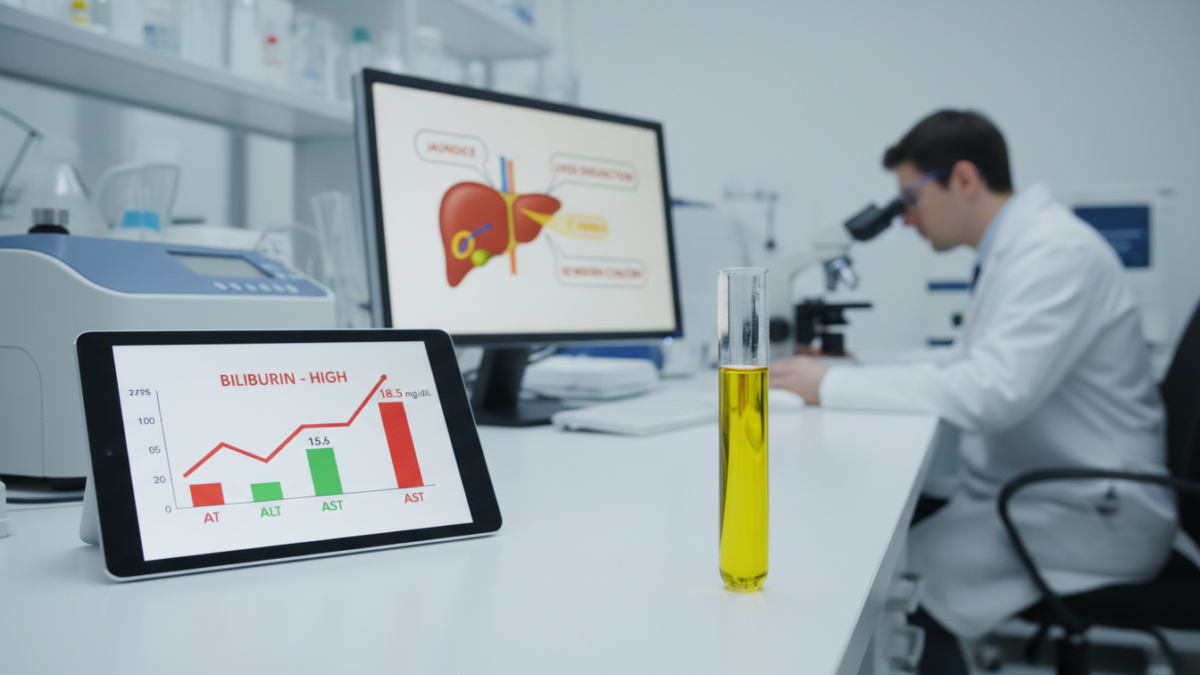
The bilirubin test is a common lab test used to check liver health. It measures a yellow pigment made when red blood cells break down. This pigment goes through the liver, gallbladder, and digestive tract before being removed from the body.
High bilirubin levels mean the body’s hemoglobin breakdown process is not working right. As red blood cells age and break down, they release bilirubin into the blood. The liver then changes this substance and sends it out through bile.
Hyperbilirubinemia, or high bilirubin, is when levels are over 1.3 mg/dL in adults. It can signal liver, bile duct, or blood cell problems. Doctors in the U.S. use this test to spot issues early.
Key Takeaways
- Bilirubin is a yellow pigment produced during the normal breakdown of red blood cells in the body.
- The liver processes bilirubin and releases it through bile into the digestive tract for excretion.
- Hyperbilirubinemia occurs when adult bilirubin levels exceed 1.3 mg/dL.
- High bilirubin levels meaning can vary based on the underlying cause, from liver disease to blood disorders.
- This test is a routine part of liver function panels ordered by healthcare providers nationwide.
- Early detection of elevated bilirubin helps guide timely diagnosis and treatment decisions.
What the Test Measures
A bilirubin blood test checks how well the body breaks down red blood cells and handles waste. It’s key for understanding liver and blood health. For adults, blood is taken from a vein in the arm. Newborns get tested through a heel prick or umbilical cord sample.
Adults might need to fast for several hours before the test. This ensures the results are accurate.
Bilirubin Types: Total and Direct
The test looks at two types of bilirubin. The ratio between them helps find the cause of high bilirubin levels.
| Bilirubin Type | Description | What It Reveals |
|---|---|---|
| Direct (Conjugated) | Processed by the liver and made water-soluble | Liver or bile duct problems |
| Indirect (Unconjugated) | Not yet processed by the liver | Excessive red blood cell breakdown |
| Total Bilirubin | Combined measurement of direct and indirect | Overall bilirubin burden in the body |
Interpretation of Bilirubin Levels
How to interpret bilirubin levels depends on the type. A rise in direct bilirubin often means bile duct or liver issues. A rise in indirect bilirubin might show hemolytic conditions, where red blood cells break down too quickly.
Urine tests also help diagnose. Healthy urine has no bilirubin. Any bilirubin found means there’s a condition to look into.
People with hepatitis C might see bilirubin levels change. This makes it important to test again to track the disease. Knowing why bilirubin levels are high helps doctors decide what to do next.
Why It Is Ordered
A bilirubin test is not routine for every patient visit. Doctors order it when specific signs or symptoms suggest a problem with the liver, bile ducts, or red blood cells. Understanding what does high bilirubin indicate starts with knowing why the test is requested in the first place.
Clinical Indications for the Bilirubin Test
Physicians request a bilirubin test when a patient shows visible signs of jaundice — a yellowing of the skin and the whites of the eyes. This discoloration signals that bilirubin is building up in the body faster than it can be processed.
The test is essential for newborns in their first few days of life. Neonatal jaundice is common and, if left unchecked, can lead to serious complications. Pediatricians rely on bilirubin screening to decide whether treatment such as phototherapy is needed.
A bilirubin test is ordered when patients report symptoms like:
- Persistent abdominal pain, specially in the upper right side
- Unexplained fever paired with fatigue
- Dark-colored urine or pale stools
- Nausea and loss of appetite
“Bilirubin measurement remains one of the most informative initial steps in evaluating liver and biliary function.” — American Association for Clinical Chemistry
Contexts for Testing
Beyond acute symptoms, the test serves as a monitoring tool for patients with known conditions. Those diagnosed with hepatitis C, cirrhosis, or gallstones often undergo regular bilirubin checks to track disease progression.
Abnormal bilirubin test results can point toward excessive red blood cell destruction, a condition known as hemolysis. This makes the test valuable in hematology evaluations as well.
Doctors may pair bilirubin testing with other liver panels to build a complete clinical picture — a topic explored in the upcoming section on normal reference ranges.
Normal Reference Range
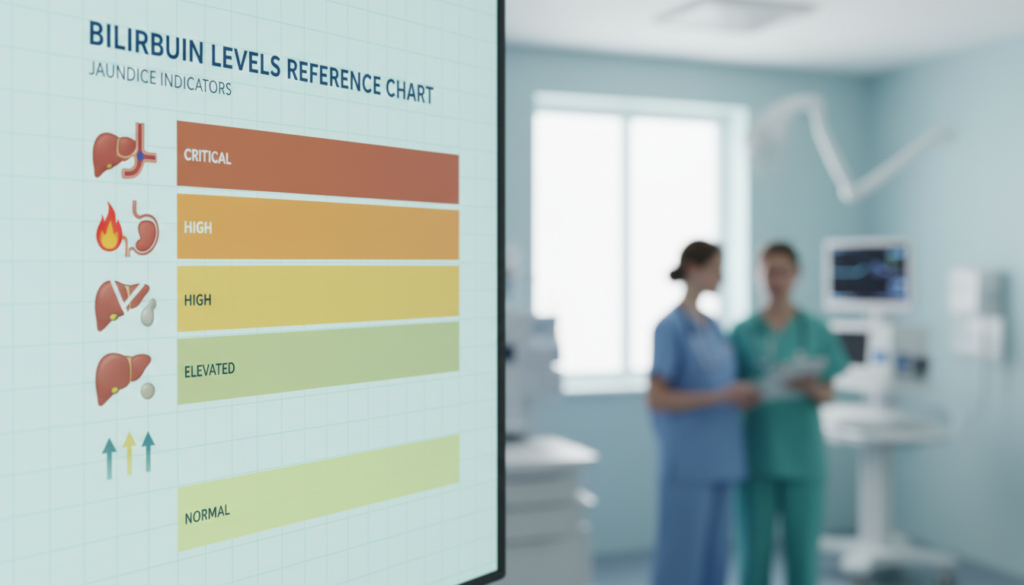
Knowing the standard reference range is key when checking liver function and bilirubin levels. These values show if a patient’s levels are normal or if there’s a problem. The ranges change with age, and newborns have their own set of standards.
Total Bilirubin Levels
Adults should have a total bilirubin level between 0.2 and 1.3 mg/dL. If it’s above 1.3 mg/dL, it’s too high and needs checking. Adults start treatment when levels hit 4 mg/dL or more, as it often means jaundice and a health issue.
Children from 15 days to 18 years old should keep their levels under 1.0 mg/dL. Newborns have different rules. Their bilirubin peaks at days 4 to 5, reaching up to 18 mg/dL. A level of 8 mg/dL on day 2 is okay, but a 6 mg/dL increase in 24 hours needs watching closely.
| Age Group | Normal Total Bilirubin (mg/dL) | Level Requiring Attention |
|---|---|---|
| Adults | 0.2–1.3 | ≥ 4.0 |
| Children (15 days–18 years) | Less than 1.0 | Above 1.0 |
| Newborns (days 4–5 peak) | Up to 12.0 | Above 18.0 |
Direct Bilirubin Levels
Direct (conjugated) bilirubin is what the liver processes. Healthy adults should have 0.0 to 0.3 mg/dL. High direct bilirubin can mean bile duct blockage or liver disease. Checking liver function and bilirubin fractions together helps doctors find the cause of jaundice and high bilirubin levels.
What High Levels May Indicate
When bilirubin levels go up, it means something is off in the body. This happens when the liver can’t break down bilirubin fast enough. Or, when too many red blood cells break down at once. Spotting these signs early is key to finding and treating the problem.
Liver Disease and Dysfunction
High bilirubin often means there’s a liver issue. Problems like cirrhosis, viral hepatitis, and autoimmune hepatitis can stop the liver from working right. Liver cancer can also damage liver tissue, leading to the same problem.
Bile duct blockages are another big cause. Gallstones can stop bile from flowing. Gilbert’s syndrome, a common genetic issue, makes it hard for the liver to handle bilirubin.
Pregnant women in their third trimester might get intrahepatic cholestasis of pregnancy. This is when bile flow slows down, causing bilirubin to build up.
Persistent elevation of bilirubin over weeks or months may indicate progressive liver damage that requires urgent medical evaluation.
Hemolysis and Blood Disorders
When red blood cells break down too fast, it’s called hemolytic anemia. This can happen due to:
- Genetic disorders like sickle cell disease or thalassemia
- Autoimmune conditions where the body attacks its own red blood cells
- An enlarged spleen that traps and destroys cells too soon
- Severe infections that cause widespread hemolysis
In these cases, high bilirubin levels show the body can’t keep up with making it. Knowing about liver and blood issues helps doctors find and treat the cause.
What Low Levels May Indicate
Low bilirubin levels are not usually a worry. They often mean the body is working well. It’s not a sign of a hidden issue.
Potential Significance of Low Levels
Low bilirubin shows the liver is breaking down hemoglobin fast. This means red blood cells are being replaced at a healthy rate. The body is getting rid of bilirubin quickly.
Some medicines can also lower bilirubin levels. These include:
- Barbiturates, which increase liver enzyme activity
- Caffeine in high amounts
- Nonsteroidal anti-inflammatory drugs (NSAIDs) like aspirin
People taking these drugs might have bilirubin levels that are too low. A doctor should check any medicines before looking at a low bilirubin reading.
Clinical Implications
Low bilirubin is rarely linked to diseases. A study in the American Journal of Medicine looked at its link to heart disease. But, the results were not clear. Doctors usually don’t investigate low bilirubin further.
When bilirubin is low, doctors look at the whole picture. A low value alone doesn’t usually change treatment plans. It’s best to look at all lab results and the patient’s history together.
Low bilirubin is generally a reassuring finding. The real clinical concern begins when levels rise above the normal range.
So, tests focus more on high bilirubin levels. Low levels remind us that not every unusual result means disease.
Related Biomarkers
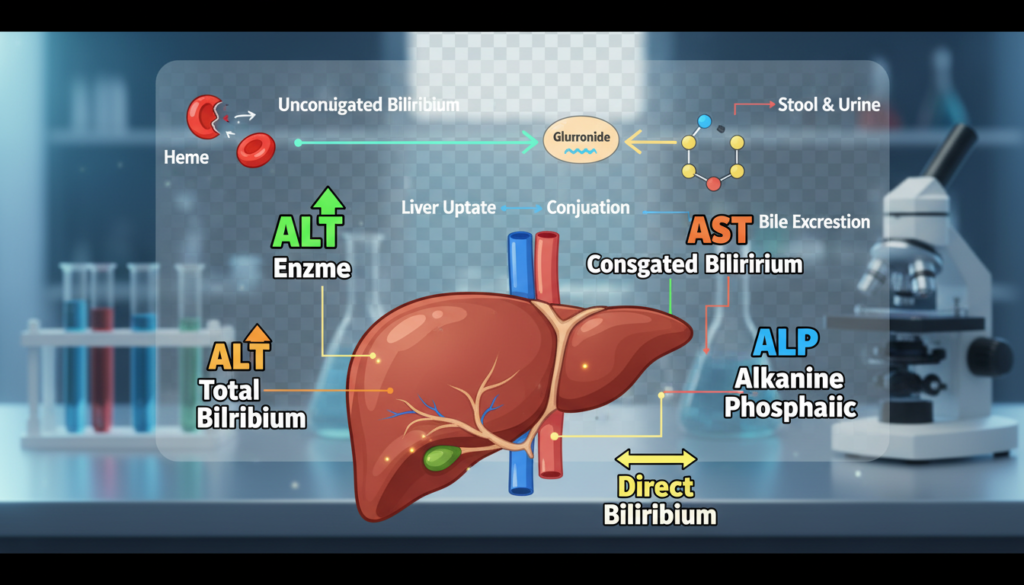
Bilirubin is not tested alone. Doctors run a set of tests to see how well the liver works. These tests help doctors understand what high bilirubin means for a patient’s health.
Other Liver Function Tests
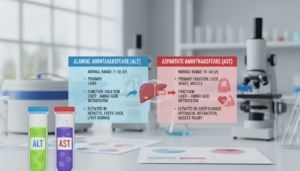
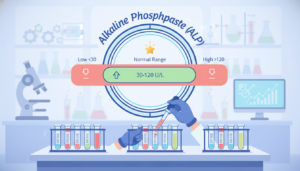
A liver panel includes enzymes and proteins. Alanine aminotransferase (ALT) and aspartate aminotransferase (AST) show liver damage. Alkaline phosphatase (ALP) and gamma-glutamyl transferase (GGT) suggest bile duct problems.
Albumin levels show how well the liver makes proteins. Low albumin with high bilirubin means chronic liver disease. Prothrombin time (PT) checks clotting factors, important for liver health.
| Biomarker | What It Measures | Clinical Relevance |
|---|---|---|
| ALT | Liver cell enzyme activity | Hepatocyte damage |
| AST | Liver and muscle enzyme activity | Liver or cardiac injury |
| Albumin | Protein synthesis capacity | Chronic liver disease |
| Prothrombin Time | Blood clotting speed | Clotting factor production |
| ALP | Bile duct enzyme levels | Cholestasis or obstruction |
Association with Other Conditions
High bilirubin can point to more than just liver issues. Hemoglobin and red blood cell counts help spot hemolytic anemia. Reticulocyte counts show if the bone marrow is making new red cells fast enough.
Hepatitis B and C tests are key if infection is suspected. Bile acid and cholesterol tests reveal how the liver handles these substances. These tests help doctors make accurate diagnoses, as the next section will explain.
Factors That Affect Results
Many things can change bilirubin test results. It’s important to know what might affect them. Understanding high bilirubin levels means looking at more than just the number. A patient’s biology, habits, and medicines all play a part in how results should be seen.
Patient Variables: Age and Gender
Age is a big factor in bilirubin levels. Newborns have higher levels because their livers are very small. They break down red blood cells fast, but their livers can’t handle it yet. Dehydration in babies can make levels even higher.
In adults, men usually have slightly higher bilirubin than women. As people get older, their livers change, affecting results. So, it’s important to look at a patient’s age and gender when checking bilirubin levels.
Medication and Lifestyle Influences
Some medicines can raise bilirubin levels. Drugs like rifampin (Rifadin) and probenecid can mess with how bilirubin is broken down. It’s important for patients to tell doctors about all their medicines before testing.
Lifestyle also plays a role. Important factors include:
- Fasting or intense exercise, which can cause spikes in people with Gilbert syndrome
- Drinking a lot of alcohol, which hurts the liver and messes with bilirubin
- Being sick or having surgery, which can change results temporarily
To really understand what high bilirubin levels mean, we need to consider these factors. A single high reading doesn’t always mean there’s a problem. Doctors must look at everything before making conclusions. This is explored further in the next section on clinical context considerations.
Clinical Context Considerations
Understanding jaundice and bilirubin levels means looking at the bigger picture. A single test result doesn’t tell the whole story. Age, health history, and symptoms all play a role in how doctors interpret the numbers. This is true for both newborns and adults.
Interpreting Bilirubin Levels in Different Populations
Newborn jaundice is common in the first week of life. It usually shows up one to three days after birth and goes away as the liver matures. The American Academy of Pediatrics suggests feeding newborns 8 to 12 times daily to help remove bilirubin through bowel movements.
If bilirubin levels get too high, phototherapy using blue light is used. This treatment usually lasts one to two days. In severe cases, intravenous immunoglobulin or exchange transfusion may be needed.
In adults, mildly elevated levels below 4 mg/dL might not need treatment. Symptoms of high bilirubin vary by severity:
- Mild elevation: Often produces no noticeable symptoms
- Moderate elevation: Visible yellowing of the skin and eyes
- Severe elevation: Abdominal pain, chills, fever, dark urine, fatigue, nausea, and vomiting
Infants with dangerous levels may be fussy, have trouble feeding, and cry a lot.
Importance of Complete Assessment
No bilirubin result should be looked at alone. Doctors combine it with other biomarkers and a full clinical exam. The table below shows how symptoms of high bilirubin differ by age.
| Population | Common Symptoms | Typical Treatment Approach |
|---|---|---|
| Newborns (0–28 days) | Yellow skin, fussiness, poor feeding | Phototherapy, frequent feedings |
| Children (1–17 years) | Jaundice, fatigue, abdominal discomfort | Treat underlying cause |
| Adults (18+ years) | Dark urine, nausea, fever, weakness | Address liver disease or hemolysis |
A complete assessment ensures jaundice and bilirubin levels are understood in the right clinical context. It connects test data to each patient’s unique situation.
Limitations of the Test
A bilirubin blood test is a useful tool, but it has its limits. It can’t pinpoint the exact cause of an abnormality with just one test. Always, abnormal results need more tests and careful evaluation to get a true diagnosis.
Sensitivity and Specificity Issues
Bilirubin levels can change from day to day, like in hepatitis C. High levels don’t always mean liver damage. Other conditions, like hemolytic anemia, can also raise bilirubin without liver problems.
To understand bilirubin levels, doctors need to look at more than just the test. They also consider a full set of liver function tests and the patient’s medical history.
Misinterpretation Risks
When it comes to newborns, timing is everything. Jaundice in the first 24 hours needs a quick response. But jaundice that shows up later needs a different approach.
High bilirubin levels in babies can cause serious problems if not treated. These problems are rare today thanks to modern hospital care.
Doctors must look at more than just the test number. They consider symptoms, age, medications, and other lab results. Without this context, results can be misread, leading to delayed care.