
The AST blood test is very common in medical checks. It helps check the liver and metabolic health. AST, or aspartate aminotransferase, is found in the liver, heart, muscles, kidneys, pancreas, and brain. When these cells get damaged, AST leaks into the blood.
This increase in AST levels is a warning sign. It tells us that something might be wrong and needs medical help.
Knowing what high AST levels mean is key for both patients and doctors. The CDC says liver disease affects about 4.5 million adults in the U.S. Around 10% of people in primary care have high AST levels. But, only about 5% of them have a serious liver problem.
So, what does it mean if AST levels are high? Mild, harmless increases need watching but not urgent action. But, if AST levels are more than five times normal, doctors act fast. They want to check for serious damage.
This article explains why AST levels are high, what it means, and how doctors interpret it. It also talks about other markers, how results can be affected, and the challenges of using just one enzyme value.
Key Takeaways
- AST is an enzyme in the liver, heart, muscles, and other organs. It gets into the blood when there’s tissue damage.
- About 10% of primary care patients have high AST levels. But, only 5% of them have serious liver disease.
- Mild increases (less than five times normal) usually mean just watching, not emergency care.
- Levels over five times normal need quick medical check-ups to find the cause.
- AST is not just for the liver. Results must be looked at with other markers and symptoms.
- Liver disease affects about 4.5 million adults in the U.S. So, routine AST tests are very useful.
What the Test Measures
An AST blood test checks the amount of aspartate aminotransferase in your blood. This enzyme, also known as serum glutamic-oxaloacetic transaminase (SGOT), is found in many organs. Doctors often test it with ALT, ALP, and bilirubin to see how well organs are working. To understand AST blood test results, it’s important to know its role and where it comes from.
Definition of AST
AST is an enzyme that helps break down amino acids. It transfers part of the aspartate amino acid to alpha-ketoglutarate. This creates oxaloacetate and glutamate, which are vital for energy production in cells.
When cells get damaged, AST leaks into the blood. This is why high AST levels often mean tissue injury somewhere in the body.
Role of AST in the Body
AST is important for energy production and protein metabolism in many organs. It is found in high amounts in:
- Liver cells (hepatocytes)
- Heart muscle (cardiac myocytes)
- Skeletal muscles
- Kidneys and red blood cells in smaller amounts
Because AST is found in many organs, its levels must be looked at in context. A simple blood test is all that’s needed. No fasting or special preparation is required before the test. The results are more meaningful when compared to other markers, as discussed in the following sections.
According to the American Association for Clinical Chemistry, AST is one of the most commonly ordered enzymes in routine metabolic panels across the United States.
Why It Is Ordered
Doctors order an AST test when they think there might be organ damage. They also use it to keep an eye on a condition they already know about. Knowing why AST levels are high helps doctors decide when to order the test.
A doctor might order the test if a patient shows certain symptoms. They also consider the patient’s medical history and any risk factors that might be a concern.
Common Symptoms Indicating Testing
Spotting high AST symptoms early can help get treatment started sooner. Liver problems are a big reason doctors ask for this test. Signs of liver trouble include:
- Jaundice — yellowing of the skin and eyes
- Persistent fatigue and unexplained weakness
- Abdominal pain or swelling (ascites)
- Dark urine or light-colored stools
- Unexplained weight loss or itching
Heart problems can also lead to testing. Symptoms like chest pain, shortness of breath, and irregular heartbeat are reasons. This is because AST is found in heart muscle.
Risk Factors Necessitating the Test
Some lifestyle and medical factors make it more likely for AST levels to be high. Doctors test patients who are at higher risk, even if they don’t show symptoms.
| Risk Factor | Details | Why It Matters |
|---|---|---|
| Excessive Alcohol Intake | Over 30g/day (men) or 20g/day (women) | Chronic use damages liver cells, releasing AST |
| Type 2 Diabetes | Linked to non-alcoholic fatty liver disease | Up to 70% of diabetics show liver fat buildup |
| Metabolic Syndrome | High waist circumference, elevated triglycerides, high blood pressure | Strongly associated with liver inflammation |
| Hepatitis Exposure | Travel or immigration from endemic regions | Chronic hepatitis B and C elevate AST |
| Blood Transfusion Before 1992 | Pre-screening era for hepatitis C | Increased risk of undetected infection |
| Family History of Liver Disease | Genetic conditions like hemochromatosis | Inherited disorders affect liver enzyme levels |
Knowing a patient’s full medical history is important. This includes recent injuries, supplements, medications, diet, and exercise. This information helps doctors understand why AST levels might be high.
Normal Reference Range

Understanding normal AST levels is key to reading lab reports with confidence. AST liver enzyme levels fall within a specific range that doctors use as a benchmark. Keep in mind that reference ranges can differ between laboratories, testing methods, and individual health factors.
AST Reference Values for Adults
For most adults, normal AST levels range from 8 to 33 U/L, though some labs define the upper limit at 35 U/L. Women tend to have slightly lower values than men. When reviewing AST blood test results, physicians often compare AST alongside ALT. Typical ALT ranges are:
- Males: 29–33 IU/L
- Females: 19–25 IU/L
Elderly patients may show AST liver enzyme levels that run slightly above the standard adult range. This is a natural shift that clinicians factor into their assessments.
Variations in Reference Ranges
Age plays a major role in interpreting AST blood test results, especialy in pediatric patients. The table below outlines expected ranges by age group:
| Age Group | AST Range (U/L) |
|---|---|
| 0–5 days | 35–140 |
| Under 3 years | 15–60 |
| 3–6 years | 15–50 |
| 6–12 years | 10–50 |
| 12–18 years | 10–40 |
| Adults | 8–33 |
Certain iron markers can also prompt further investigation. A transferrin saturation of 45% or higher—paired with serum ferritin above 250–300 ng/mL in men or above 200 ng/mL in women—may lead a physician to order hereditary hemochromatosis testing. These distinctions matter when interpreting normal AST levels in a broader clinical picture, which the next section on elevated results explores in detail.
What High Levels May Indicate
High AST levels can mean different things. They might show liver, muscle, heart, or other organ issues. Doctors look at many factors to figure out what’s wrong.
Liver Conditions
AST levels are closely tied to liver health. Problems like viral hepatitis, autoimmune hepatitis, and cirrhosis can cause high AST. Nonalcoholic fatty liver disease (NAFLD) is also a common cause, affecting 25–51% of people with high transaminases.
Drugs like acetaminophen and NSAIDs can also raise AST. About 9% of cases are linked to dietary supplements.
| AST:ALT Ratio | Suggested Condition | Typical Mean AST:ALT |
|---|---|---|
| Greater than 2 | Alcoholic liver disease | 152:70 |
| Less than 1 | Nonalcoholic fatty liver disease | 66:91 |
Muscle Disorders
AST is found in muscles too, not just the liver. So, high AST doesn’t always mean liver problems. Conditions like rhabdomyolysis and muscular dystrophy can also raise levels.
After a myocardial infarction, AST levels go up within 6–8 hours. They peak at 24–36 hours and go back to normal in 3–7 days.
Other Health Issues
There are other reasons for high AST levels:
- Pancreatitis
- Hemochromatosis (affects about 1 in 150–250 Northern European Caucasians)
- Infectious mononucleosis
- Seizures and hemolysis
- Recent surgery or pregnancy
These various causes highlight the importance of looking at related biomarkers for accurate diagnosis.
What Low Levels May Indicate
Low AST blood test results are not usually a worry. Doctors see them as a good sign. They pay more attention to high values than low ones.
But, there are times when levels can drop too low. Knowing why helps doctors understand what’s going on.
Nutritional Factors
A big reason for low AST is a vitamin B6 deficiency. AST needs B6 to work right. The National Institutes of Health says about 10–15% of Americans lack enough B6.
Not getting enough protein can also lower AST. The liver uses amino acids to make enzymes. People on strict diets or facing food shortages might have lower AST levels.
Rare Conditions
Some rare cases can also lead to low AST levels:
- People on kidney dialysis might have lower values because dialysis removes B6
- Pregnancy, in the first and second trimesters, can also lower readings slightly
- Some people have genetic traits that naturally keep their AST levels low
Low AST values usually don’t need treatment and don’t mean disease in most cases.
Doctors see low AST levels as less of a concern than high ones. They compare AST with other markers like ALT, ALP, and bilirubin. This helps them understand what’s happening better.
Related Biomarkers
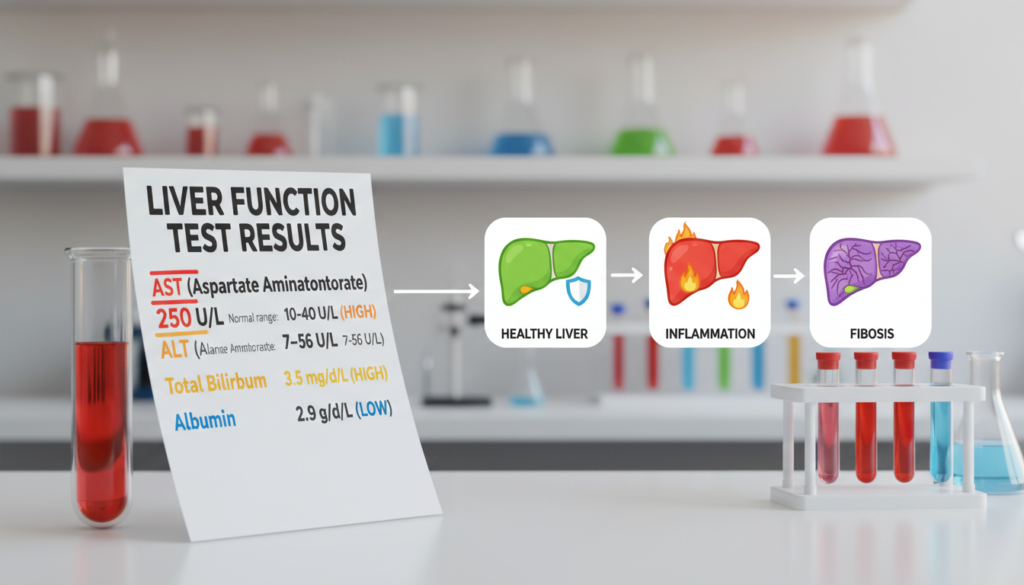
AST blood test results are more useful when combined with other biomarkers. A full liver test includes ALT, ALP, GGT, bilirubin, and LDH. Each one helps doctors understand the extent of liver damage.
ALT (Alanine Aminotransferase)
ALT is more specific to the liver than AST. The ratio between these two enzymes is key. A high AST:ALT ratio suggests alcohol-related liver disease. A low ratio points to non-alcoholic fatty liver disease.
High levels of aminotransferases over 500 U/L hint at viral hepatitis or acetaminophen poisoning. In autoimmune hepatitis, AST levels can soar up to 10 times normal.
| AST:ALT Ratio | Likely Condition | Positive Likelihood Ratio |
|---|---|---|
| Greater than 2 | Alcoholic liver disease | 17 |
| Less than 1 | Non-alcoholic fatty liver disease | 80 |
| Greater than 5 (normal ALT) | Extrahepatic injury (muscle, heart) | Varies by source |
ALP (Alkaline Phosphatase)
ALP levels go up in bile duct and bone issues. High ALP and AST suggest bile duct problems. Doctors check GGT to confirm liver issues, not bone problems.
Bilirubin
Bilirubin comes from breaking down red blood cells. High bilirubin means liver problems, like bile duct blockage or hepatitis. It’s a strong sign of liver trouble when AST is also high.
Doctors also check:
- Creatine kinase — for muscle damage
- Troponin and natriuretic peptides — for heart issues
- Thyroid panel and celiac antibodies — for metabolic and autoimmune diseases
Factors That Affect Results
Many things can change AST test results, even in healthy people. Knowing these factors helps doctors tell if a problem is real or just a temporary change. Age, sex, exercise, alcohol, and some medicines all play a part.
Age and Gender Variations
Children have different AST levels based on their age, often higher than adults during growth. Older adults might have slightly higher AST levels than younger ones. Women usually have lower AST levels than men because of muscle and hormone differences.
Recent Physical Activity
Hard exercise can raise AST levels. Running marathons, lifting heavy weights, or doing intense workouts can damage muscles. This damage releases AST into the blood, which can stay high for a few days. Doctors advise avoiding hard exercise before blood tests to get accurate results.
Alcohol Consumption
Drinking too much alcohol is a big reason for liver problems in Western countries. The daily limit is 30 grams for men and 20 grams for women. Drinking more than this can harm the liver and raise AST levels.
Some medicines and health events can also raise AST levels. Here are some examples:
| Category | Examples | Effect on AST |
|---|---|---|
| Statins | Atorvastatin, Rosuvastatin | Rare mild elevation |
| Analgesics | Acetaminophen (even therapeutic doses) | Moderate to significant rise |
| Antihypertensives | Lisinopril, Losartan | Mild elevation |
| Antimicrobials | Ciprofloxacin, Isoniazid, Ketoconazole | Moderate elevation |
| Psychiatric Drugs | SSRIs, Valproic Acid | Mild to moderate elevation |
| Other Events | Burns, heart procedures, seizures, surgery | Variable, often transient |
Pregnancy and blood sample issues can also affect AST levels. Doctors need to consider these factors when looking at test results.
Clinical Context Considerations
A single AST result doesn’t tell the whole story. Understanding abnormal AST levels requires looking at the patient’s whole picture. A UK study of 1,300 patients found that only fewer than 5% had a serious condition after excluding fatty liver disease.
Only 1.3% needed immediate treatment. This included 13 cases of viral hepatitis and 4 of hereditary hemochromatosis.
Patient History Importance
Doctors need to ask many questions before understanding AST levels. They should ask about alcohol use, drug use, blood transfusions, and medications. A detailed physical exam also provides important clues.
Interpretation of Results in Relation to Symptoms
Testing without thinking about the patient’s symptoms is often a waste. Studies show that 84% of elevated results remained abnormal after one month. And 75% stayed high after two years.
In about one-third of patients, liver enzymes get better in 2–4 weeks on their own. Symptoms like fatigue or jaundice should guide further testing.
Clinicians can use advanced tools to assess risk:
| Assessment Tool | Purpose | Type | When to Use |
|---|---|---|---|
| NAFLD Fibrosis Score | Predicts risk of liver complications and death | Calculated score (age, BMI, platelets, albumin, AST/ALT ratio) | Suspected fatty liver disease |
| Vibration-Controlled Transient Elastography (FibroScan) | Assesses hepatic fibrosis | Noninvasive imaging | Chronic liver enzyme elevation |
| Gastroenterology Referral | Specialist evaluation and management | Clinical consultation | High fibrosis scores or persistent disease |
Using lab results, symptoms, and scoring tools leads to better understanding and care for patients.
Limitations of the Test
AST blood tests are useful but have limits. They can’t tell us everything. Knowing these limits helps avoid unnecessary worry and guides further testing.
Non-specificity of AST
AST is found in many organs, like the liver, heart, and muscles. High levels don’t always mean liver damage. For example, thyroid disorders and celiac disease can also raise AST levels.
Celiac disease needs special antibody tests to confirm. Rare conditions like Wilson disease require specific tests. Alpha-1-antitrypsin deficiency affects many, but few get diagnosed.
Potential for Misinterpretation
High AST levels don’t always mean liver disease. In fact, only a small percentage of abnormal AST levels lead to significant liver issues. This shows the danger of making assumptions based on one test.
Autoimmune hepatitis, affecting a few people per 100,000, needs more tests for diagnosis. If AST levels stay high, imaging studies or even a liver biopsy might be needed. Relying only on AST can lead to missed diagnoses or unnecessary worry.
A complete evaluation that includes lab tests, imaging, and medical history is best. This approach gives a clearer picture of a patient’s health.